Historical Civil War Autographs
infobar.gif


Our Newsletter


MasterCard
americanexpress.gif         visa.gif


Recently Viewed Items

Presidents & First Ladies

.
Products
Showing All 40 Items.
  Show Paging 

ADAMS, JOHN QUINCY (1767-1848)

# 5874

Sixth U.S. President - 1825-29

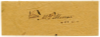
Franked Panel, 3” x 4 ½”, “J.Q. Adams,” as U.S. Congressman from Massachusetts, the front portion of a postal cover, also addressed by Adams to his nephew, “Lieut[ena]n[t] Thomas B. Adams, Fort Brooke, Tampa Bay, Florida,” with stamped free designation and an October 11 [1837], Washington City postmark.

The brother of John Quincy Adams, third son and youngest child of John and Abigail Adams, Thomas Boylston Adams died in 1832. Born in 1809, his son of the same name and the addressee on this panel, was stationed at various posts in the South after graduation from West Point in 1828. Young Lieutenant Adams subsequently saw action in the Second Seminole War, during which he died of disease at Fort Dade, Florida on December 14, 1837, one month after the receipt of this mailing at the outpost, as indicated by vertical docketing at left beneath the postmark. On the panel’s reverse (images are available upon request) are approximately fifteen partial lines from the associated letter, with social content, presumably in the hand of a family member.

OUT OF STOCK
 

ADAMS, JOHN QUINCY (1767-1848)

# 6078

Sixth U.S. President - 1825-29

U.S. Congressman John Quincy Adams submits information relating to the loss of a Seminole War troop transport in Tampa Bay, Florida

Autograph Letter Signed, 7 ½” x 9”, to “James Collier Esqr., Cohassett, Mass[achuse]tts,” with excellent early-Florida, Seminole War association.

As Congressman from Massachusetts, the former U.S. President informs Collier that he has submitted a report to Secretary of War Joel Poinsett regarding payment for the services of the schooner Rubicon in the rescue of the transport Charles Wharton, lost while carrying U.S. troops bound for service in the Second Seminole War. Congressional records state: “the ship Charles Wharton was chartered by the United States for the purpose of transporting nearly three hundred volunteer troops, with arms, provisions, baggage, and a quantity of sauer kraut from Philadelphia to Tampa Bay. While on the voyage, and so laden, about the 20th of December [1837], she grounded on a shoal near the entrance of Tampa Bay, and was found in a very perilous condition…” The same record further indicates that the crew of at least one other vessel, “…at great risk, and with much labor, aided and assisted in saving the troops, the guns, ammunition, and private property of the officers.”

Washington, 24 Feb[ruar]y 1838. Sir, I have submitted your Letter of the 6th inst[an]t to the consideration of the Secretary of War, and have received an answer from him enclosing a report from the acting Quartermaster General T[rueman] Cross of the following report: ‘In reply to the Letter of Mr. James Collier referred to me by the War Department a few days since I have the honour to state that this office possesses no information whatever in relation to the loss of the ship Charles Wharton or the services alleged to have been rendered by the Schooner Rubicon. It appears however, by Mr. Colliers own admission, that the Quarter Master at Tampa Bay, paid the Captain of the Rubicon six hundred dollars, which it is a fair presumption was the value of his services.’ The fair presumptions of the Quarter-Master General may doubtless be rebutted by positive testimony. If you have any such, I shall be happy to give any assistance in my power to exhibit the same before the proper department. I am, very respectfully, Sir, your obed[ien]t Serv[an]t, J.Q. Adams.”

Interestingly, Adams’s nephew, Thomas Boylston Adams, a lieutenant in the U.S. Army and a Seminole War veteran, had died of disease at Fort Dade, Florida just two months earlier, on December 14, 1837. Also of note, Trueman Cross, the acting quartermaster general mentioned in this letter, was killed on April 21, 1846 by Mexican bandits near Fort Brown, Texas, just three days before the United States declared war with Mexico.

The sheet bears general soiling and wear.  Paper weakness and minor separation at the usual folds, along with several chips and tears in the margins, none affecting the text of the letter, have been professionally stabilized with archival backing on the reverse.

OUT OF STOCK
 

ADAMS, LOUISA C. (1775-1852)

# 6783

U.S. First Lady – 1825-29

Autograph Letter Signed, 8” x 10”, with a seldom-seen second form of her signature, “Wife of John Quincy Adams,” added at the conclusion. Graciously writing to the wife of the politically connected Benjamin Ogle Tayloe, the former first lady sends an engraving for Mrs. Tayloe’s collection.

Quincy [Massachusetts], 28th Oct[o]ber, 1842. Herewith I have the pleasure my Dear Madam to send you the promised engraving to be placed so flatteringly in your elegant Collection of Autographs, where I shall have the gratification of shining, at least through a reflected light, among the brilliant luminaries who so greatly adorn your Book. In the hope of soon meeting you and Mr. Tayloe in Washington; permit me to offer the sentiment of regard of Louisa Catherine Adams. Wife of John Quincy Adams.”

Although the engraving mentioned is no longer present, this letter is accompanied by a 3 ¼” x 6 ¼” address panel, also addressed by Mrs. Adams, to “Mrs. B.O. Tayloe, Washington.”

The letter has a few light water stains and small edge tears, detracting very little from excellent overall condition.

OUT OF STOCK
 

BUCHANAN, JAMES (1791-1868)

# 6667

Fifteenth U.S. President - 1857-61

Autograph Letter Signed, 8” x 10”, as U.S. Senator from Pennsylvania, to “Samuel C. Patterson, Esq.”  Writing from his hometown in Pennsylvania, Buchanan recommends one Robert King for a position as an official for the 1840 census.  In an interesting four-line postscript, Buchanan further reveals that King had been passed over for superintendent of the Columbia & Philadelphia Railroad, completed in 1834 as the first government-built rail line, in favor of a Mr. Cameron, probably a member of the politically connected family which included future War Secretary Simon Cameron.

Lancaster, 19 September 1839. Dear Sir, There is a very respectable man, by name Robert King Esquire, a citizen of Marietta in this County who is desirous of obtaining the appointment to take the census for the townships of Manor, East & West Hempfield, Raphoe, Mountjoy & East & West Donegal.  He has met with reverses of fortune in his day & is now obliged to work hard at his trade for his living; but there is no man in the town where he lives who maintains a better character.  He is an acting magistrate & a man of business & is an active & efficient friend of the present State & National administrations.  I believe his appointment would give general satisfaction whilst it would be peculiarly agreeable to your friend sincerely, James Buchanan.  P.S. Mr. King was powerfully recommended as superintendent of the Columbia & Philadelphia Rail Road; but Mr. Cameron was appointed.  I consider that his appointment to take the census, whilst it would be an excellent one in itself would be highly politic.”

The letter is lightly and evenly toned, with a few edge chips and tears.  Paper weakness at one of three horizontal folds has been reinforced on the reverse, and there is show-through of old hinging on the reverse in the upper and lower margins.

OUT OF STOCK
 

CLEVELAND, FRANCES FOLSOM (1864-1947)

# 6605

U.S. First Lady – 1886-89 & 1893-97

Signed Photograph, 4 ¼” x 6”, as First Lady, “M.W.J. – from - Frances F. Cleveland, 1894,” a cabinet photo imprinted Copyright by C.M. Bell on the lower edge of the image.

The image is unaffected by minor wear and chipping to the edges of the mount.

OUT OF STOCK
 

CLEVELAND, ROSE ELIZABETH (1846-1918)

# 6429

Sister of Grover Cleveland

Autograph Letter Signed, on the imprinted 5” x 8” stationery of the Executive Mansion at Albany, New York.  During the final months of her unmarried brother's tenure as New York Governor, Rose Cleveland expresses their gratitude and good wishes upon the receipt of a gift from this letter’s recipient.

5 January 1885. Dear Mr. Wood, Thanks for the kindness which prompted the sending of your package. I hope I may sometime have time to more appreciatively acknowledge all such remembrance. With kind regards from the Governor and myself to you and your mother. Yours, Rose Elizabeth Cleveland.”

Light, even toning, a small stain at lower center, and reinforcement of the folds on reverse detract very little.

Price: $200.00
Quantity: 
 

DAVIS, VARINA HOWELL (1826-1906)

# 6602

First Lady of the Confederacy


DAVIS, VARINA ANNE (1864-1898)  Daughter of Jefferson & Varina Davis; Known as the “Daughter of the Confederacy”

Signed Album Page, 4” x 7”, “Varina Jefferson Davis.,” also signed and dated by the Davis’s daughter, Winnie, at their Mississippi home, “Varina Anne Davis, Beauvoir, Miss., Nov 5th 1893,” with the collector’s biographical notations in the lower margin.

Overall condition is excellent, with light, even toning.

OUT OF STOCK
 

DAVIS, VARINA HOWELL (1826-1906)

# 0510

First Lady of the Confederacy

Autograph Letter Signed, 4 ½” x 7”, to “Danl. E. Soper, Esqr.,” marked “Personal.” Writing on “Beauvoir House” imprinted black-bordered mourning stationery, due to the death of her husband, Jefferson Davis, just two months earlier, the former Confederate First Lady responds to a request for the autographs of her family and refers the recipient to a New Orleans photographer for a picture of Mr. Davis.

“…Dear Sir, I thank you for the bookmarks sent & return you my autograph & the back of a letter addressed to me by my Husband. My Daughter is in Italy & consequently I cannot send her autograph. W.W. Washburne, Canal St., New Orleans will I am sure send you the best picture he has of Mr. Davis if you apply to him. Believe me Respectfully & truly yours, V. Jefferson Davis. Feb[ruary] 17th 1890.”

A center horizontal fold and a few superficial stains detract very little from excellent overall condition.

OUT OF STOCK
 

DAVIS, VARINA HOWELL (1826-1906)

# 6761

First Lady of the Confederacy

“Mr. Davis is not writing any thing…He is not strong and both of us nil very much in a valetudinarian kind of old aged way truly depressing.”

Autograph Letter Signed, two pages, front and reverse of a 5” x 8” sheet, signed with her seldom-seen full name.

From her Mississippi home, Mrs. Davis thanks a friend, identified only as “Mr. Derby,” for his assistance during the illnesses of both an unnamed friend and her daughter Varina Anne “Winnie” Davis, known throughout the South as the “Daughter of the Confederacy,” due to her birth in the Confederate White House in Richmond during the Civil War. Particular gratitude is expressed for Mr. Derby’s help with Winnie’s literary pursuits, presumably relating to at least one of the books she would publish in the subsequent years, most notably An Irish Knight of the Seventeenth Century, The Veiled Doctor, and Foreign Education for American Girls. In an amusing, melancholy conclusion, Mrs. Davis laments her husband’s lack of literary possibilities, along with the couple’s declining health. Former Confederate President Jefferson Davis died the following year, on December 6, 1889.

“Beauvoir House, 18th April, 1888. Dear Mr. Derby, I am disappointed over my poor friend’s MS, but know that you did your very best for me and her, for though uncertain sometimes of your success, I never am of your kind desire to serve your friends. Winnie is today is [sic] so unwell that she commissioned me to thank you very gratefully for the trouble you have taken in her behalf and as you decide the question of name as you and our dear old friends the Lovells think best. She does not feel able to read the proof. She will be in New York in the course of the summer and I hope will see you and them while there. Mr. Davis is not writing any thing but has had several literary propositions which have not been accepted. He is not strong and both of us nil very much in a valetudinarian kind of old aged way truly depressing.  With the hope that you and yours are all well I am my dear friend, Very truly yours, Varina Howell Davis.”

There are several areas of slightly heavier toning, along with the usual horizontal folds.

Price: $1500.00
Quantity: 
 

FILLMORE, MILLARD (1800-74)

# 6464

Thirteenth U.S. President - 1850-53

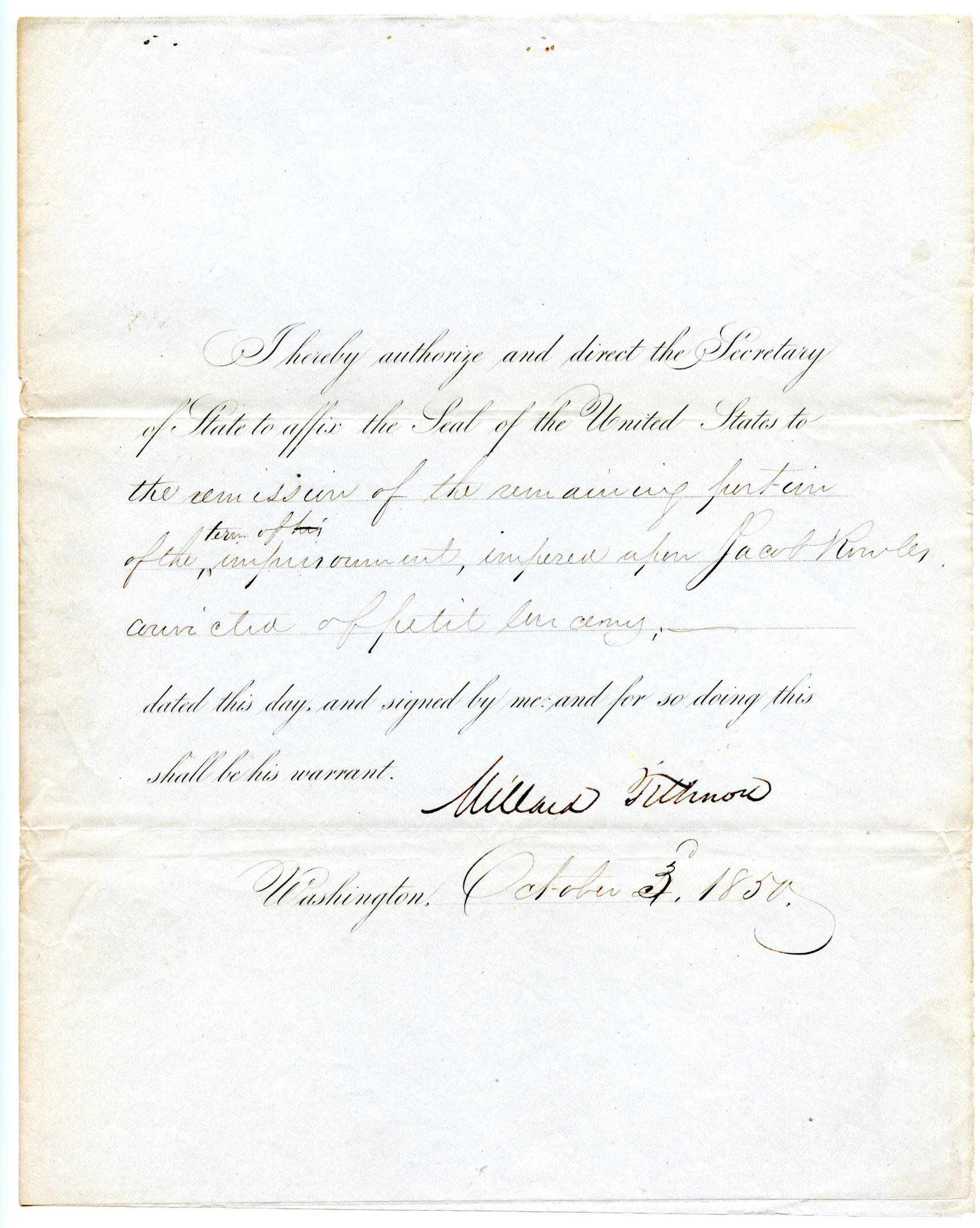
Autograph Letter Signed, 5” x 8”, an excellent example with a full signature.

Washington, July 18. J. Streum, Esq. D[ea]r Sir, I have yours of the 4th and I enclose a general letter as I have not time to write more. Truly yours, Millard Fillmore.”

The year is unstated, but the handwriting is consistent with Fillmore’s letters from his 1849 to 1853 tenure as Vice President and President. Although we can’t be sure, it is conceivable that Fillmore’s haste in this correspondence was associated with his becoming President just days after the unexpected death of Zachary Taylor on July 9, 1850.

The overall condition is excellent, with very light, even toning and two horizontal folds.

OUT OF STOCK
 

GARFIELD, JAMES A. (1831-81)

# 6684

Twentieth U.S. President – 1881; Union Major General - Ohio

Signed Photograph, 2 ¼” x 4”, “J.A. Garfield, Ohio,a Brady carte-de-visite.

There is light soiling and wear, and the upper corners of the card have been trimmed diagonally. The ornate back-mark has been marred by past mounting.

Price: $1350.00
Quantity: 
 

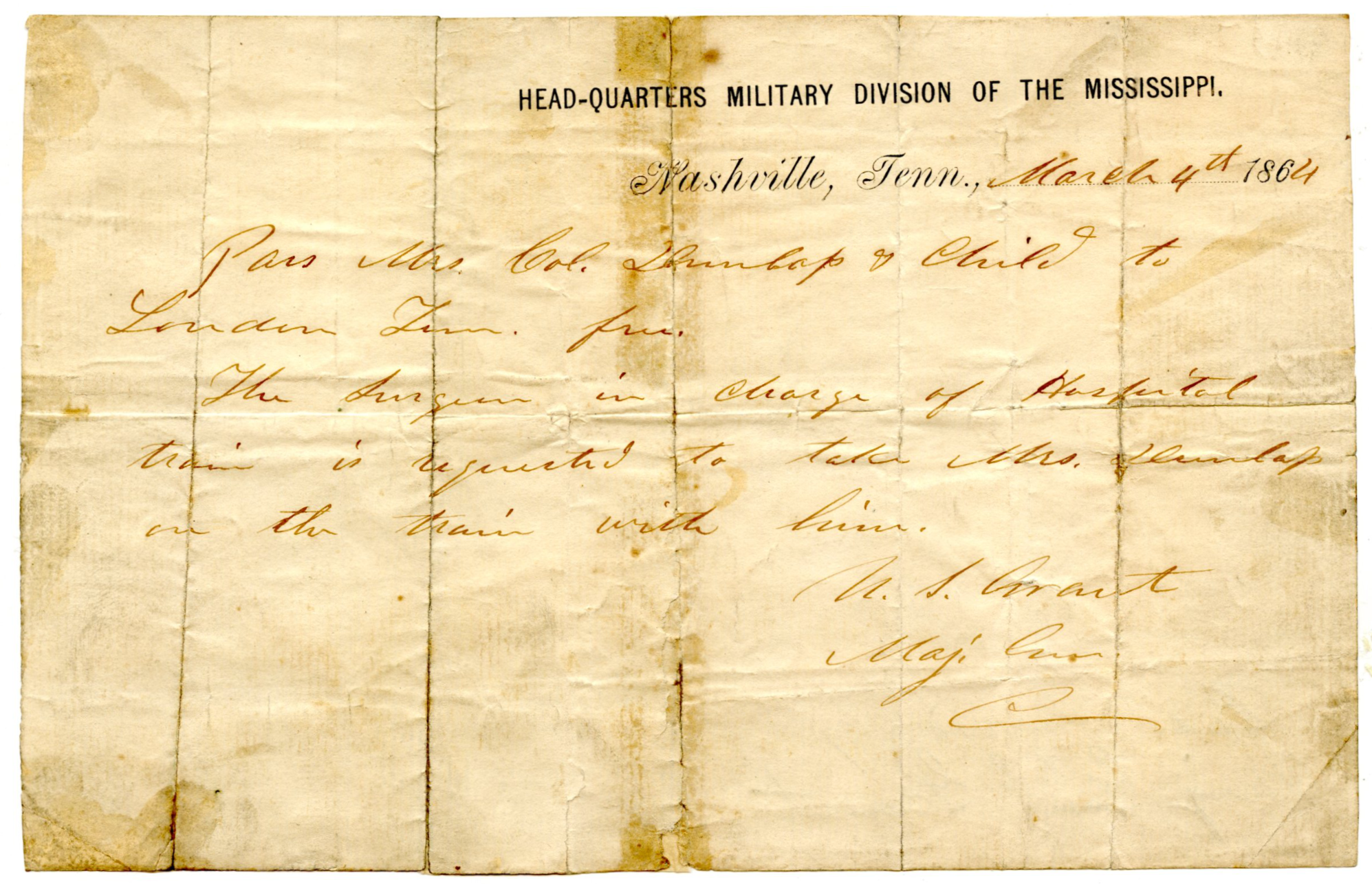
GRANT, ULYSSES S. (1822-85)

# 7027

18th U.S. President - 1869-77; Union Lieutenant General

From Vicksburg, Grant Exerts His Authority Over the Mississippi, in an Incident with the Steamer Empress – Later Burned by Nathan Bedford Forrest

War-Date Autograph Letter Signed, 1 ½ pages, front and reverse of the first leaf of a folded 5” x 8” letter-sheet, to a United States Treasury agent identified only as “Mr. Montrose.”

From his headquarters in Vicksburg, Mississippi, the Confederate river stronghold having fallen to Federal forces under Grant just three months earlier, the Union commander informs Agent Montrose of the improper seizure of a cotton-laden steamer on the river by the U.S. Navy. As unhindered shipping on the Mississippi had resumed after the mid-summer fall of Vicksburg and Port Hudson, Montrose is further instructed to provide passes for use by Union vessels as additional protection against future seizures in violation of orders already issued by Grant.


“H[ea]d Q[uarte]rs Dep[artmen]t of the Ten[nessee], Vicksburg, Miss[issippi], Oct[ober] 6th 1863. Mr. Montrose, Ag[en]t Treas[ury] Dept. Sir, The gentlemen with Gen[eral] Stewart, the bearer of this, have all shipped Cotton on the Steamer Empress, from Natchez, Miss[issippi] in conformity with Gen[eral] Orders No. 57, current series and were stopped at the mouth of the Red river by the Navy. I have written to the Naval Commander at that place, enclosing a copy of the order referred to and presume with this the Empress will be permitted to pass. However for further security I have to request that you issue Treasury passes in addition to the Authority already granted. Yours truly, U.S. Grant, Maj[or] Gen[eral].”
Three passages from the Official Records, communications between the U.S. Navy vessels involved, provide further details of the controversy, in part:

“U.S.S. Choctaw, Off Mouth of Red River, October 4, 1863. Sir: This morning the steamer Empress came down from Natchez, having on board about 2,800 bales of cotton, taken on board by permission of Brigadier-General M.M. Crocker, commanding U.S. forces at Natchez…Never having received orders to pass cotton shipped by permission of army officers, and the proclamation of the President of March 31, 1863, and the regulations of the Secretary of the Treasury of the same date not permitting any such trade, I ordered the captain of the Empress to return to Natchez with the cotton, and gave him a letter to General Crocker, a copy of which I enclose. I was informed by the captain of the Empress that these permits were given by General Grant…Frank M. Ramsay, Lieutenant-Commander, Commanding Third District.”

“U.S.S. Benton, Off Natchez, October 9, 1863…I was informed by my executive officer that he had forwarded a letter from General Grant to Captain Ramsay, a copy of which I send, in which the general was willing to assume the responsibility in the premises and referred to an order from the Treasury Department of September 15, 1863, which caused him to issue his General Order No. 57, which I send enclosed…Jas. A. Greer, Lieutenant-Commander, Comdg. 4th Dist., Miss. Squadron.”

“U.S.S. Choctaw, Off Mouth of Red River, November 8, 1863. Captain Couthouy told them that you commanded the Mississippi River; that General Grant was absolute on shore, but that he did not control so much of the water of the Mississippi as would be sufficient for him to wash his face in; that this was no question between military and naval authority, but simply whether the officers in command of gunboats should obey your orders and those of the Secretary of the Navy or those of General Grant…A person calling himself General David Stewart (who, I was informed in Natchez, is supposed to be a cotton speculator) took it upon himself to spread a number of reports, and was the principal speaker among the passengers on the Empress…Frank M. Ramsay, Lieutenant-Commander, Comdg. 3rd Dist., Miss. Squadron.”


While Navy officers were still embroiled in the controversy back on the Mississippi, Grant was en route to Chattanooga just two weeks after the date of this letter to Agent Montrose, in command of the new Military Division of the Mississippi, setting the stage for the battles of Chattanooga, Lookout Mountain, and Missionary Ridge. Interestingly, it was later reported that the Empress was burned by Confederate cavalry forces under Nathan Bedford Forrest at Island #34 on October 28, 1864.

There is light, even toning, with the usual folds, several small stains, and somewhat heavier soiling and wear to the docketed fourth page of the letter-sheet. Slight trimming of the margins, perhaps inadvertent when the envelope in which the letter was delivered was opened, affects several letters of text in the last line of the first page and in the first word of the second.

OUT OF STOCK
 

NewGRANT, ULYSSES S. (1822-85)

# 7148

18th U.S. President - 1869-77; Union Lieutenant General

Signed Card, 2 ¼” x 3 ½”, “U.S. Grant.”

The card is lightly and evenly toned, with a barely noticeable one-eighth inch tear at the right edge and old mounting remnants on the reverse.

OUT OF STOCK
 

HARRISON, WILLIAM HENRY (1773-1841)

# 6680

Ninth U.S. President - 1841

Document Signed, 2 ¼” x 4 ½”, a manuscript note as aide-de-camp to General “Mad Anthony” Wayne, requesting a supply of paper from the quartermaster.

“Sir, be pleased to Issue one Quire Paper for the use of the publick. Wm. H. Harrison, Comm[an]d[i]n[g]. The Quartermaster, 7th Oct. 1796.”

The note bears light soiling and wear, along with a few small stains.

OUT OF STOCK
 

HAYES, RUTHERFORD B. (1822-93)

# 6859

Nineteenth U.S. President - 1877-81; Union Brigadier General - Ohio

Signature, with date and sentiment, “…1st Sept[ember] 1867. Sincerely, R.B. Hayes,” on a 5” x 5 ½” sheet of lined paper, for “Wm. A. Baker, Auburn, N.Y.

The sheet is lightly and evenly toned, with minor show-through from old glue staining on the reverse, and there are two horizontal folds.

OUT OF STOCK
 

HOOVER, LOU HENRY (1874-1944)

# 6533

U.S. First Lady - 1929-33

Signed White House Card, 2 ¾” x 4 ¼”, as First Lady, “Lou Henry Hoover.”

Overall condition is very good, both front and reverse, with light, even toning and an area or two of very minor soiling.

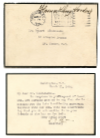
The card is sold with the transmittal envelope and a typed letter from Mrs. Hoover’s secretary, dated January 27, 1933, sending the autograph. Both pieces bear White House embossing and the typewritten address, “Mrs. J.G. McCreery, East Lawn Sanitarium, Northville, Michigan.”

OUT OF STOCK
 

JACKSON, ANDREW (1767-1845)

# 6025

Seventh U.S. President - 1829-37

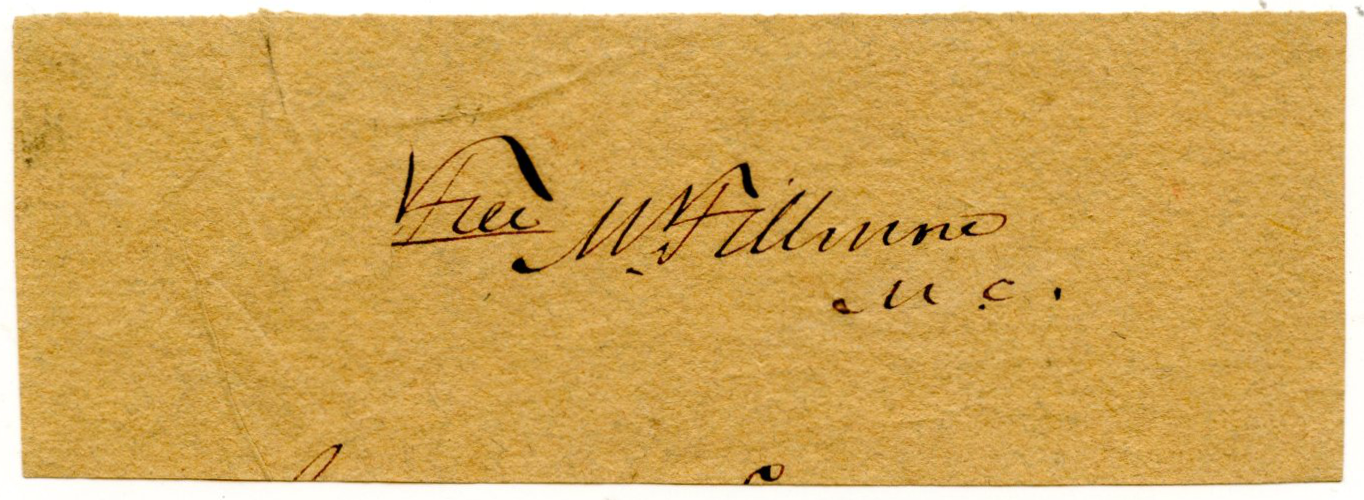
Franked Panel, 8” x 10”, “Free, Andrew Jackson,” also addressed by Jackson, to “Major A.J. Donelson, Charge de Affairs from the U[nited] States to the Republic of Texas. By pr[ivate] Waggoner [sic] or Bearer of Dispatches – to the care of Capt. Easthorn, merchant New Orleans.”

A graduate of the U.S. Military Academy in 1820, Andrew Jackson Donelson served as aide-de-camp to his uncle, General Andrew Jackson, during his term as Governor of the Florida Territory and as private secretary to the President during Jackson’s two terms in office. Appointed U.S. Charge d’Affaires to the Republic of Texas in 1844, Donelson was instrumental in the negotiations which resulted in the admission of the state of Texas to the Union in 1845. This hand-carried cover can thus be dated to that period, and the importance of the letter it carried from the former President is a matter upon which we can only speculate.

Light soiling and wear, particularly along the usual folds; numerous tears and breaks, along with paper loss associated with the opening of the wax seals have been professionally repaired on reverse.

OUT OF STOCK
 

JACKSON, ANDREW (1767-1845)

# 6693

Seventh U.S. President - 1829-37

A Double-Signed Check, as President

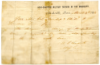
Document Signed, 2 ¾” X 7”, as President, Washington, August 24, 1835, “Andrew Jackson,” a partly printed check, also accomplished by Jackson. Drawn on the Bank of the Metropolis for $200, the check is made payable to Jackson’s son, “Andrew Jackson, j[u]n[io]r,” and thus bears a second full signature.

The check is lightly and evenly toned, with several folds and light creases. A cross-cut cancellation at center intersects portions of the upper signature.

OUT OF STOCK
 

JEFFERSON, THOMAS (1743-1826)

# 6189

Third U.S. President - 1801-09

MADISON, JAMES (1751-1836)
Fourth U.S. President - 1809-17


Partial Document Signed
, as President, “Th: Jefferson,” a 5 ¾” x 8 ½” portion of a four-language ship’s paper, issued at Baltimore, December 22, 1807. Countersigned by the Secretary of State, “James Madison.”

Several light creases, one passing through Jefferson’s signature, with paper loss in the blank left margin, well away from the signatures and text.

OUT OF STOCK
 

JEFFERSON, THOMAS (1743-1826)

# 6492

Third U.S. President - 1801-09

Autograph Note Signed, 3” x 6 ¼”, a personal, handwritten dinner invitation. Although the year is unstated, the note can probably be traced to 1814, one of only two years after Jefferson’s presidency when the seventh day of November fell on a Monday. The other was 1825, the final year of his life.

“Th: Jefferson asks the favor of Mr. Davis to dine at Monticello tomorrow (Tuesday). Monday, Nov. 7.”

Bearing light soiling and wear, along with several fold lines and creases, the note has been affixed to a 7 ¾” x 9 ¾” sheet, with the manuscript notation, “Thos. Jefferson, Signer Declaration of Independence & President U. States,” above. There is show-through of the recipient’s name, “Mr. Davis,” also in Jefferson’s hand, from the reverse.

OUT OF STOCK
 

KENNEDY, JOHN F. (1917-63)

# 6559

Thirty-Fifth U.S. President – 1960-63

Typed Letter Signed, as President on 7” x 10 ½” White House stationery, to “Honorable Edmund G. Brown, Governor of California, Sacramento, California.”

In expressing appreciation for Governor Brown’s cooperation in support of a house bill to preserve California’s salmon and steelhead trout resources, President Kennedy gives voice to the spirit of conservation, for both domestic and strategic purposes, that would define American policy for almost two decades.

Washington, August 21, 1962. Dear Governor Brown: Your letter regarding the Administration’s program for the preservation and enhancement of our individual natural resources is highly appreciated. The legislative proposal, as contained in H.R. 11356 and identical bills, would authorize the Secretary of the Interior, in cooperation with your Department of Fish and Game, to take appropriate action to preserve and develop the salmon and steelhead trout and other fishery resources of the streams entering the Pacific Ocean from the State of California. These resources, vital to California’s economy, are of national concern. It is imperative that they be given adequate protection and, where possible, increased in abundance. The program will strengthen our hand in international negotiations, and advance our long-range plans for fishery conservation. We are pleased, therefore, to know that you are solidly behind Mr. Miller’s bill. Sincerely, John Kennedy.”

There are two light horizontal folds, a few staple holes in the upper margin, and several filing stamps and handwritten notations.

OUT OF STOCK
 

LINCOLN, ABRAHAM (1809-65)

# 6379

Sixteenth U.S. President - 1861-65

A Request for a Lieutenant’s Promotion – Just Two Months Before He was Mortally Wounded at Cedar Creek

Civil War-Date Autograph Note Signed, as President on a 5” x 8” sheet of Executive Mansion stationery, beneath a request from F.H. Baldwin for the promotion of his brother, a lieutenant in the 5th U.S. Artillery.

“The above, written by a very good man, is submitted to the Secretary of War. A. Lincoln.”

Noted as a resident of Allentown, Pennsylvania in the accompanying National Archives records, Mr. Baldwin was undoubtedly a caller at the Executive Mansion, and was directed to write his request, hoping that President Lincoln would approve and advance it through the proper channels. His letter, accomplished in pencil, in full:

Aug. 12th 1864. To His Excellency, Abraham Lincoln, President of the U.S. I desire the transfer or promotion of my brother, Lt. Henry M. Baldwin, Battery M, 5th Reg[imen]t U.S. Artillery, to any vacancy in the Regt. which you may decide it possible to place him, consistent with the good of the service. Very Resp[ectfull]y, F.H. Baldwin.”

There is no record of Lieutenant Baldwin’s promotion or transfer before he was severely wounded through the chest and left arm on October 19, 1864 – just two months later - at the Battle of Cedar Creek. He died on November 8, 1864 at Sheridan Hospital, near Winchester, Virginia.

The letter is in excellent condition, with creases from two vertical folds.                                                                                      

OUT OF STOCK
 

LINCOLN, ABRAHAM (1809-65)

# 6678

Sixteenth U.S. President - 1861-65

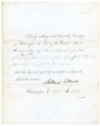
Civil War-Date Document Signed, 15” x 19”, as President, Washington, July 29, 1861, “Abraham Lincoln,” a partly printed appointment for “…Stephen Brooks…Surveyor of the Customs for the District of Middletown in the State of Connecticut.” Countersigned by the Secretary of the Treasury, “S.P. Chase.”

The document is in excellent overall condition, with light age toning and several minor paper breaks at the intersections of the usual folds. Both signatures are distinct and free from flaw in every respect.

OUT OF STOCK
 

LINCOLN, ABRAHAM (1809-65)

# 6679

Sixteenth U.S. President - 1861-65

Civil War-Date Franked Envelope, 3” x 5 ¼”, as President, “A. Lincoln.” The envelope is also addressed by Lincoln, to “Rev[erend] Z.P. Wilds, 120 Prince Street, New York,” and has a June 21, 1862, Washington postmark.

The previous day, Lincoln met with a six-member delegation of Progressive Friends, composed of Thomas Garrett, Alice Eliza Hambleton, Oliver Johnson, Dinah Mendenhall, William Barnard, and Eliza Agnew. The group presented the President with a memorial, urging him to decree the emancipation of the slaves, the position adopted at the Friends’ annual meeting. It is quite worthy of note that Lincoln wrote Reverend Wilds, well known as a longtime missionary to the poor of New York City, the day following his meeting with this group of prominent leaders in the Abolition and Underground Railroad movements.

Set into an attractive, inlaid pedestal frame, the envelope bears general soiling and wear, along with minor paper loss along the right edge and above the somewhat smudged postmark.

OUT OF STOCK
 

MADISON, DOLLEY P. (1768-1849)

# 6490

U.S. First Lady - 1809-17

Autograph Quotation Signed, on the front leaf of a 5” x 8” letter-sheet.

“A Toast. ‘The Rights of man the Gift of God; The powers of government the Grant of the people.’ D.P. Madison. Washington, June 6th 1842.”

The letter-sheet is lightly and evenly toned, with light soiling and wear. There are two horizontal folds and old glue staining in the upper margin.

OUT OF STOCK
 

MADISON, JAMES (1751-1836)

# 6926

Fourth U.S. President - 1809-17

Signature, “James Madison,” on a 1 ¼” x 3” slip of paper.

A sound example, with light soiling and wear.

OUT OF STOCK
 

McKINLEY, WILLIAM (1843-1901)

# 5977

Twenty-Fifth U.S. President - 1897-1901

Signed by President McKinley for the First Lady

Executive Mansion Card, 2 ¾” x 4 ¼”, signed by President William McKinley on behalf of the First Lady, “Ida S. McKinley.”

The card is undeniably rare, this being the first such example I have seen. Minor smudging of ink at the conclusion of the signature detracts very little from otherwise excellent condition.

OUT OF STOCK
 

McKINLEY, WILLIAM (1843-1901)

# 7047

Twenty-Fifth U.S. President - 1897-1901

Signed by President McKinley for the First Lady

Signatures, of the twenty-fifth President and the First Lady - both in the hand of President William McKinley - “William McKinley, Ida S. McKinley,” on a 5” x 7 ½” album page. Dating in an unidentified hand, “1/5/[18]99,” places the signing during McKinley’s first term in office.

Overall condition is excellent, with light, even toning and minor smearing of ink to several letters.

OUT OF STOCK
 

MONROE, JAMES (1758-1831)

# 6928

Fifth U.S. President - 1817-25

Signature, with a ten-word closing also in Monroe’s hand, “I am Sir with great respect Y[ou]r very ob[edien]t serv[an]t, Jas. Monroe,” on a 5” x 6 ½” portion of a letter as U.S. Secretary of State.

The sheet is lightly and evenly toned, with a few pinholes along the left of two vertical folds; there is a small hole in the margin at right, presumably from the opening of a wax seal.

OUT OF STOCK
 

POLK, JAMES K. (1795-1849)

# 6712

Eleventh U.S. President - 1845-49

Franked Envelope, 3 ¼” x 5 ¼”, “Free, J.K. Polk,” addressed in another hand to “Gen[eral] Thomas H. Bradley (Care of Gregg & Elliott), Philadelphia, Penn[sylvania],” also bearing a Washington City postmark and stamped “Free” postal designation.

There is nothing to indicate if the envelope is dated to Polk’s tenure in the U.S. Congress, 1825-39, or to his single term as U.S. President. The recipient, Thomas H. Bradley, a Williamson County, Tennessee native, served in the 1st Tennessee Volunteers during the Second Seminole War. Afterward, he established a large plantation on the Mississippi River in Arkansas, becoming one of the wealthiest planters in the area. In 1861, Bradley, a Unionist Democrat, was elected to the Arkansas Secession Convention, at which he was named brigadier general of Arkansas state troops.

Moderate soiling and wear is somewhat heavier at the edges.

OUT OF STOCK
 

POLK, JAMES K. (1795-1849)

# 6713

Eleventh U.S. President - 1845-49

Autograph Letter Signed, 8” x 10”. Just three weeks before his election to the presidency, Polk directs “Gen[era]l Bradley, Franklin, Tennesseein the posting of a letter to William G. Childress, possibly a member of the family of Polk’s wife, Sarah.

Columbia [Tennessee], Oct[ober] 16th 1844. My Dear Sir: I have written a letter to Wm. G. Childress – by this day’s mail, addressed to him at Franklin. I have to request that you will take it out of the office and send it to him to night, as I desire that he shall receive it early. I make this request because he may not call at the Post office for a day or two. You will oblige me by sending it out. In haste, Your friend, James K. Polk.”

The integral leaf is addressed by Polk to “Gen[era]l Thomas H. Bradley, Franklin, Williamson County, Tennessee,” and bears an October 16, Columbia, Tennessee postmark. A Williamson County native and veteran of the Second Seminole War, Bradley was at this time probably helping Polk, a fellow Tennessee Democrat, in his ultimately successful presidential campaign. In the years leading up to the Civil War, Bradley established a large plantation on the Mississippi River in Arkansas, becoming one of the wealthiest planters in the area. He was elected to the 1861 Arkansas Secession Convention, at which he was named brigadier general of Arkansas state troops.

Overall condition is excellent, with the usual folds and an old paper clip stain in the upper margin. There is a small area of paper loss in the lower margin of the address leaf, due to the opening of the wax seal.

OUT OF STOCK
 

POLK, SARAH CHILDRESS (1803-91)

# 6481

U.S. First Lady - 1845-49

Signed Card, 2” x 3 ¾”, “Mrs. James K. Polk,” dated in another hand on reverse, May 4, 1887.”

Lightly and evenly toned, with minor bleeding of ink at the “P” in the last name.

OUT OF STOCK
 

ROOSEVELT, ANNA ELEANOR (1884-1962)

# 6866

U.S. First Lady - 1933-1945

Typed Letter Signed, 6” x 7”, on Mrs. Roosevelt’s imprinted personal stationery.

New York, January 6, 1950. My dear Mr. Hallman: I have received your letter and I appreciate your writing. I am glad to know of the celebration that was held in Mexico. With many thanks and best wishes, Very sincerely yours, Eleanor Roosevelt.”

Condition is excellent, with a horizontal fold at the center.

OUT OF STOCK
 

ROOSEVELT, FRANKLIN DELANO (1886-1945)

# 6035

32nd U.S. President - 1933-45

FDR Writes to a Young Polio Victim Who Hopes to go to Warm Springs

Typed Letter Signed, on embossed 8” x 10 ½” stationery as New York Governor, to “Miss Lenora Burge, 228 N. Orange Street, Rialto, California,” apparently a young polio victim, hoping to go to Warm Springs. Responding personally to her request for information, FDR refers the matter to the head physician at the well known rehabilitation center, founded by Roosevelt in 1927 for the treatment of others afflicted with polio.

Albany, June 8, 1931. Dear Lenora:- I have your letter of May 27th and am taking the liberty of sending it to Dr. Leroy W. Hubbard, the physician in charge at Warm Springs, Georgia, with the request that he send you full information about Warm Springs. Very sincerely yours, Franklin D. Roosevelt.”

Overall condition is excellent, with light, even toning and two horizontal folds.

OUT OF STOCK
 

ROOSEVELT, THEODORE (1858-1919)

# 6863

Twenty-Sixth U.S. President – 1901-09; Colonel of the Rough Riders - Awarded the Congressional Medal of Honor for the Battle of San Juan Hill, July 1, 1898

Signed Card, 2 ½” x 4”, “Theodore Roosevelt.”

Overall condition is excellent, with light, even toning and small mounting remnants on the reverse.

OUT OF STOCK
 

TAFT, HELEN H. (1861-1943)

# 6495

U.S. First Lady – 1909-13

Autograph Letter Signed, two pages, 4 ¼” x 5 ½”, dated “1919” in another hand at the conclusion. Writing on imprinted stationery from the family home in Quebec, Mrs. Taft arranges to send a copy of her autobiography, along with autographs from her husband, which are no longer present.

“To W.E. Ambler. My dear Mr. Sir: I will send you an [sic] copy of my book which costs three dollars and a half, but I am in Canada now, and I can not get it easily. I will get it when I go back to my own country. Mr. Taft sends autographs but that is all. Yours sincerely, Helen H. Taft. July 3rd.”

Condition is excellent overall, with a horizontal fold at the center.

OUT OF STOCK
 

TAFT, HELEN H. (1861-1943)

# 7053

U.S. First Lady – 1909-13

Franking Signature, “Helen H. Taft, Free,” on a 3 ½” x 5 ½” black-bordered mourning envelope – due to the death of her husband, William Howard Taft, the previous spring – also addressed by Mrs. Taft, to “Mr. George A. Stare, 1152 Muirfield Road, Los Angeles, California.”

The envelope is lightly and evenly toned, with light soiling and wear. There is a small hole just above the address, which is intersected by the oddly positioned October 23, 1930, Washington, D.C. postmark.

OUT OF STOCK
 

TAFT, WILLIAM HOWARD (1857-1930)

# 6724

27th U.S. President - 1909-13; U.S. Supreme Court Chief Justice - 1921-30; U.S. Secretary of War - 1904-08

Signed White House Card, 2 ¾” x 4 ¼”, as President, “Wm. H. Taft.”

The card is pristine, both front and reverse.

OUT OF STOCK
 

TAFT, WILLIAM HOWARD (1857-1930)

# 7002

27th U.S. President - 1909-13; U.S. Supreme Court Chief Justice – 1921-30; U.S. Secretary of War - 1904-08

Typed Letter Signed, as President on 7" x 9” White House stationery. Late in his single term, President Taft informs Texas Governor Oscar Branch Colquitt that an unspecified matter, about which Colquitt has inquired, has been referred to U.S. Attorney General George W. Wickersham.

Washington, February 19, 1912. My dear Governor: I have yours of February 16th and have invited the comment of the Attorney General, as you suggest. Sincerely yours, Wm. H. Taft.”

Lightly and evenly toned, with a horizontal fold at center.

OUT OF STOCK
 

WILSON, EDITH BOLLING (1872-1961)

# 7054

U.S. First Lady – 1915-21

Franking Signature, “Edith Bolling Wilson,” on a 3 ½” x 6” black-bordered mourning envelope, postmarked Washington, D.C., March 12, 1924 – shortly after the February 3 death of her husband, Woodrow Wilson. Addressed in another hand, to “The American Legion, Allein Post No. 3, Vicksburg, Mississippi.”

Accompanied by a black-bordered card, with the printed inscription, “Mrs. Woodrow Wilson desires to express her deep appreciation of your kind sympathy.”

Both pieces are lightly toned, and the envelope has slightly heavier soiling and wear. Much of the signature is intersected by the postmark.

OUT OF STOCK
 
Showing All 40 Items.
  Show Paging