New Items
These are our most recently listed items, in all categories.
 BLANCHARD, JAMES HUMPHREY (1872-1954) Prominent Post-Bellum Resident of Greenwood, Mississippi
-100.png)
-100.png)
Signed Photograph, 6” x 8”, a silver-print image of Blanchard as a young man, circa 1900. Signed in pencil on the reverse, “J.H. Blanchard, Greenwood, Miss[issippi],” with pencil notations in another hand just above, seemingly indicating an obituary or biographical placement in a local newspaper.
Excellent, with light toning and old mounting remnants on the reverse.
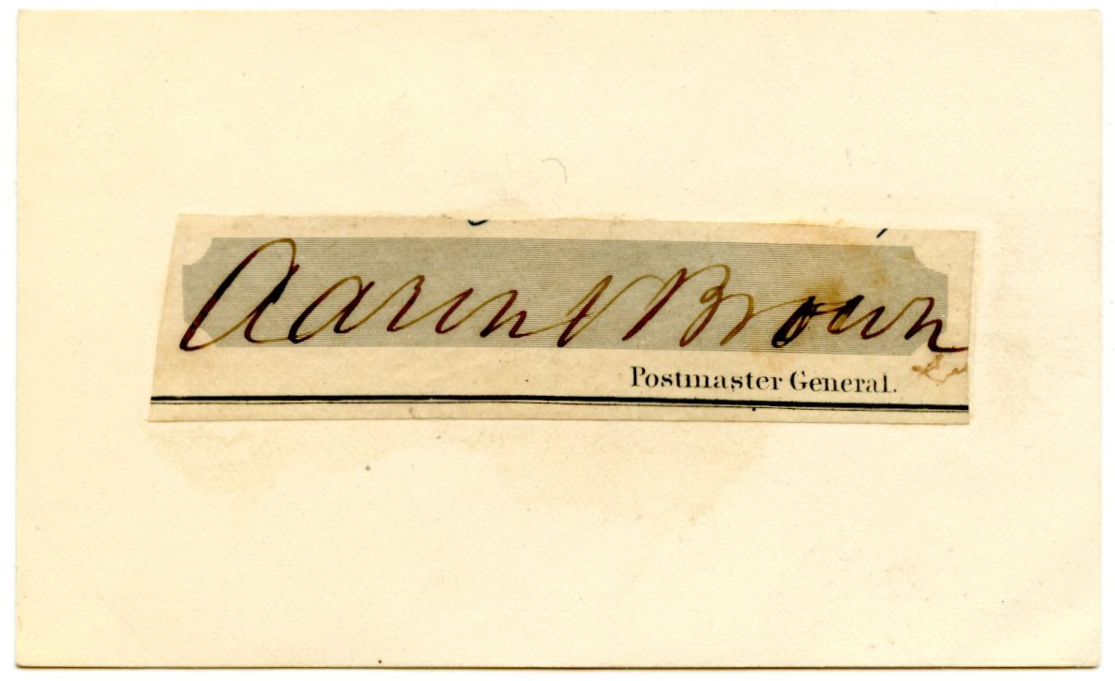
BROWN, AARON VENABLE (1795-1859) U.S. Postmaster General – 1857-59; Governor of Tennessee – 1845-47; U.S. Representative – Tennessee – 1839-45
Signature, “Aaron Brown,” on a ½” x 2 ½” portion of a document, signed as U.S. postmaster general. Affixed to a heavier card.
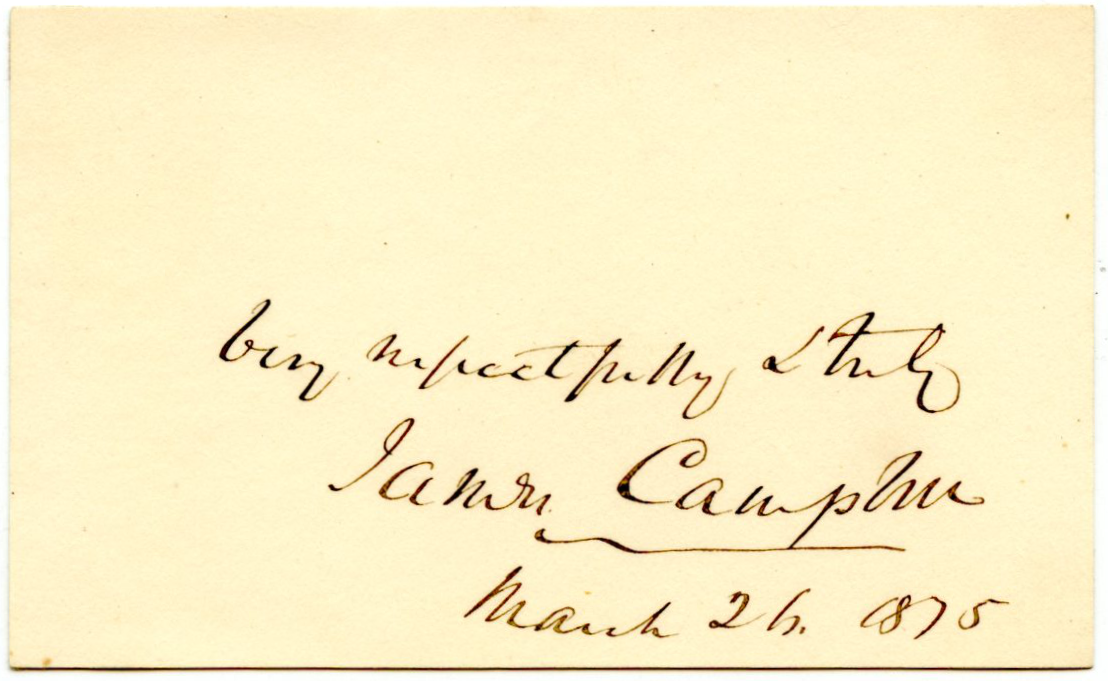
CAMPBELL, JAMES (1812-93) U.S. Postmaster General – 1853-57; Attorney General of Pennsylvania – 1852-53; Prominent Antebellum Catholic Politician from Philadelphia, Pennsylvania
Signed Card, 2 ¼” x 3 ½”, “Very respectfully & truly, James Campbell, March 26, 1875.”
Lightly and evenly toned, with old mounting traces and pencil biographical notations on the reverse.
CUDWORTH, WARREN HANDEL (1825-83) Union Chaplain - 1st Massachusetts Infantry; Unitarian Pastor; Authored “History of the First Regiment (Massachusetts Infantry),” published in 1866
-100.png)
-100.png)
Signed Envelope, 3” x 5 ¼”, “Soldier’s Letter, W.H. Cudworth, Chaplain, Mass[achusetts] 1st,” transmittal for a Civil War letter (no longer present) from an unidentified soldier; addressed in another hand, to “Mr. Joseph L. Rand, North Waterford, Maine,” and bearing a “Due 3” postal stamp. Pencil arithmetic notations are on the reverse.
Moderate toning throughout, with the expected wear, soiling, and edge chips and tears.
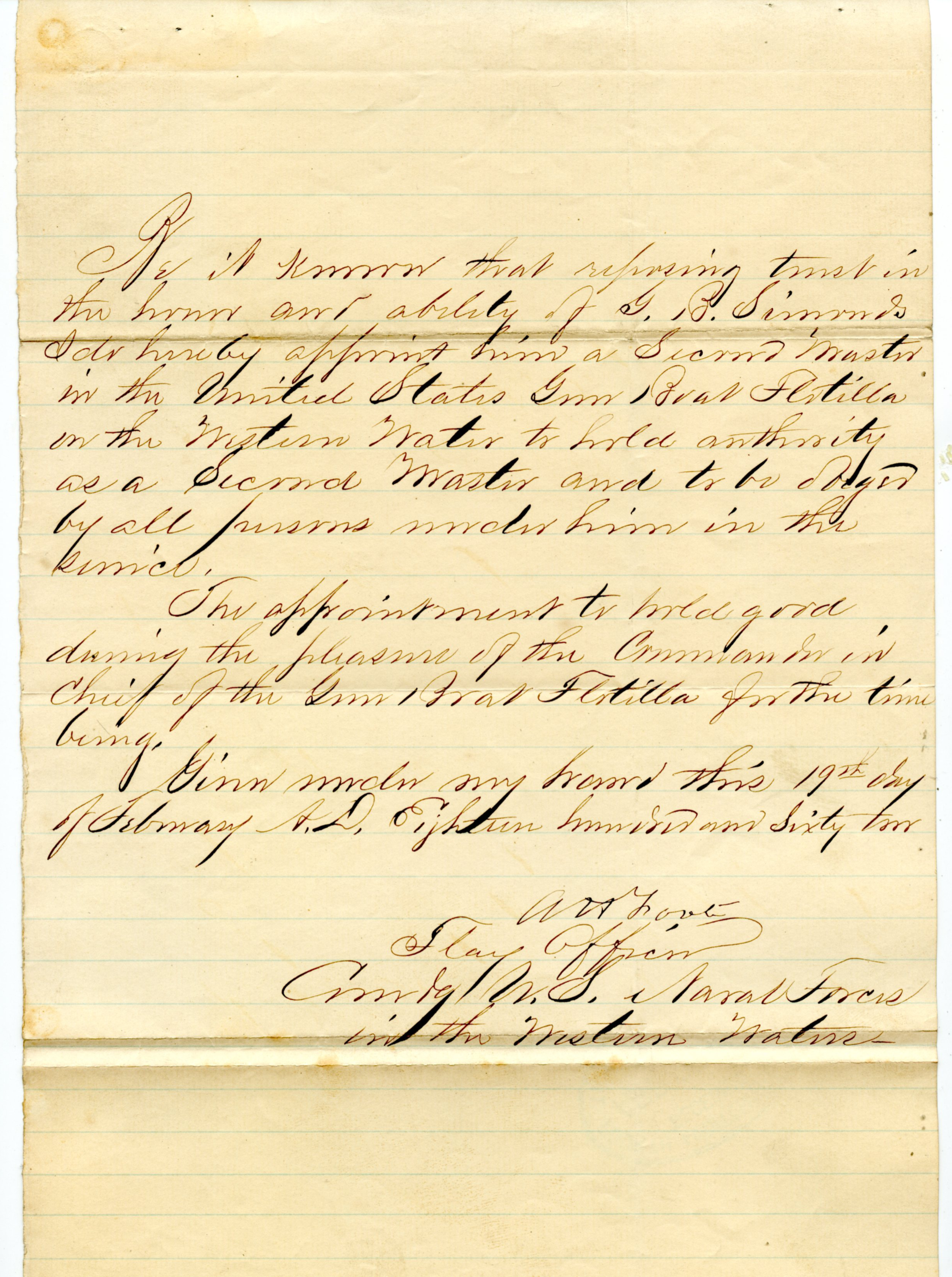
FOOTE, ANDREW HULL (1806-1863) Union Navy Officer, promoted to Rear Admiral on July 16, 1862
Just days after the capture of Fort Donelson, Foote makes an appointment in the Western Gun Boat Flotilla, while General Ulysses S. Grant emerges as a champion of the Union.
Civil War-Date Document Signed, 8” x 12 ½”, a manuscript order appointing one G.B. Simmonds to the rank of second master. Fort Donelson, at the time a Confederate installation on the Cumberland River in Tennessee, was surrendered on February 16, 1862, just three days prior to this order. Union forces, including Flag Officer Foote, were under the command of General Ulysses S. Grant, whose action during the siege, battle, and capitulation – specifically his demand for “unconditional and immediate surrender” of the Confederate command at the fort - propelled him into national prominence.
“Be it known that reposing trust in the honor and ability of G.B. Simmonds, I do hereby appoint him a Second Master in the United States Gun Boat Flotilla on the Western Water to hold authority as a Second Master and to be obeyed by all persons under him in the service. The appointment to hold good during the pleasure of the Commander in Chief of the Gun Boat Flotilla for the time being. Given under my hand this 19th day of February A.D. Eighteen hundred and Sixty two. A.H. Foote, Com[man]d[in]g U.S. Naval Forces in the Western Waters.”
Overall condition is very good, with light, even toning, a few minor stains, and the expected folds.
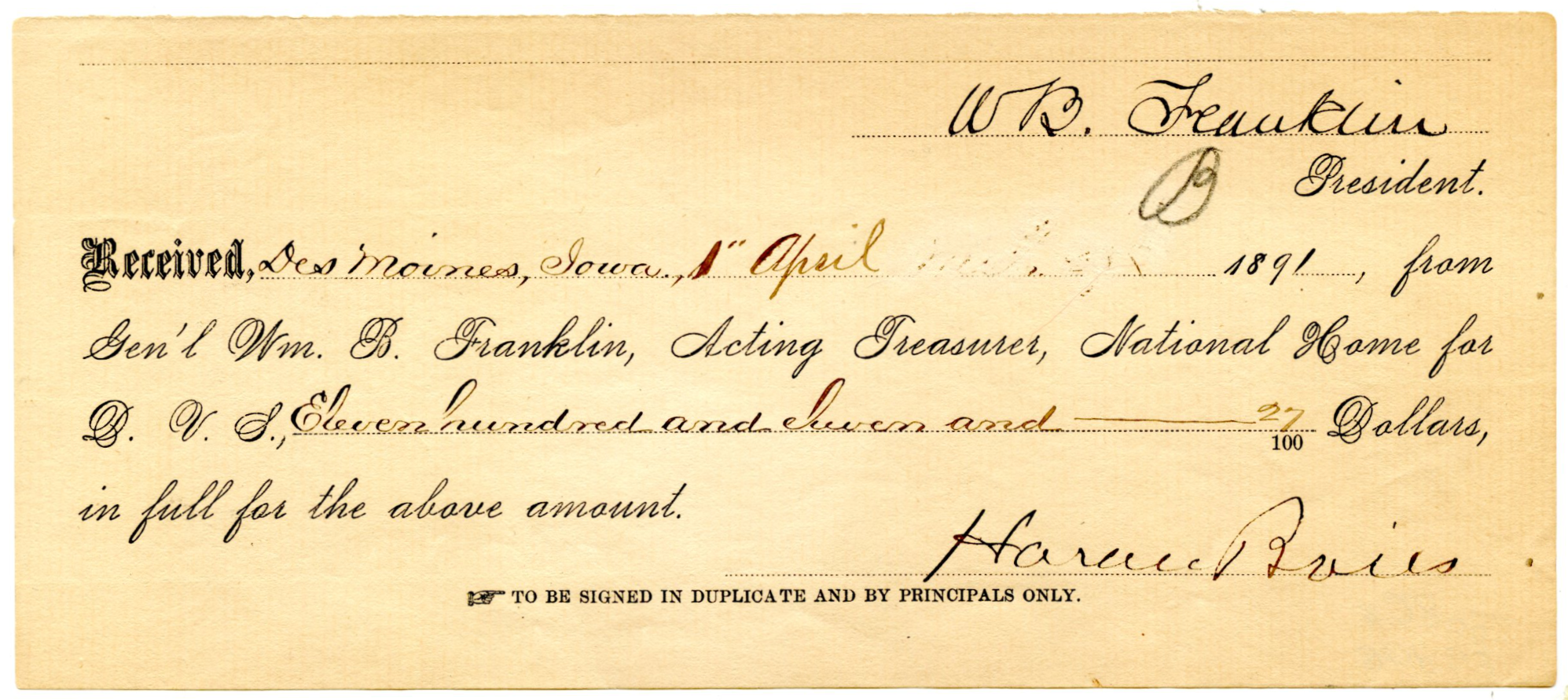
FRANKLIN, WILLIAM BUEL (1823-1903) U.S. Army Officer; Union Major General during the American Civil War
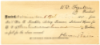
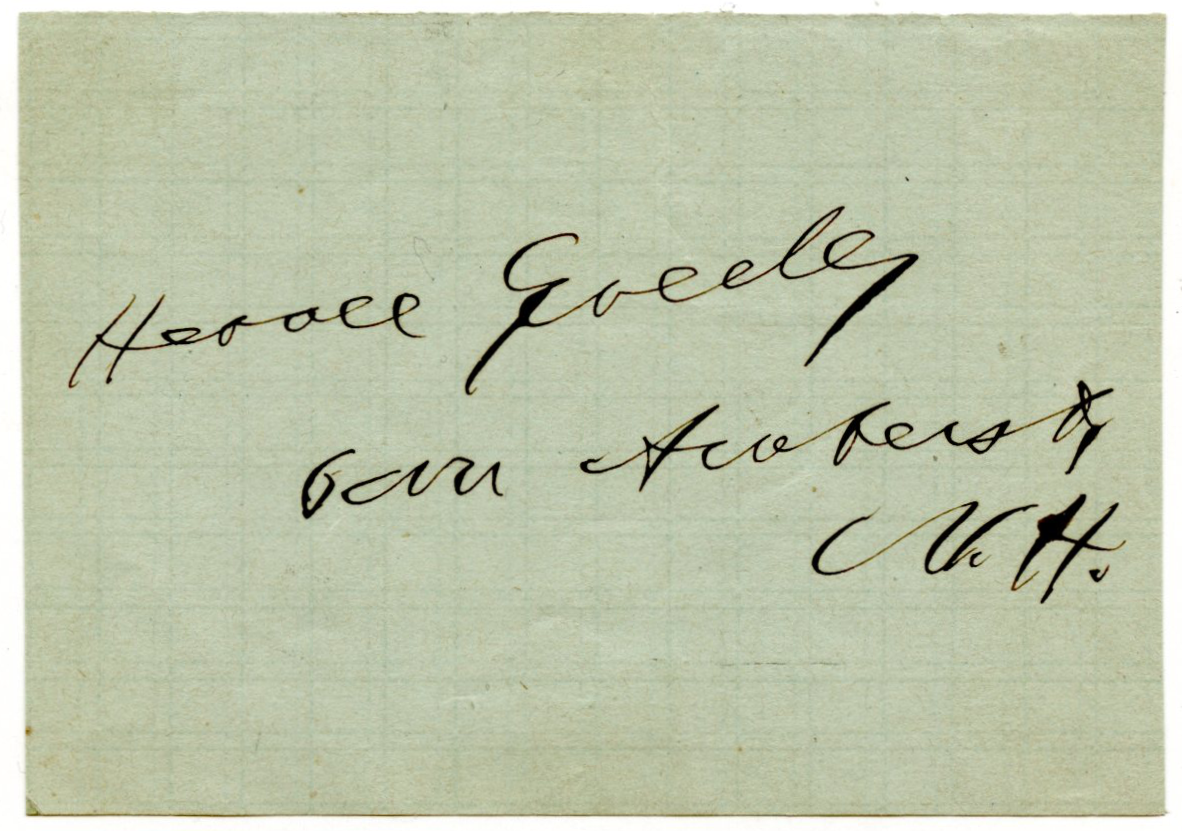
GREELEY, HORACE (1811-72) American Editor & Abolitionist; Founder of the New York Tribune; Democratic Candidate for U.S. President - 1872
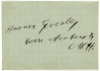
Signature, “Horace Greeley, 6am, Amherst, N[ew] H[ampshire],” on a 2 ¾” x 3 ¾” slip of paper.
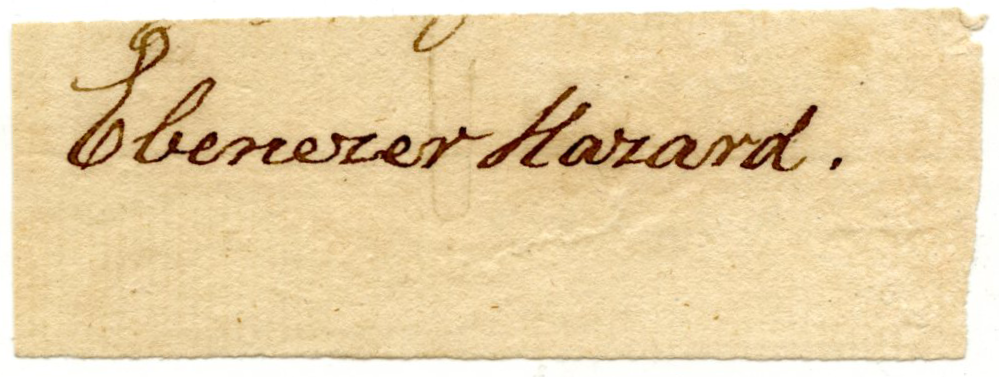
HAZARD, EBENEZER (1744-1817) U.S. Postmaster General - 1782-89; Postmaster of New York City & Surveyor General of the Continental Post Office during the American Revolutionary War
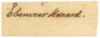
Signature, “Ebenezer Hazard,” on a 1 ¼” x 3 ¼” slip of paper, an uncommon full signature removed from a larger letter or document.
Lightly and evenly toned, with a slightly irregular right edge; old pencil biographical notations on the reverse.
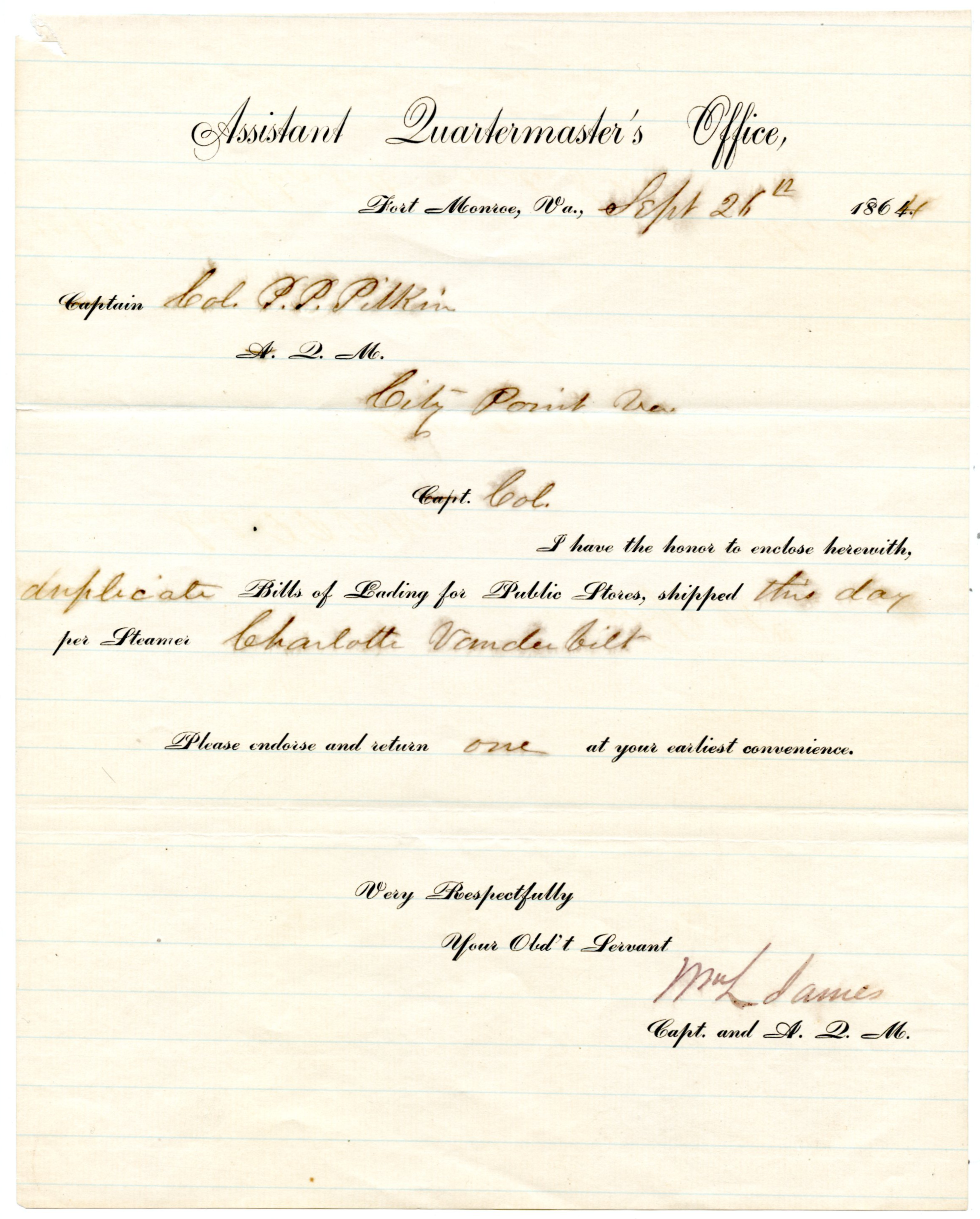
JAMES, WILLIAM LEVIS (1833-1903) Union Brevet Brigadier General; Civil War Colonel in the Quartermaster’s Department
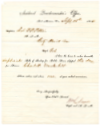
War-Date Letter Signed – City Point, Virginia, September 1864 – Bills of Lading for the “Steamer Charlotte Vanderbilt.”
Civil War-Date Letter Signed, on an imprinted 7 ½” x 9 ½” form. Partly printed, with the manuscript portions also being accomplished by James.
“Assistant Quartermaster’s Office, Fort Monroe, V[irgini]a, Sept[ember] 26th 1864. Captain Col[onel] P.P. Pilkin, A[ssistant] Q[uarter] M[aster] City Point, Va. Col[onel], I have the honor to enclose herewith, duplicate Bills of Lading for Public Stores, shipped this day per Steamer Charlotte Vanderbilt. Please endorse and return one at your earliest convenience. Very respectfully Your Ob[e]d[ien]t Servant, Wm. L. James, Capt[ain] and A[ssistant] Q[uarter] M[aster].”
Lightly and evenly toned, with two horizontal folds; there is a small tear, with minor paper loss, in the upper left corner.
McARTHUR, DUNCAN (1772-1839) U.S. Army Brigadier General during the War of 1812; Governor of Ohio – 1830-32; U.S. Representative – Ohio – 1823-25
-100.png)
-100.png)
Autograph Letter Signed, 6 ¾” x 8”, as U.S. Congressman, to one Augustus Gamble. The attached leaf of the same dimension, stamped “FREE” and bearing a Chillicothe, Ohio postmark, is franked and addressed by McArthur: “Free. D. McArthur, M[ember] C[ongress]. Augus[tus] Gamble, Esquire, x roads Ann Arundel County, Maryland.”
“Chillicothe [Ohio], Nov[embe]r 8th 1824
Dear Sir,
Your favour of the 4th Ult[imo] came duly to hand.
The surveys in the name…Young Wilkins have been made…ground and the plats forwarded…office of Col[onel] Richard C. Anderso…principal surveyor who resides ne[ar]…Louisville, Kentucky, for record. So soon as recorded, he has been requested to forward them, to the Gen[era]l Land Office at the City of Washington.
I trust that you will…your Patents in the course of the ensuing winter, and be ready to convey to my son the part which will be due for his services. respectfully yours, Duncan McArthur.”
Moderately toned throughout, with general soiling and wear. The upper edge is somewhat irregular, having been hand torn for use. Paper separation at the usual folds has resulted in the loss of paper at the right edge, containing words from six lines of text.
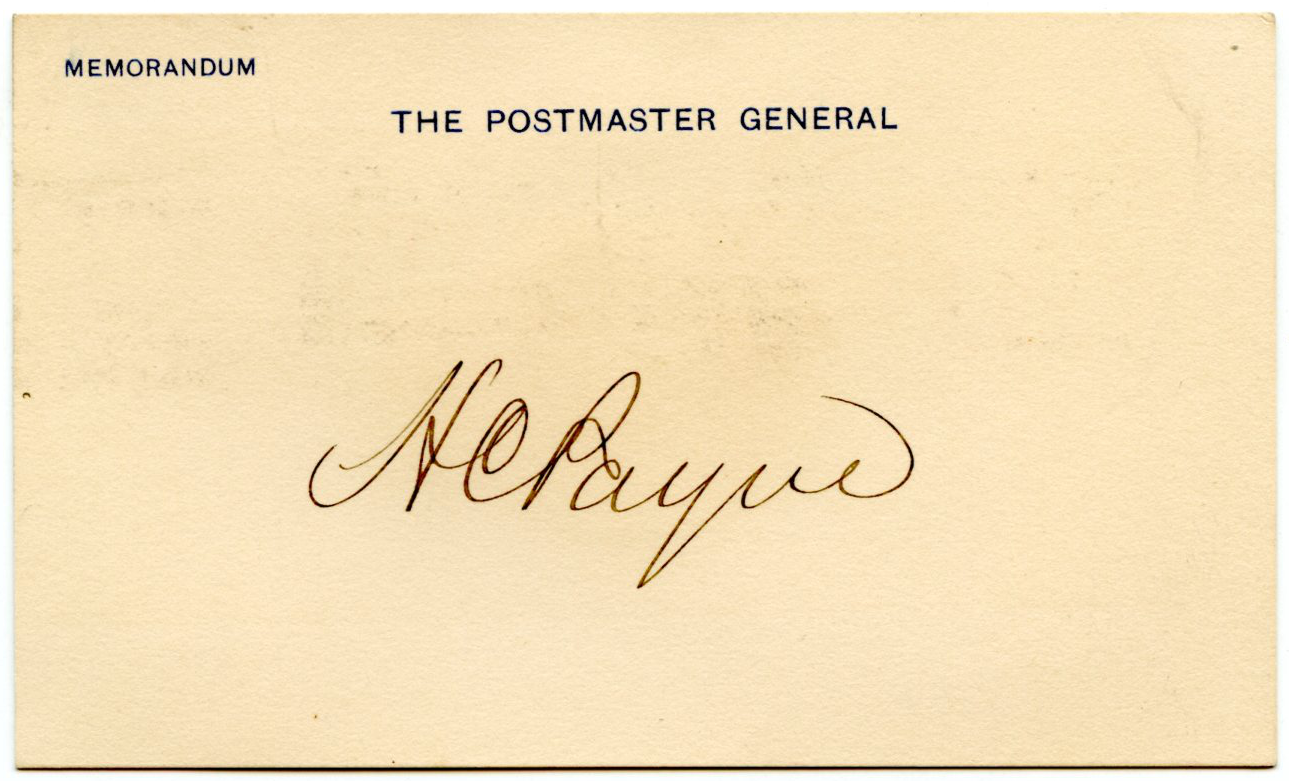
PAYNE, HENRY CLAY (1812-93) U.S. Postmaster General – 1902-04; Postmaster of Milwaukee, Wisconsin – 1876-86
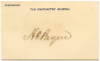
Signed Card, 2 ½” x 4 ¼”, imprinted as U.S. Postmaster General, “H.C. Payne.”
Lightly and evenly toned, with old mounting traces on the reverse.
SCATES, WALTER BENNETT (1808-86) Union Brevet Brigadier General; Attorney General of the State of Illinois – 1836-37; Served as Chief Justice of the Illinois Supreme Court – 1855; Collector of Customs for the Port of Chicago – 1866-69
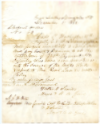
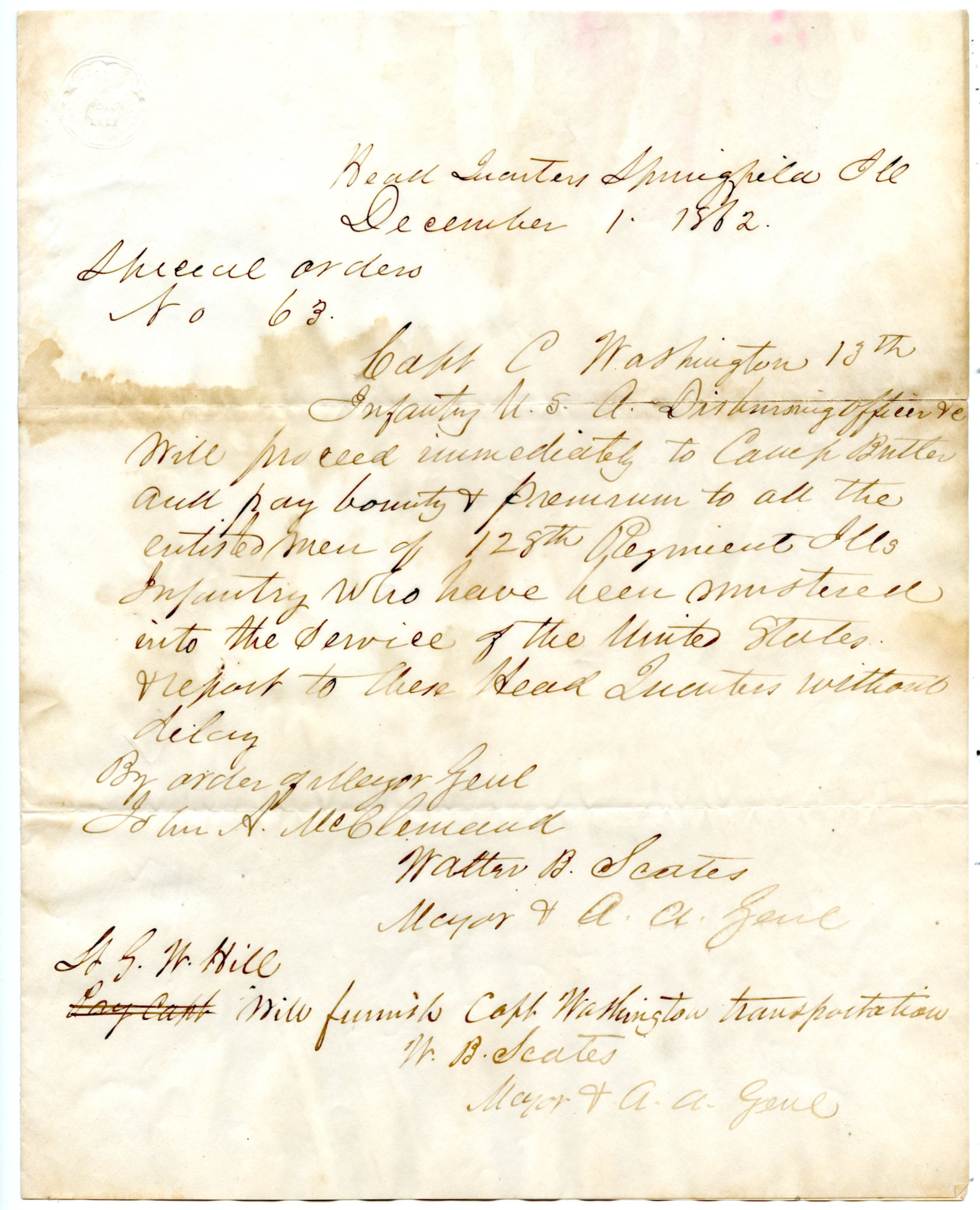
Civil War “Special Order,” directing a 13th U.S. Army Officer, mortally wounded at Vicksburg six months later, to report to Camp Butler
Document Signed, 8” x 10”, a manuscript special order, signed twice by Scates at the conclusion, directing 13th U.S. Infantry Captain Edward Crawford Washington, mortally wounded in the May 19, 1863 assault on Vicksburg, Mississippi, to report immediately to Camp Butler, near Springfield, Illinois, to enlist and pay bounty to the newly formed 128th Illinois Infantry.
“Head Quarters Springfield, Ill[inois], December 1, 1862. Special orders No. 63. Capt[ain] C. Washington, 13th Infantry, U.S.A. Disbursing Officer & c. Will proceed immediately to Camp Butler and pay bounty & premium to all the enlisted men of 128th Regiment Ill[inoi]s Infantry who have been mustered into the Service of the United States & report to these Head Quarters without delay. By order of Major General John A. McClernand. Walter B. Scates, Major & A[ssistant] A[djutant] Gen[era]l. L[ieutenan]t G.W. Hill Will furnish Capt. Washington transportation. W.B. Scates, Major & A.A. Genl.”
Exhibits the expected soiling, toning, and wear; water staining and clean separation, with no loss of paper, at the upper of two horizontal folds.
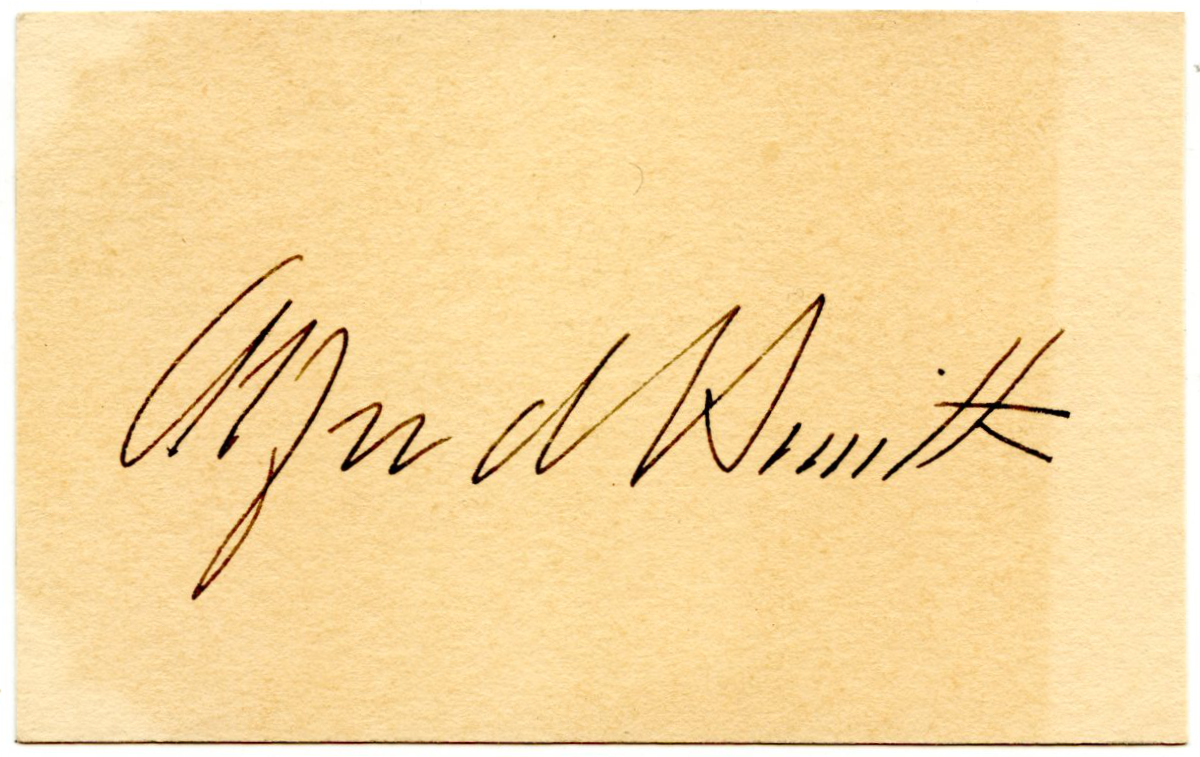
SMITH, ALFRED EMANUEL (1873-1944) Governor of New York – 1919-20 & 1923-28; U.S. Presidential Candidate – Democratic Party – 1928, the first Roman Catholic to be nominated by a major Political Party
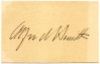
Signed Card, 2 ½” x 4”, “Alfred A. Smith.”
Barely discernible, slightly lighter toning at the right edge.
STEPHENS, ALEXANDER HAMILTON (1812-83) Confederate Vice President; U.S. Congressman – Georgia – 1843-59 & 1873-82; Governor of Georgia – 1882-83
-100.png)
-100.png)
Franked Envelope, 3” x 5 ¼”, “Free, Alexander H. Stephens, M[ember] C[ongress],” also addressed by Stephens, to “John L. Stephens, La Grange, G[eorgi]a,” a recurring correspondent. Stephens was frail and frequently ill, even as a young man, this atypical signature being an obvious example from one of his unsteady periods.
General soiling and wear, with numerous small tears and breaks at the edges.
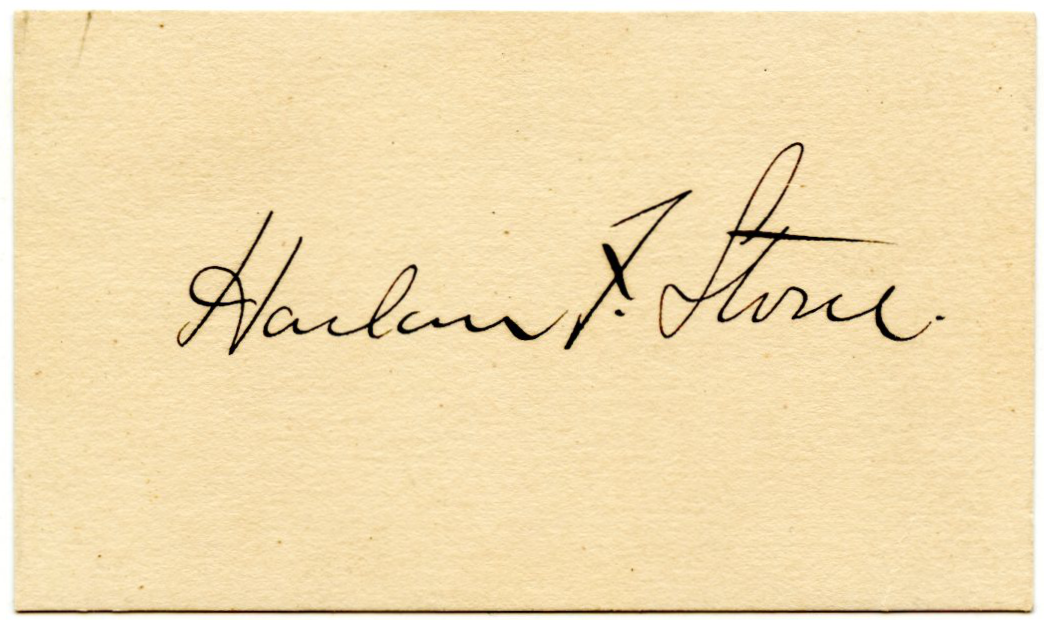
STONE, HARLAN FISKE (1872-1946) Chief Justice of the United States, Supreme Court – 1941-46; Associate Justice of the U.S. Supreme Court – 1925-41; U.S. Attorney General – 1924-25
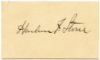
Signed Card, 2” x 3 ¼”, “Harlan F. Stone.”
Excellent, with light, even toning.
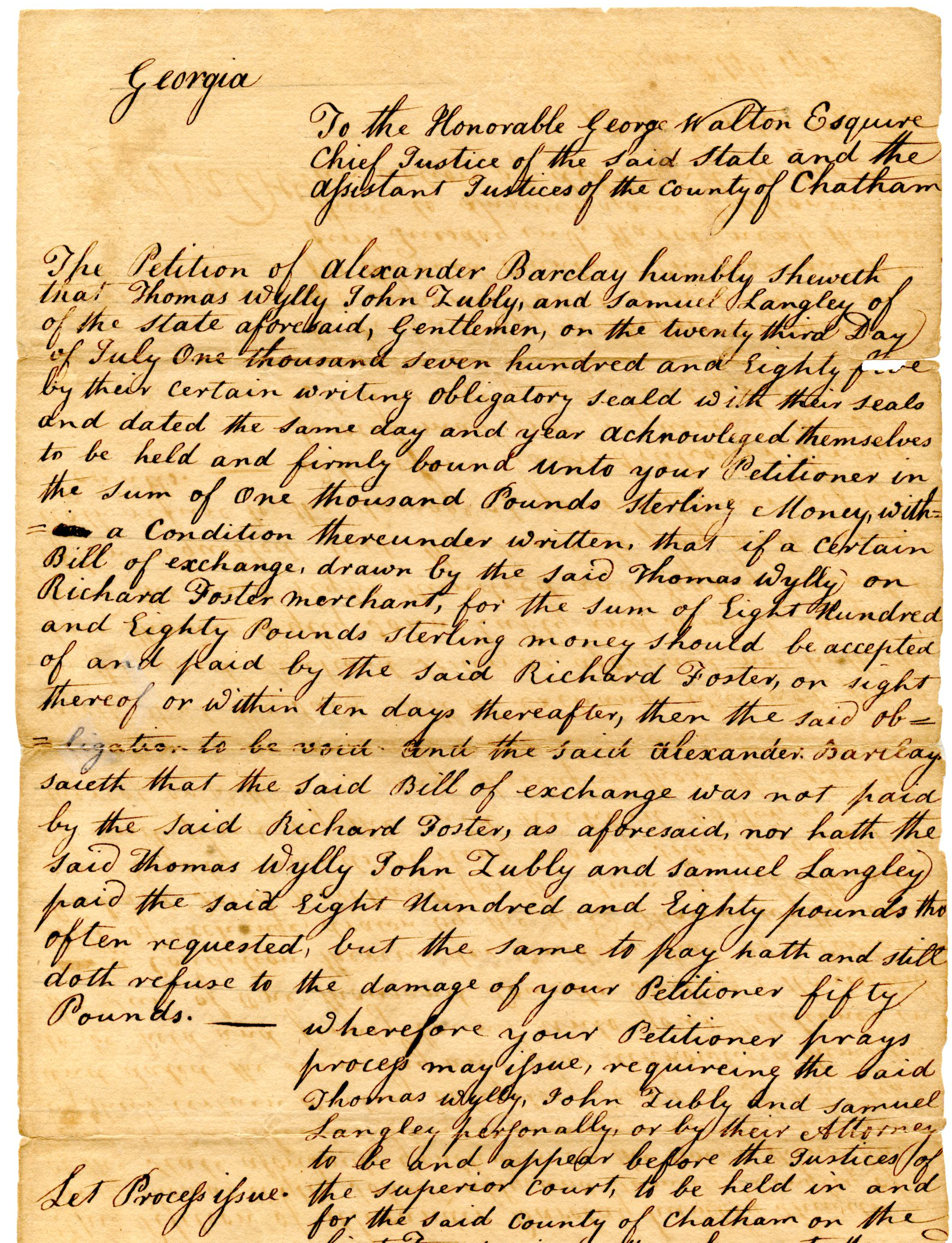
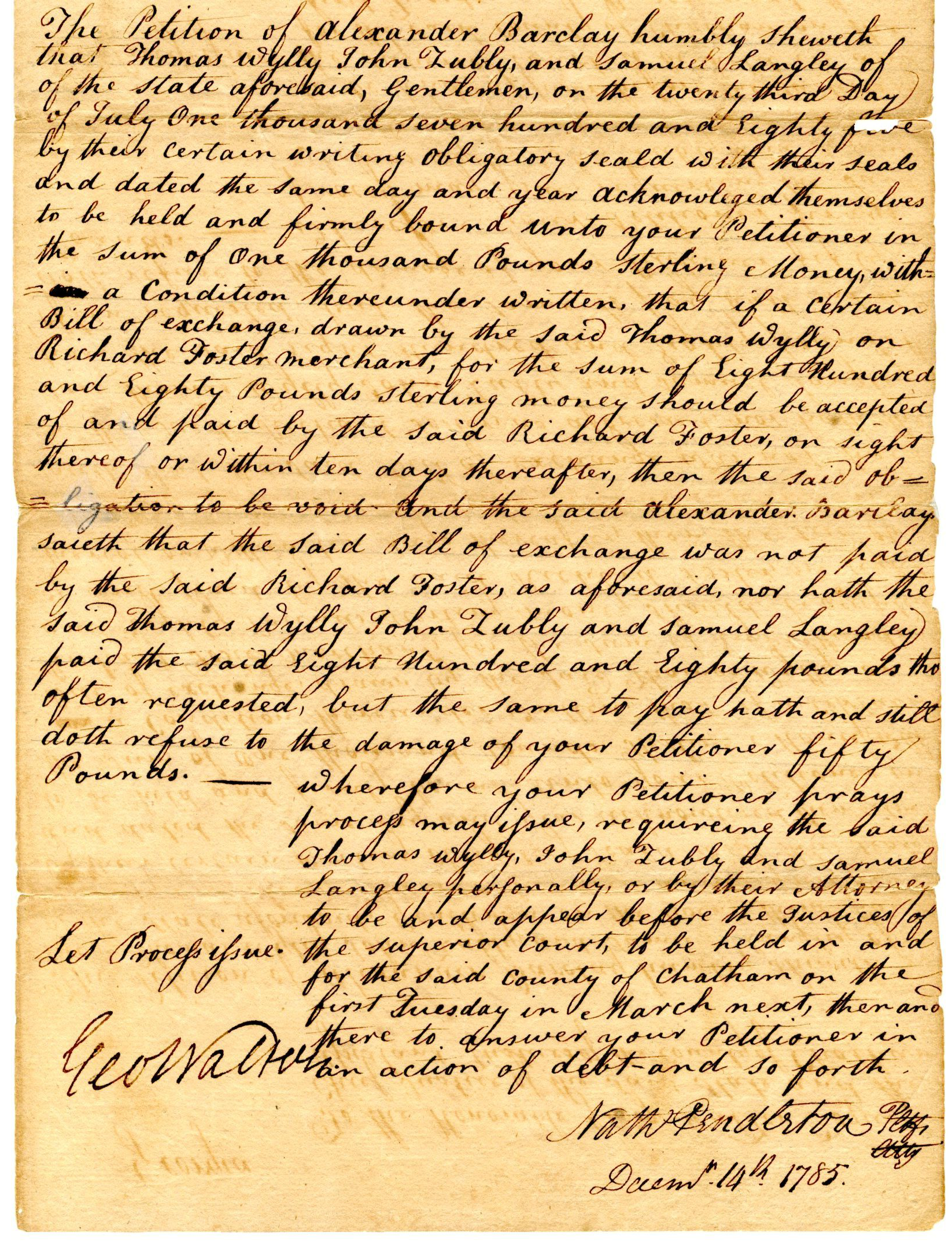
WALTON, GEORGE (1749-1804) Signer of the Declaration of Independence; U.S. Senator – Georgia – 1795-96; Governor of Georgia – 1789-90; Chief Justice of Georgia 1783-89
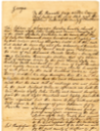
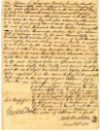
Document Signed, 8” x 12 ½”, Chatham County, Georgia, December 14, 1785, “Geo. Walton,” as Chief Justice of the Georgia Supreme Court, a manuscript legal document regarding the payment of a debt.
The document is evenly toned, with several stains and a few insignificant edge chips and tears. One word of text is affected by a small area of paper loss near the right edge, along the uppermost of three horizontal folds, another of which has been repaired on the reverse. Detachment of the upper one-fourth of the document at the uppermost fold could easily be repaired by a professional conservator.
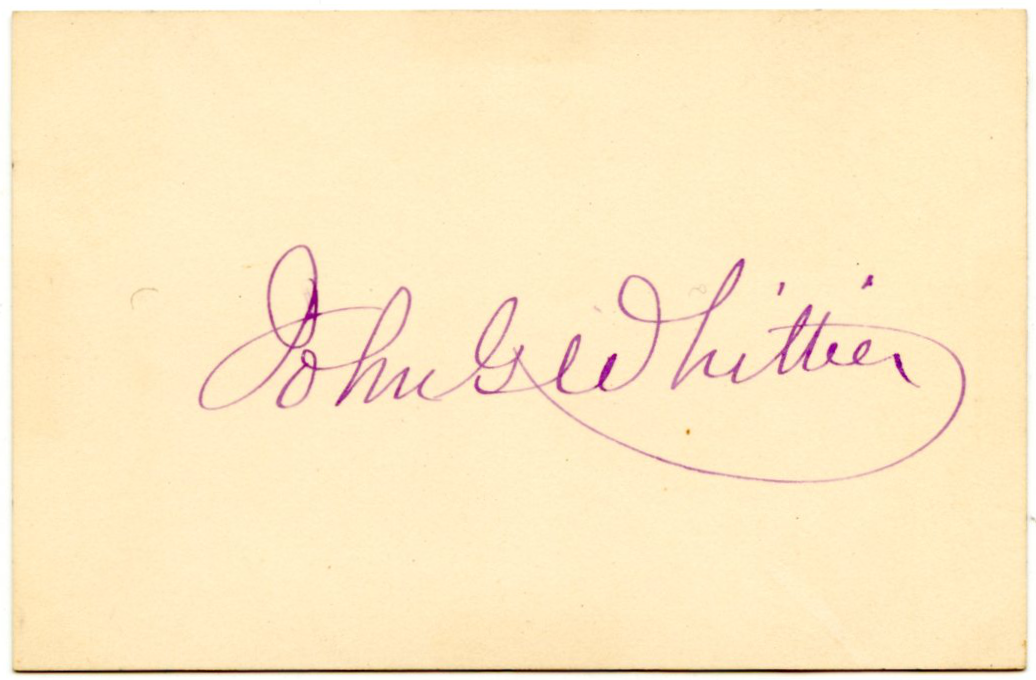
WHITTIER, JOHN GREENLEAF (1807-92) American Quaker Poet & Abolitionist
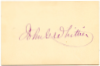
Signed Card, 2 ¼” x 3 ¼”, “John G. Whittier,” in violet ink.
Excellent, with light, even toning.
WICKHAM, WILLIAMS CARTER (1820-88) Confederate Brigadier General; Colonel of the 4th Virginia Cavalry; Confederate Congressman – 1864-65
Leave of Absence for a 4th Virginia Cavalry Officer – Killed-in-Action just two weeks later at the Battle of First Bull Run
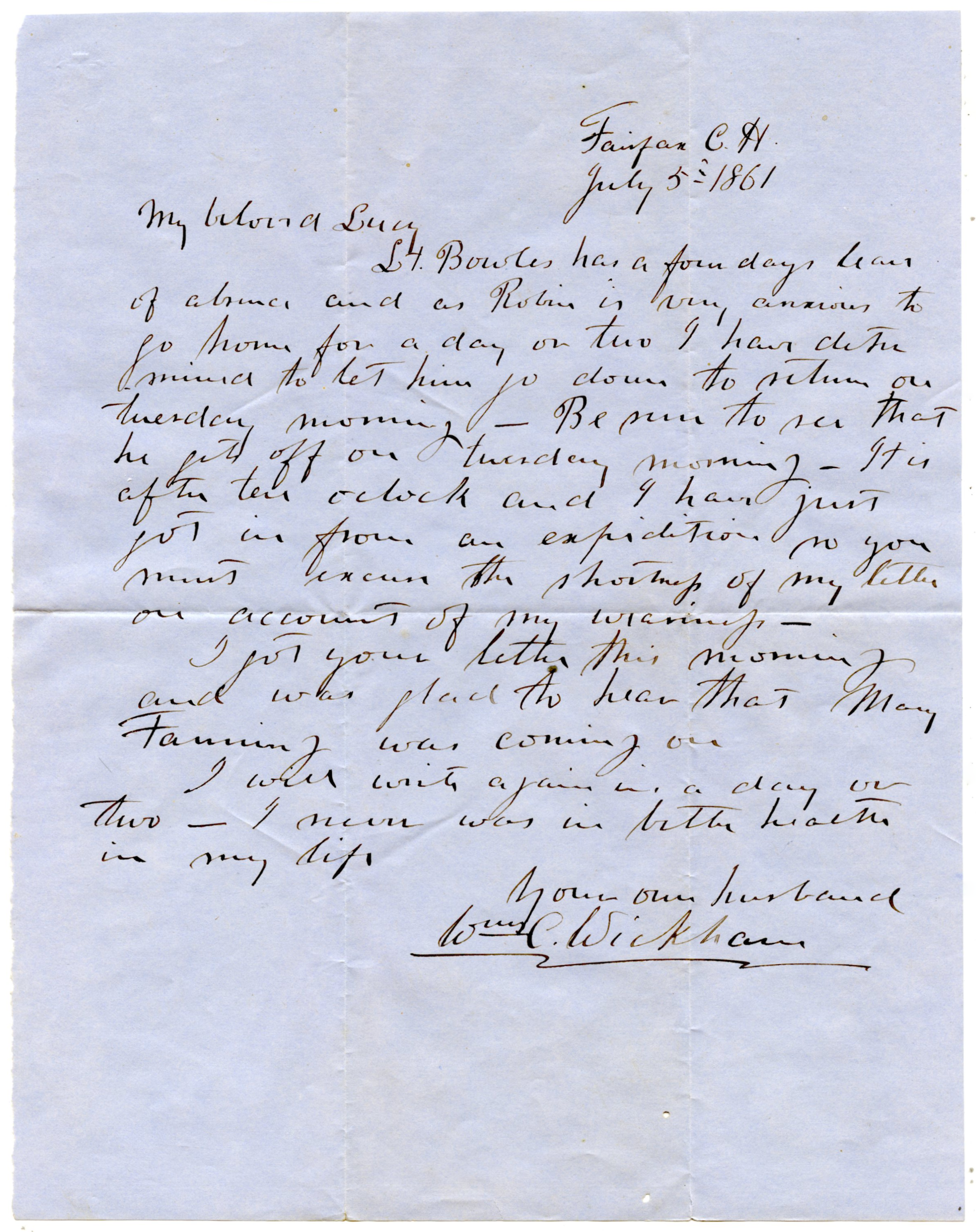
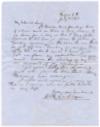
Civil War-Date Autograph Letter Signed, 7 ¾” x 9 ¾”. Writing to his wife from his northern Virginia headquarters just two weeks before the Battle of First Manassas, the opening major engagement of the American Civil War in the East, Wickham informs her of the leave of absence for an officer in the 4th Virginia Cavalry.
“Fairfax C[ourt] H[ouse] [Virginia], July 5th 1861. My beloved Lucy, L[ieutenan]t Bowles has a four days leave of absence and as Robin is very anxious to go home for a day or two I have determined to let him go down on tuesday morning. Be sure to see that he gets off on Tuesday morning. It is after ten o’clock and I have just got in from an expedition so you must excuse the shortness of my letter on account of my weariness. I got your letter this morning and was glad to hear that Mary Fanning was coming on. I will write again in a day or two. I never was in better health in my life. Your own husband, Wm. C. Wickham.”
The named officer, Boldman Bowles, here referred to in an informal first name, is quite possibly a family friend or neighbor in Hancock County, Virginia. Modern records, courtesy of Historical Data Systems, Inc., as follows: “Boldman Bowles. Residence was not listed; a 34 year-old farmer. Enlisted on 5/9/1861 at Ashland, VA as a 2nd Lieutenant. On 5/9/1861 he was commissioned into ‘H’ Co. VA 4th Cavalry. He was Killed on 7/21/1861 at Bull Run, VA (Shot in head).”
Overall condition is excellent, with minor separation at the edges of the expected folds; there are two tiny holes in the extreme lower margin, well away from all text.
-1905.png)
-1917.png)
-1601.png)
-1606.png)
-1388.png)
-1661.png)
-1648.png)
-1663.png)