Civil War
ALVORD, BENJAMIN (1813-84) Union Brigadier General; Graduate of the U.S. Military Academy at West Point – 1833; Veteran of the Mexican & Second Seminole Wars
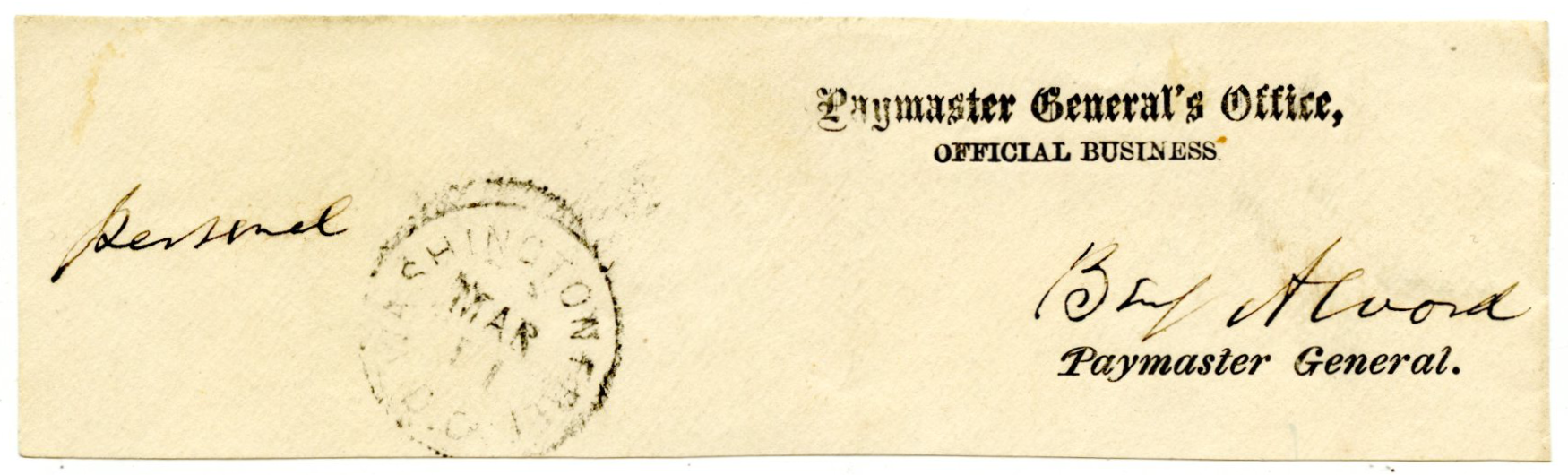
Signature, “Benj[amin] Alvord,” a frank on a 1 ½” x 5 ¾” portion of an imprinted “Paymaster General’s Office” envelope; marked “Personal” by Alvord, with a Washington, D.C. postmark at mid left.
Lightly and evenly toned, with minor staining.
ANDREW, JOHN ALBION (1818-67) Governor of Massachusetts – 1861-66, instrumental in enlisting some of the first units of Colored Troops for the Union, including the 54th Massachusetts Infantry
-100.png)
-100.png)
Civil War-Date Autograph Letter Signed – seeking a pass “to reclaim the remains of a dead Soldier.”
Autograph Letter Signed, on beautifully imprinted 6” x 7 ½” official stationery as Massachusetts governor. During the second year of war, Andrew seeks the assistance of Franklin E. Howe, an officer in the 36th Massachusetts Volunteer Infantry, in procuring a pass for a colleague in the regiment, to reclaim the remains of an unnamed dead soldier. Modern records indicate that Howe died of disease on May 5, 1864 in Westminster, Massachusetts.
“Boston, April 29, 1862, L[ieutenan]t Col[onel] Howe. My d[ea]r Col[onel], If you can help Mr. A.S. Tuttle to get a passage to Roanoke Island to reclaim the remains of a dead Soldier you will confer a favor. I am unaware about the regulations nom a sick passenger to N[orth] C[arolina] not in military service. Your serv[ant], John A. Andrew.”
Accompanied by the imprinted transmittal envelope, addressed to Howe. The letter is excellent overall, with light, even toning and two horizontal folds; the transmittal envelope bears heavier staining, with irregular tearing at the edges from opening.
ASHBY, TURNER (1828-62) Confederate Brigadier General; Killed-in-Action near Harrisonburg, Virginia – June 6, 1862
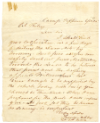
Civil War-Date Autograph Letter Signed
Early in the American Civil War, Ashby’s 7th Virginia Cavalry functioned primarily on scout and outpost duty along the Potomac. In the spring of 1862, Colonel Ashby served with distinction in the Shenandoah Valley campaign as head of Stonewall Jackson’s cavalry. Only two weeks after his promotion to brigadier general, Ashby was killed-in-action.
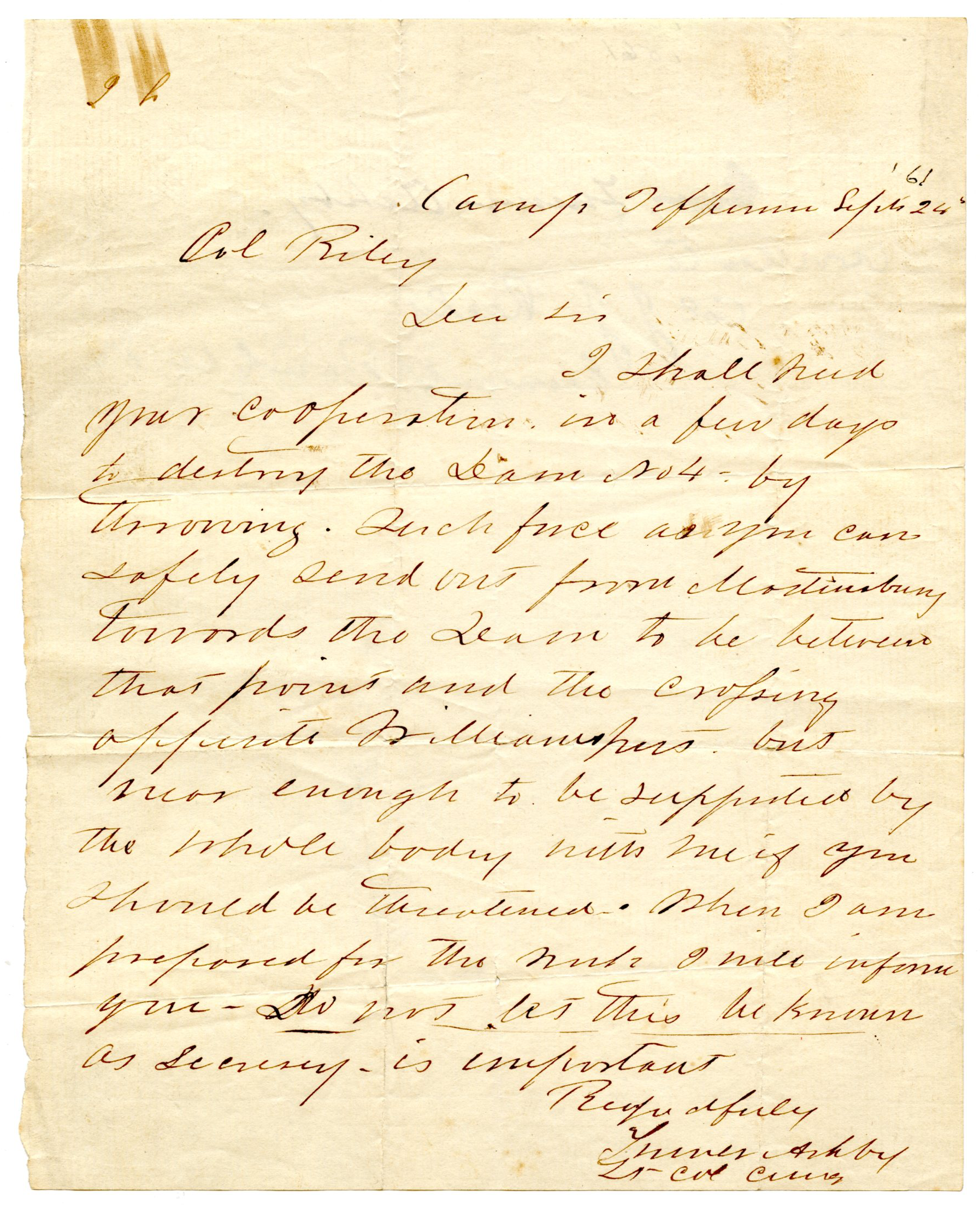
Autograph Letter Signed, 5 ¾” x 7”, an important, confidential early-war strategic communication, directing the destruction of a dam on the Potomac, between Martinsburg, Virginia and Williamsport, Maryland.
“Camp Jefferson, Sept[ember] 24, [18]61. Col[onel] Riley. Dear Sir, I shall need your cooperation in a few days to destroy the Dam No. 4 – by throwing such force as you can safely send out from Martinsburg towards the Dam to be between that point and the crossing opposite Williamsport, but near enough to be supported by the whole body with me if you should be threatened. When I am prepared for the work I will inform you – Do not let this be known as secrecy is important. Respectfully, Turner Ashby, L[ieutenan]t Col[onel] Com[mandin]g.”
Extremely rare, as no other such examples have been offered for sale in the recent past.
Lightly and evenly toned, with a few stains, and there are inconsequential pinholes and minor breaks at the intersections of several folds.
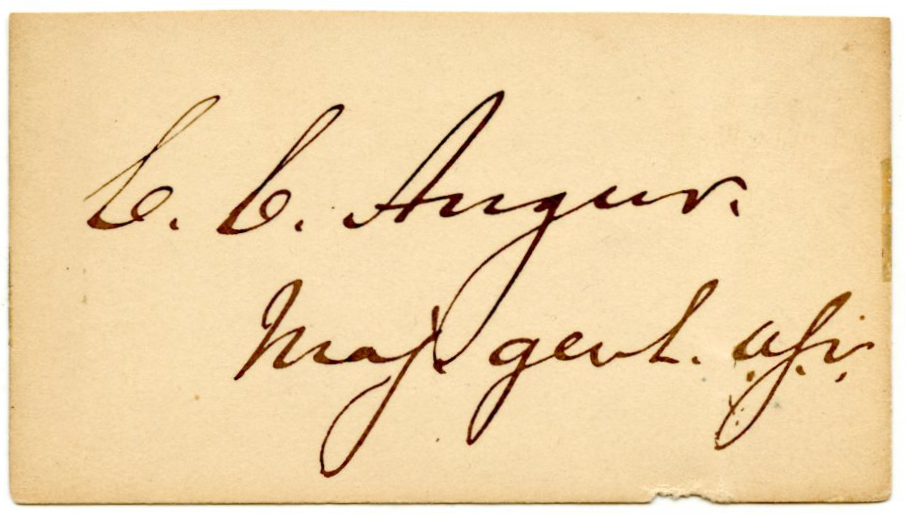
AUGUR, CHRISTOPHER COLUMBUS (1821-98) Union Major General; Veteran of the Mexican War
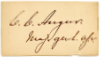
Signed Card, 1 ½” x 3”, “C.C. Augur, Maj[or] Gen[era]l U[nited] S[tates] V[olunteers].”
Evenly toned, with minor chipping at the lower edge.
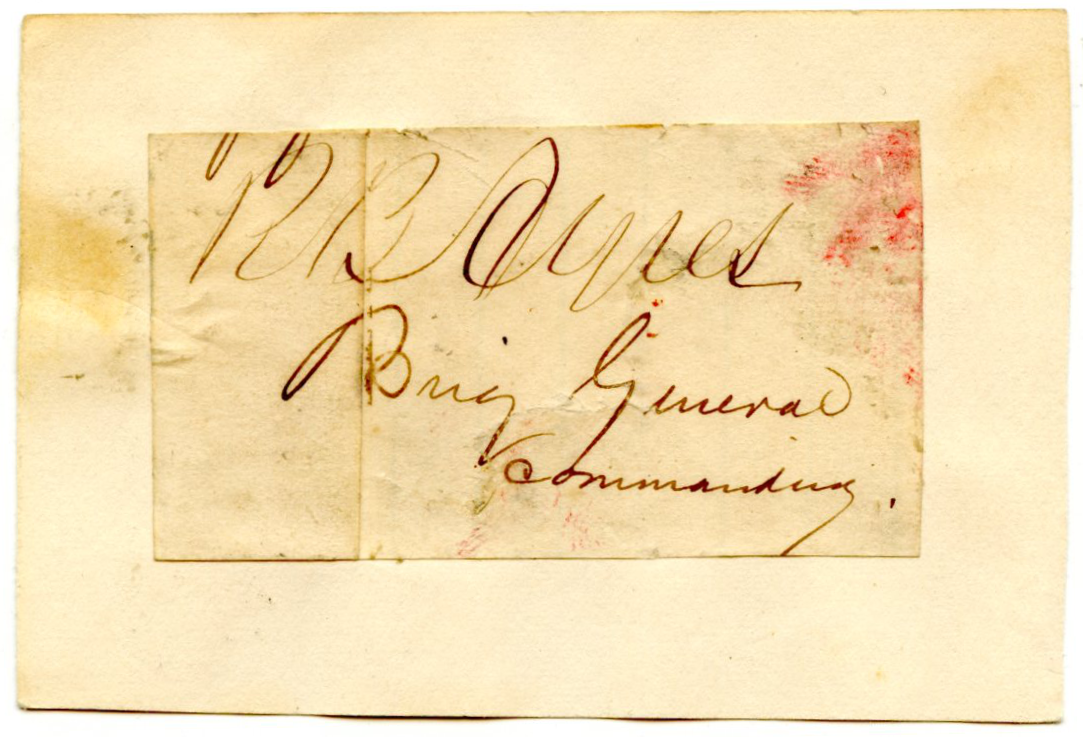
 AYRES, ROMEYN BECK (1825-88) Union Brigadier General; Veteran of the Mexican War
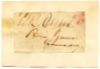
Signature, with rank in another hand, possibly war-date, “R.B. Ayres, Brig[adier] General Commanding,” on a 1 ½” x 2 ½” portion of a larger document; affixed to larger backing.
Moderate staining throughout, with a vertical crease at left center.
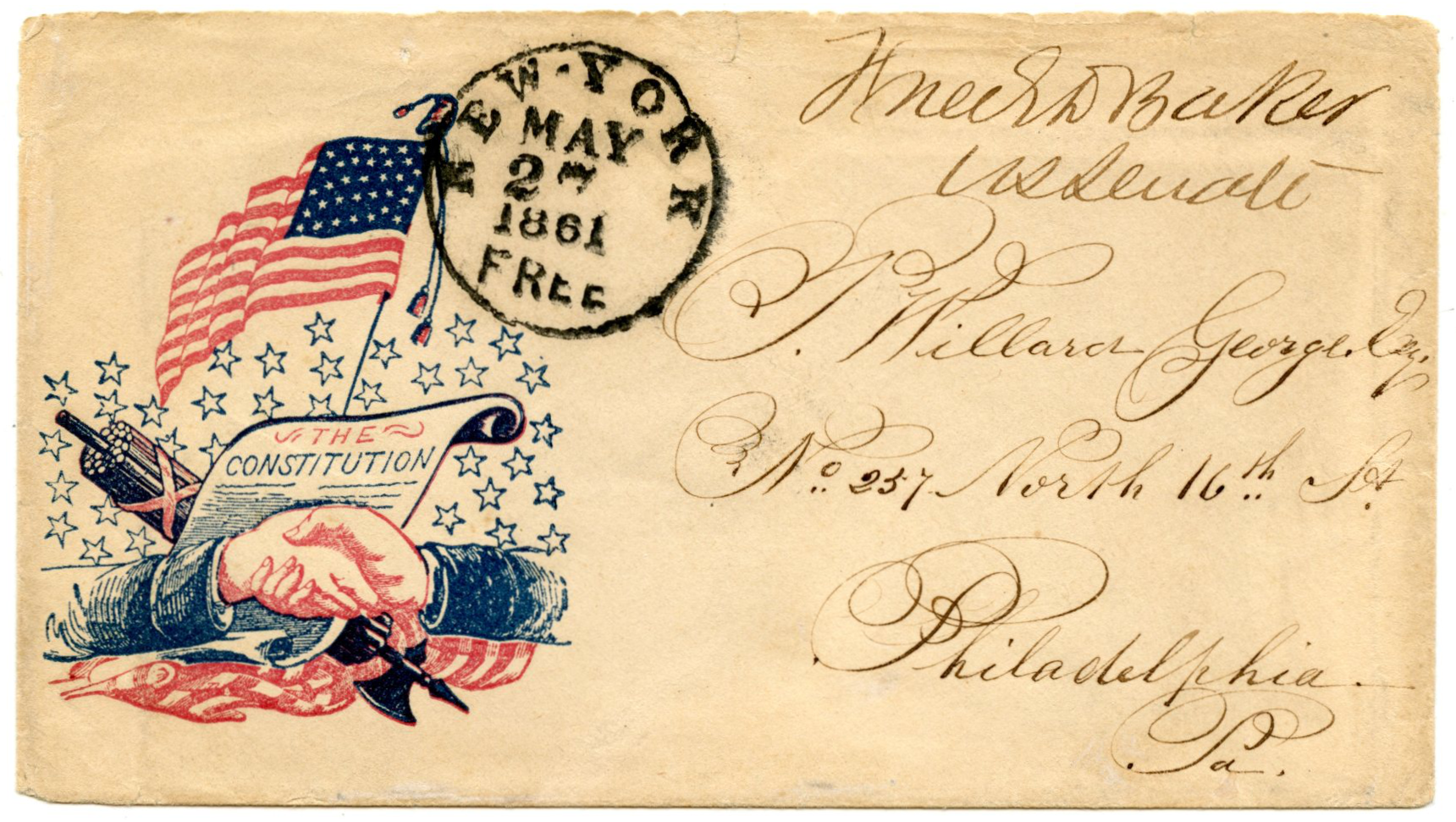
BAKER, EDWARD DICKINSON (1811-61) Union Major General; Killed-in-Action at the Battle of Ball’s Bluff - October 21, 1861; Union Colonel – 71st Pennsylvania Infantry
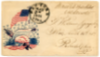
Early War-Date Franked Patriotic Envelope
Franked Patriotic Envelope 3” x 5 ½”, “Free, E.D. Baker, U.S. Senate,” with a May 27, 1861, New York postmark. Addressed in another hand to “P. Willard George, Esq[uire], No. 257 North 16th St[reet], Philadelphia, P[ennsylvani]a.”
Expected toning, soiling, and wear, with several chips and small tears at the edges.
Veteran of the Mexican War; U.S. Congressman – Illinois – 1845-47 & 1849-51; U.S. Senator – Oregon – 1860-61; Close friend of Abraham Lincoln
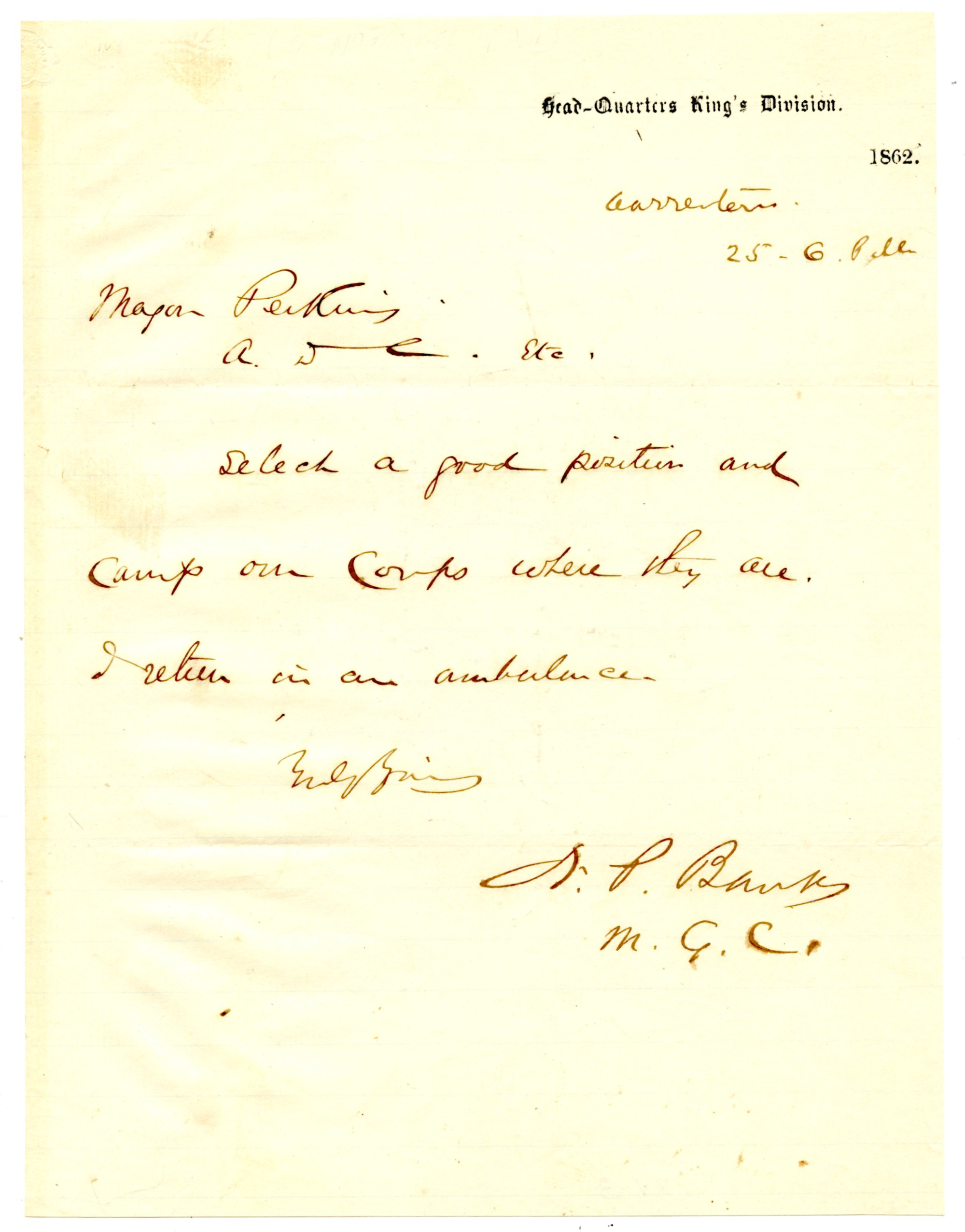
BANKS, NATHANIEL PRENTISS (1816-94) Union Major General – Massachusetts; Speaker of the U.S. House of Representatives – 1855-57; Governor of Massachusetts – 1858-61
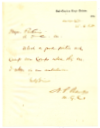
Civil War-Date Autograph Letter Signed
Autograph Letter Signed, 7” x 9”, on “Head-Quarters King’s Division” imprinted stationery, directing the encampment of his corps, shortly after the conclusion of the Shenandoah Valley campaign.
“Warrenton [Virginia], 25 – 6 [June, 1862]. P.M. Major Perkins, A[ide] D[e] C[amp], Etc. Select a good position and camp our Corps where they are. I return in an ambulance. Truly Yours, N.P. Banks, M[ajor] G[eneral] C[ommanding].”
Lightly and evenly toned, with a few light stains; minor bleeding of ink on several letters; two horizontal folds.
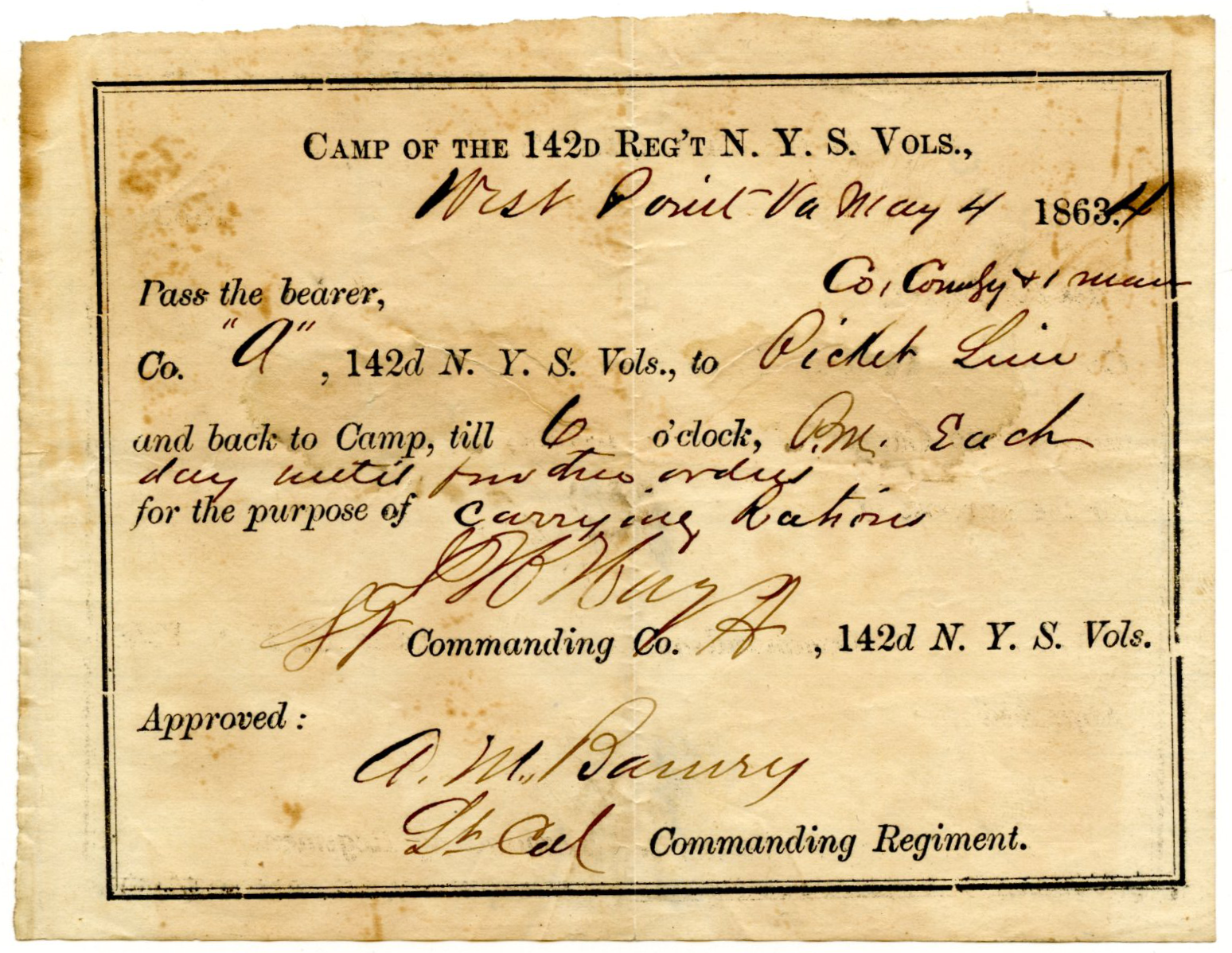
BARNEY, ALBERT MILTON (1837-86) Union Brevet Brigadier General; Colonel of the 142nd New York Infantry
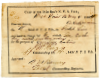
Civil War-Date Document Signed – an imprinted 142nd New York Infantry Pass
Document Signed, 3 ¾” x 5”, West Point, Virginia, May 4, 1864, “A.M. Barney, L[ieutenan]t Col[onel] Commanding Regiment,” a desirable, partly printed pass; dated one day before the fighting began at the Battle of the Wilderness and countersigned by 142nd New York Lieutenant Joseph Hastings Hays, who was wounded at Drewry’s Bluff, Virginia the following month.
Lightly toned, with the expected folds; general wear and staining throughout.
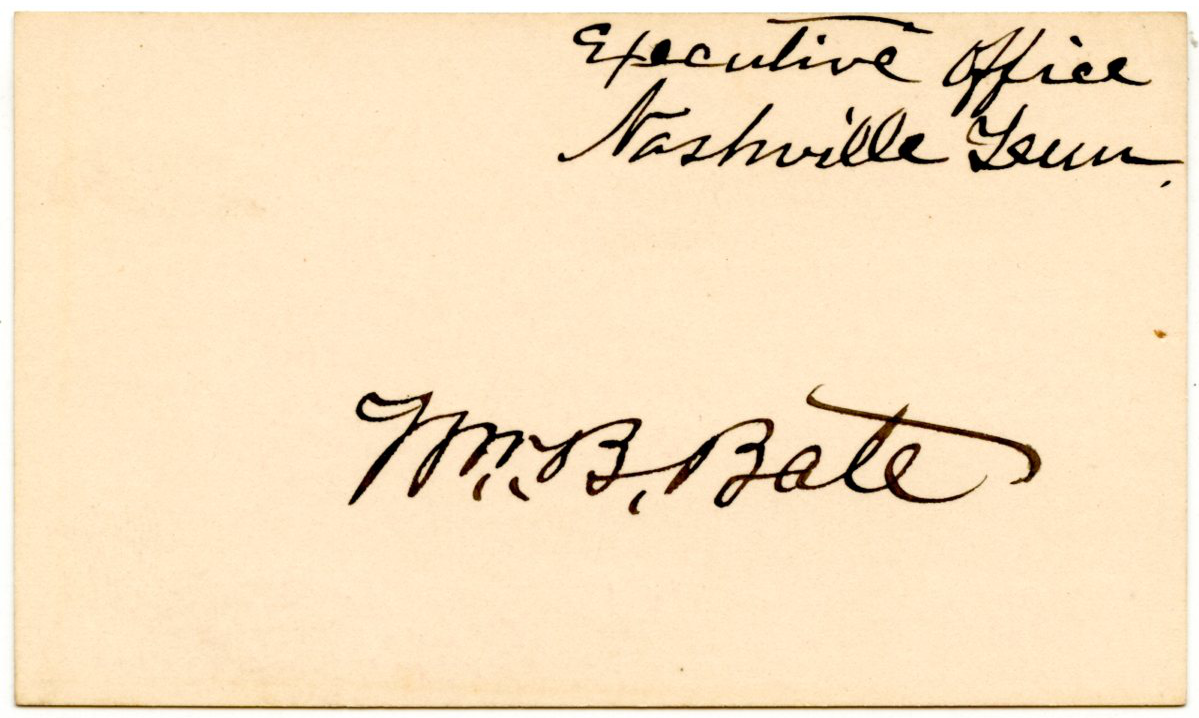
BATE, WILLIAM BRIMAGE (1826-1905) Confederate Major General; Colonel of the 2nd Tennessee Infantry; Veteran of the Mexican War; Governor of Tennessee – 1883-87; U.S. Senator – Tennessee – 1887-1905

Signed Card, 2 ¼” x 4”, as Tennessee Governor, “Executive Office, Nashville, Tenn[essee], Wm. B. Bate.”
Excellent.
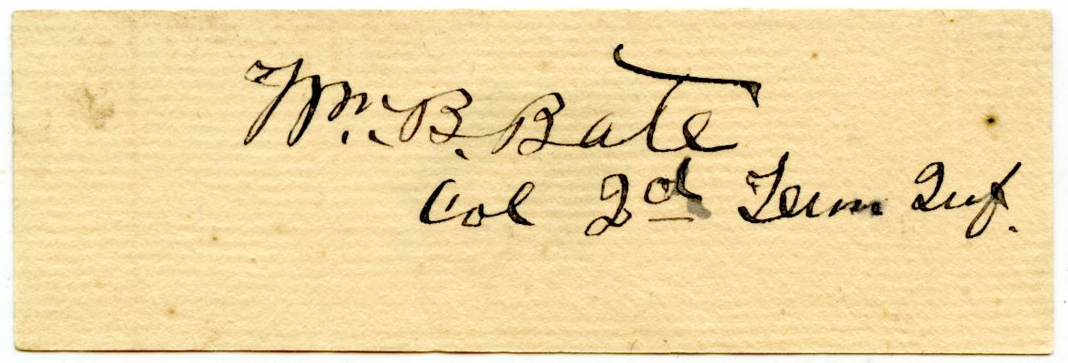
BATE, WILLIAM BRIMAGE (1826-1905) Confederate Major General; Colonel of the 2nd Tennessee Infantry; Veteran of the Mexican War; Governor of Tennessee – 1883-87; U.S. Senator – Tennessee – 1887-1905
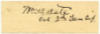
Signature, probably war date, with the rank Bates held from enlistment until October 3, 1862, “Wm. B. Bate, Col[onel] 2nd Tenn[essee] Inf[antry],” on a 1 ¼” x 3 ½” slip of paper.
Lightly and evenly toned, with old mounting remnants on the reverse.
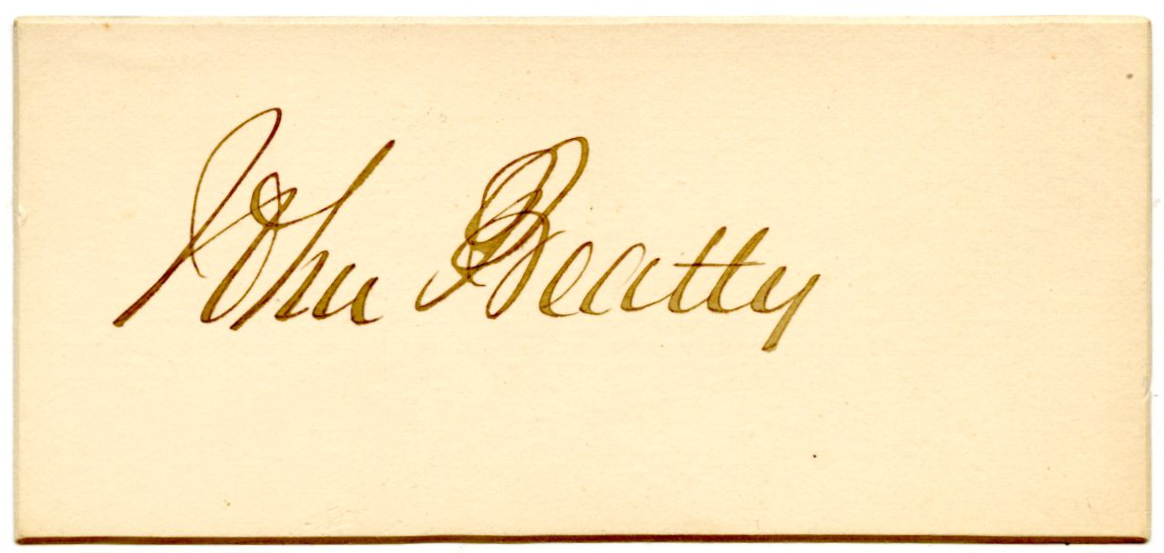
BEATTY, JOHN (1828-1914) Union Brigadier General; Colonel of the 3rd Ohio Infantry; U.S. Representative – Ohio – 1868-73
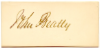
Signed Card, 1 ¾” x 3 ¾”, bevel-edged, “John Beatty.”
Excellent.
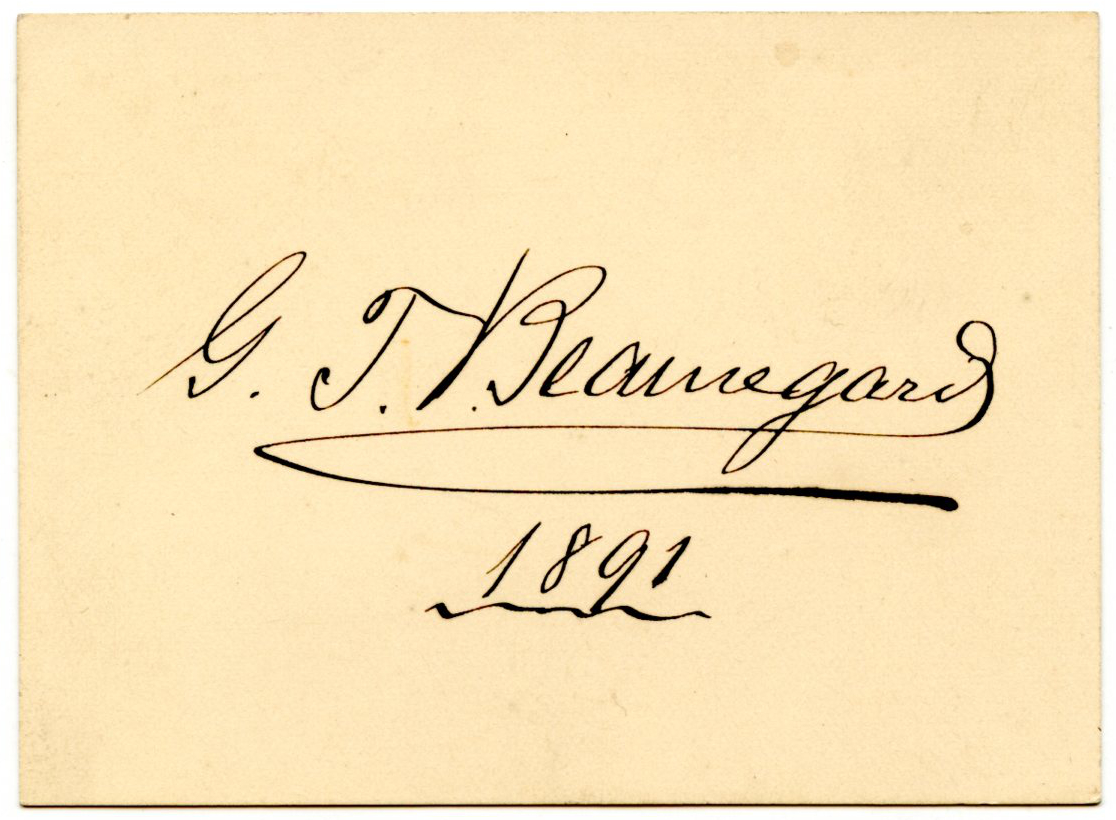
BEAUREGARD, PIERRE GUSTAVE TOUTANT (1818-93) Confederate General; Commanded the Confederates who began the American Civil War with an artillery assault on Fort Sumter, South Carolina; Veteran of the Mexican War
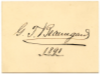
Signed Card, 2 ½” x 3 ½”, “G.T. Beauregard, 1891.”
Exceptional.
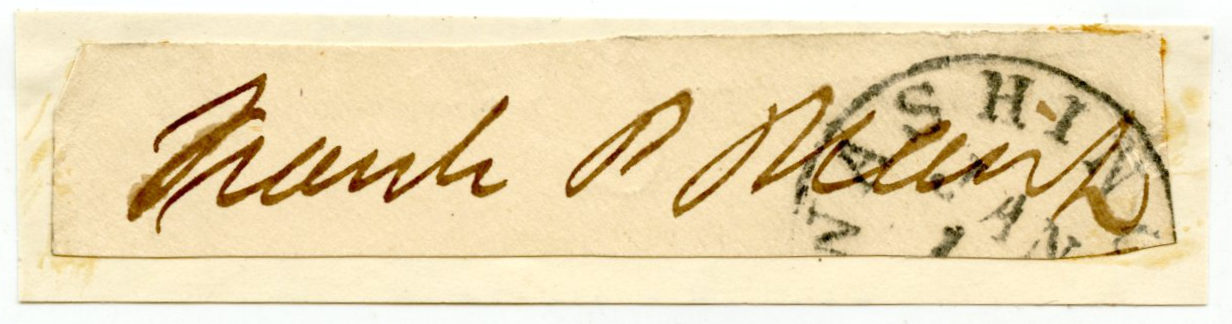
BLAIR, FRANCIS PRESTON, JR. (1821-75) Union Major General; U.S. Congressman – Missouri – 1857-62; U.S. Senator – Missouri – 1871-73; Democratic Candidate for Vice President - 1868
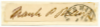
Franking Signature, “Frank P. Blair, Jr.” on a ½” x 3 ¾” portion of an envelope, a Washington, D.C. postmark intersecting the signature. Affixed to slightly larger backing, with minor glue staining at the edges.
BLAIR, FRANCIS PRESTON, JR. (1821-75) Union Major General; U.S. Senator – Missouri – 1871-73; U.S. Representative – Missouri – 1857-64; Democratic Candidate for U.S. Vice President on the Horatio Seymour Ticket - 1868

Civil War-Date Autograph Letter Signed
Autograph Letter Signed, 8” x 10”, as U.S. Representative from Missouri, detailing the specifics of a land purchase.
“Wash[ington]
Mrs. Carroll,
D[ea]r Madam,
Mr. Bonifant sold me a small portion of the land he bought of you to straighten the line as he desired at $100 per acre before I consented to buy the part I bought. I do not know how much but Mrs. [?] does – these few acres being paid for by Bonifant at $100 per acre come to me at that price from him as by agreement, but is to be included in your deed to me. The three hundred dollars withheld, is to cover the difference in price between the few acres bought of Bonifant & the main body I bought of you. The $300 will cover that am[oun]t as well as the Supposed deficit in am[oun]t of land surveyed & off[ered] to me.
Y[ours] ob[edientl]y,
F.P. Blair
19 February [18]64].
Lightly and evenly toned, with a few minor stains, the expected folds, and a small area of paper loss in the upper left corner.
BLANDING, JAMES DOUGLAS (1821-1906) Confederate Colonel – 9th South Carolina Infantry; Veteran of the Mexican War; Mayor of Sumter, South Carolina
-100.png)
-100.png)
Civil War-Date Signed Envelope
Signed Envelope, 3” x 5 ¼”, “J.D. Blanding, Col[onel] 9th Reg[imen]t S[outh] C[arolina] V[olunteers],” also addressed by Blanding, to “Wm. F.B. Haynesworth, Esq[ui]r[e]…Sumter, South Carolina.” An indistinct postmark, undoubtedly Tudor Hall, Virginia, and Due “10” markings at upper right; with vertical pencil notations, in an unknown hand, “from Col[onel] 9th Rec[eive]d Oct[ober] 29, 1861” along the left edge.
Somewhat lacking in contrast, with moderate toning throughout and the expected wear, soiling, and edge chips.
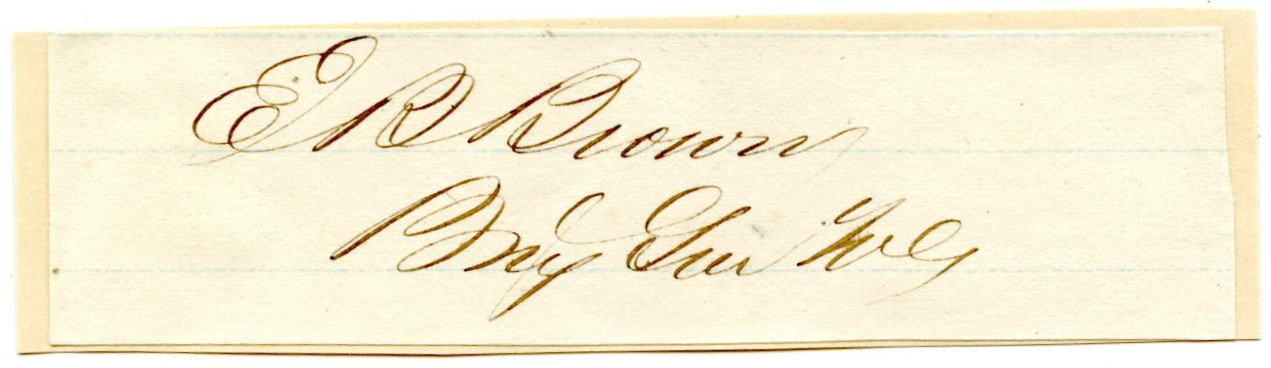
BROWN, EGBERT BENSON (1816-1902) Union Brigadier General; Early-war Lieutenant Colonel of the 7th Missouri Infantry; Saw Civil War action in Missouri, the Indian Territory, and the Trans-Mississippi; Elected Mayor of Toledo, Ohio - 1849
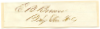
Signature & Rank, probably war date, “E.B. Brown, Brig[adier] Gen[eral] Vol[unteer]s,” on a 1” x 3 ¾” slip of lined paper; affixed to slightly larger backing.
Lightly and evenly toned.
BROWN, JOHN, JR. (1821-95) Eldest child of noted Abolitionist John Brown; Civil War Union Captain – 7th Kansas Infantry, Jennison’s Jayhawkers
-100.png)
-100.png)
Civil War-Date Autograph Letter Signed - from Leavenworth, Kansas
Autograph Letter Signed, 5 ¼” x 8 ¼”. From Leavenworth, Kansas, the vicinity of his father’s actions at the Pottawatomie Massacre and the Battles of Osawatomie and Black Jack in 1856 “Bleeding Kansas,” Brown conveys details of his return home to his wife in Ohio. Accompanied by the transmittal envelope, imprinted “R. Stevenson, Photographic ARTIST, 40 Delaware Street, Leavenworth, Kansas”; addressed by Brown, to “Mrs. Wealthy C. Brown, Jefferson, Ashtabula Co[unty], Ohio, Box 125,” with a three-cent U.S. postage stamp and a June 6, 1862, Leavenworth City, Kansas Territory postmark at the upper right corner.
“Leavenworth City Kansas, Thursday, June 5 1862.
My Loved Wife,
I have this moment got yours of the 28th. All in a hurry this morning as a Boat for St. Louis has just come and is off in a few minutes.
It will take me about five days to Chicago including one Sunday – say two days there then, one perhaps at Cleveland when I will be home as fast as I can. Every thing is waiting and I must say good bye.
Your own, John.”
Lightly and evenly toned, with a few minor stains and smearing of ink to several characters; chipping at the upper right corner and at the edge of the lower of two horizontal folds detracts very little. The envelope has the expected wear at the edge and the right edge has been torn somewhat irregularly in opening.
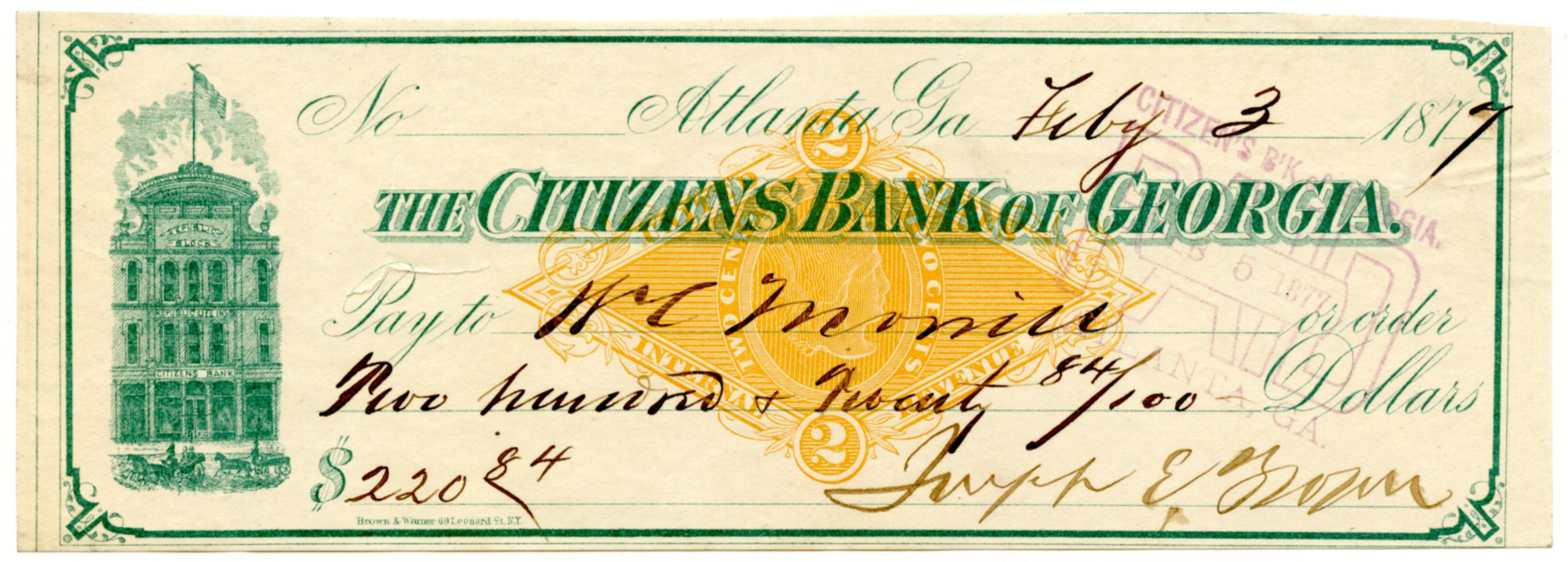
BROWN, JOSEPH EMERSON (1821-94) Governor of Georgia – 1857-65; U.S. Senator – Georgia – 1880-91
A staunch proponent of states’ rights, Governor Brown clashed repeatedly with Confederate President Jefferson Davis and became a major impediment to the prosecution of the American Civil War.
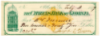
Document Signed, Atlanta, Georgia, February 3, 1879, “Joseph E. Brown,” a partly printed 2 ¾” x 7 ½” check with an imprinted revenue stamp, drawn on The Citizens Bank of Georgia for $220.84.
Excellent. The signature and text are unaffected by a punch cancellation, with no loss of paper, at mid left.
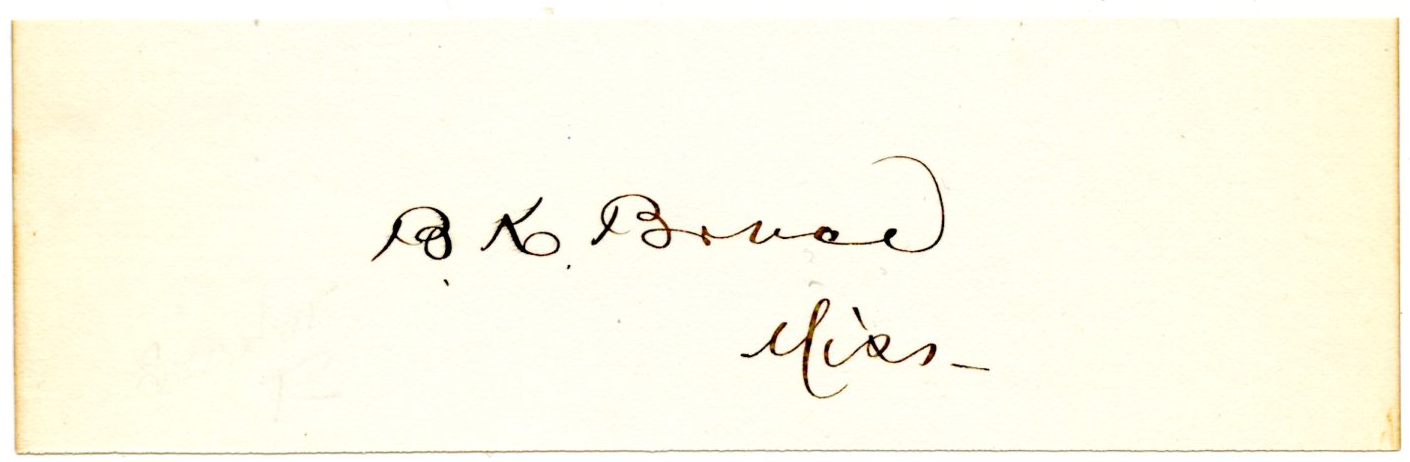
BRUCE, BLANCHE KELSO (1841-98) U.S. Senator – Mississippi – 1875-81; First elected African-American Senator to serve a full term; Register of the U.S. Treasury – 1881-85 & 1897-98
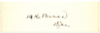
Signature, as U.S. Senator, “B.K. Bruce, Miss[issippi],” on a 1 ½” x 4 ½” portion of an album page.
Excellent.
BUCKNER, SIMON BOLIVAR (1823-1914) Confederate Lieutenant General; Surrendered Fort Donelson, Tennessee to Union General Ulysses S. Grant – February, 1862; Veteran of the Mexican War; Governor of Kentucky – 1887-91
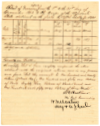
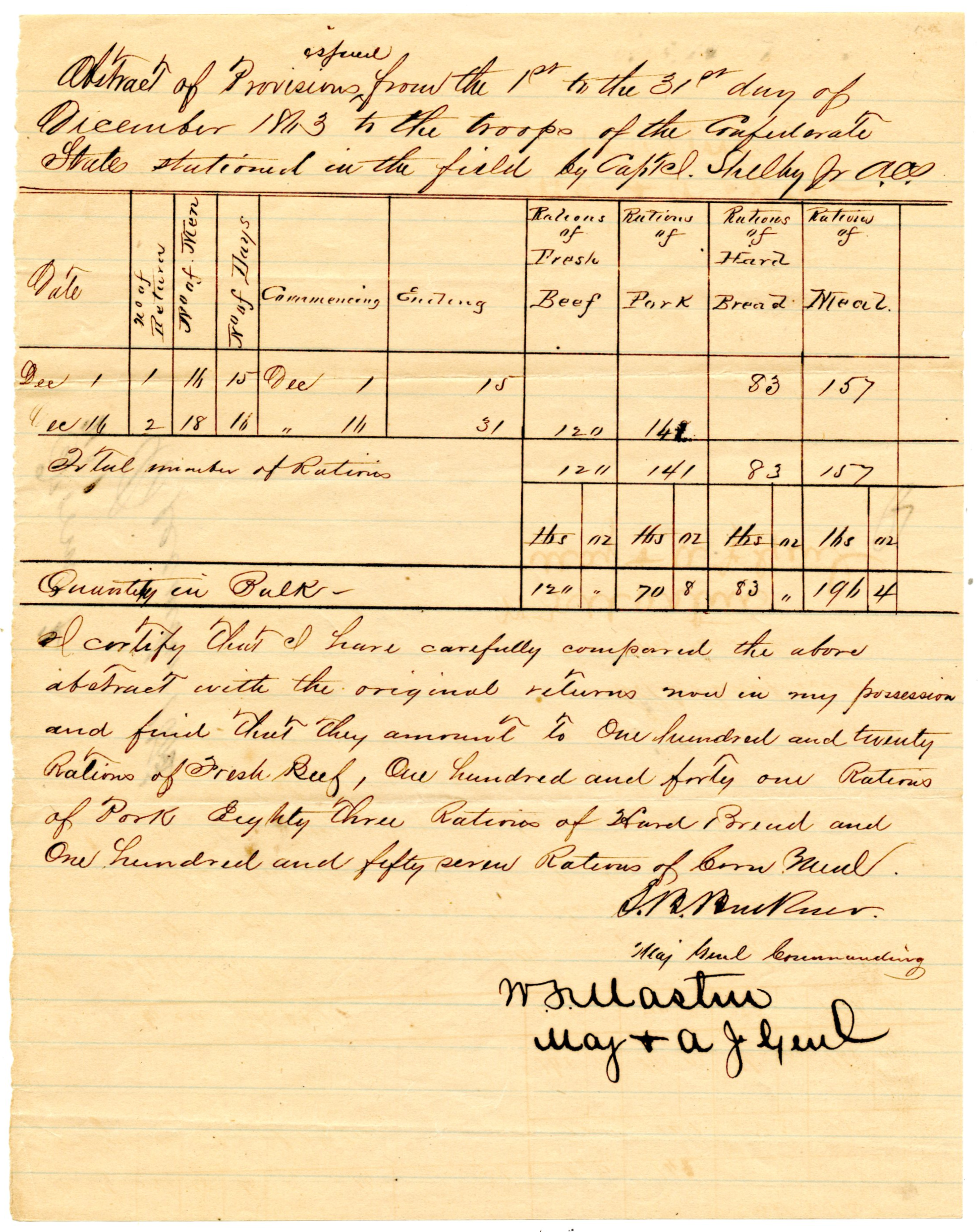
Civil War-Date Document Signed, 7” x 9”, “S.B. Buckner, Maj[or] Gen[era]l Commanding,” a manuscript listing of rations, “Abstract of Provisions issued from the 1st to the 31st day of December 1863 to the troops of the Confederate States stationed in the field by Capt[ain] I. Shelby, Jr…”
Lightly and evenly toned, with two horizontal folds.
-1852.png)
-1847.png)

-1606.png)
-1612.png)
-1696.png)
-1682.png)