Civil War
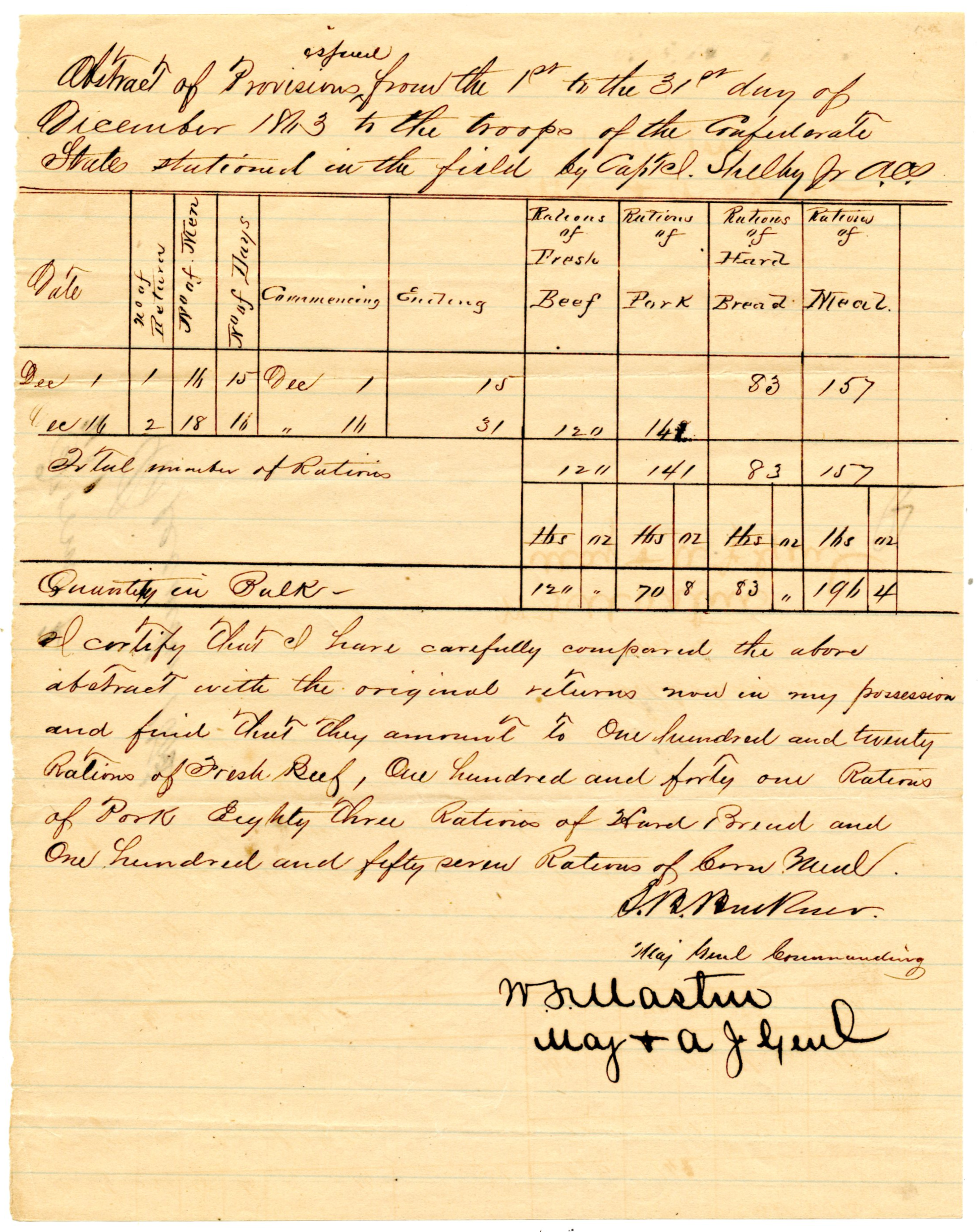
BUCKNER, SIMON BOLIVAR (1823-1914) Confederate Lieutenant General; Surrendered Fort Donelson, Tennessee to Union General Ulysses S. Grant – February, 1862; Veteran of the Mexican War; Governor of Kentucky – 1887-91
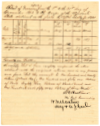
Civil War-Date Document Signed, 7” x 9”, “S.B. Buckner, Maj[or] Gen[era]l Commanding,” a manuscript listing of rations, “Abstract of Provisions issued from the 1st to the 31st day of December 1863 to the troops of the Confederate States stationed in the field by Capt[ain] I. Shelby, Jr…”
Lightly and evenly toned, with two horizontal folds.
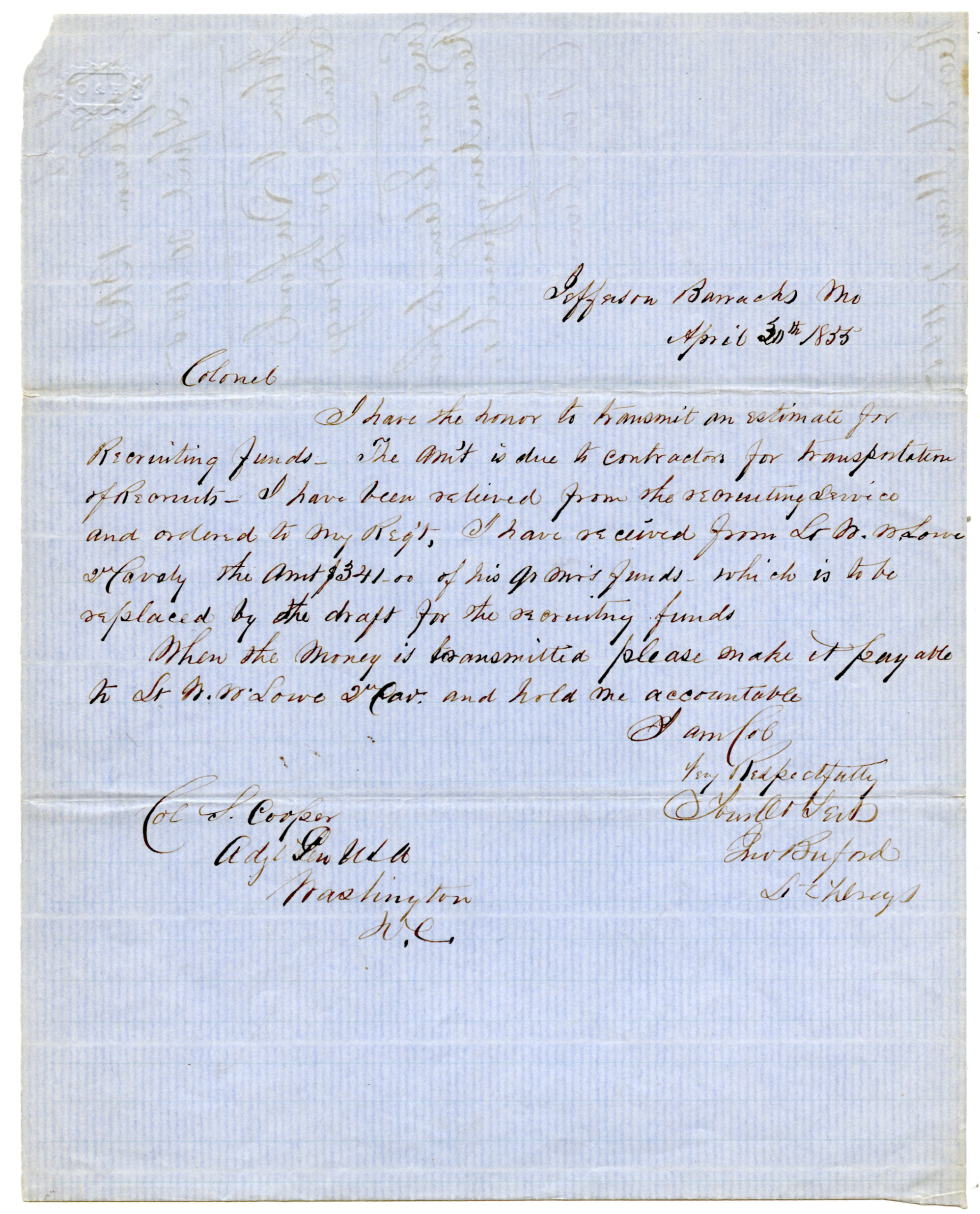
 BUFORD, JOHN (1826-63) Union Major General – most remembered for heroic action opposing a Confederate division on the first day at the Battle of Gettysburg; Died of exhaustion and typhoid fever later in the year, December 16, 1863
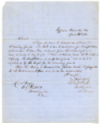
From the military post at Saint Louis, Missouri
Autograph Letter Signed, 8” x 10”. Addressing “Col[onel] S. Cooper, Adj[utan]t Gen[eral] U.S.A., Washington, D.C.”, later the highest-ranking general in the service of the Confederacy, Buford conveys details relating to the disposition of funds in the recruiting department. Mentioned by Buford in the handling of the funds is future Union Brevet Brigadier General William Warren Lowe, further brevetted for gallantry at Chickamauga, Georgia and Huntsville, Alabama during the Civil War.
Jefferson Barracks, M[iss]o[uri]
April 30, 1855
Colonel,
I have the honor to transmit an estimate for Recruiting funds. The am[oun]t is due to contractors for transportation of Recruits. I have been relieved from the recruiting service and ordered to my Reg[imen]t. I have received from L[ieutenan]t W.W. Lowe 2nd Cavalry the am[oun]t $341.00 of his Q[uarte]r M[aste]rs funds, which is to be replaced by the draft for the recruiting funds.
When the money is transmitted please make it payable to L[ieutenan]t W.W. Lowe 2nd Cav[alry] and hold me accountable.
I am Col[onel]
Very Respectfully
Your O[bedien]t Ser[van]t
Jno. Buford
L[ieutenan]t Drag[oon]s
Overall condition is very good, with two horizontal folds and minor paper loss at the upper left corner.
BURNHAM, HIRAM (1811-72) Union Brigadier General; Colonel of the 6th Maine Volunteer Infantry; Killed-in-Action at the Battle of Chaffin’s Farm – September 29, 1864
-100.png)
-100.png)
Civil War-Date Document Signed by a Killed-in-Action Union General
Document Signed, 7 ¾” x 12”, “Approved, Hiram Burnham, Col[onel] 6th Maine Vol[unteer]s,” a manuscript “Abstract of articles expended in the public service at Camp near Bell[e] Plains, V[irgini]a…in the month ending on the 31st December 1862.” Countersigned three times, front and reverse, by Lieutenant Addison P. Buck.
Lightly and evenly toned, with a few superficial stains and three horizontal folds.
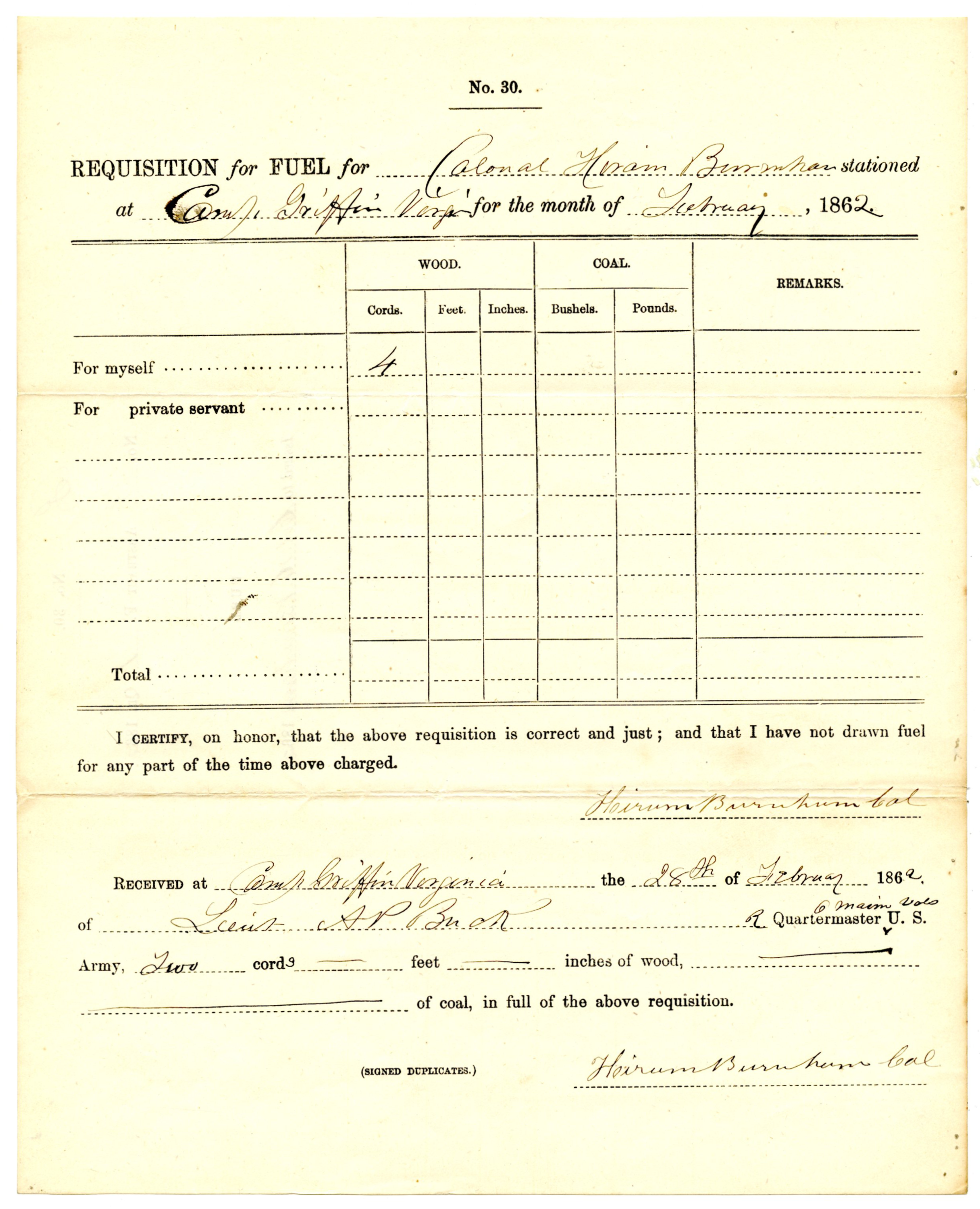
BURNHAM, HIRAM (1811-72) Union Brigadier General; Colonel of the 6th Maine Volunteer Infantry; Killed-in-Action at the Battle of Chaffin’s Farm – September 29, 1864
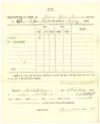
Civil War-Date Document Signed Twice by a Killed-in-Action Colonel, later promoted to the rank of Brigadier General
Document Signed, 8” x 10”, Camp Griffin, Virginia, February 28, 1862, “Hiram Burnham, Col[onel],” a partly printed requisition for personal wood fuel the month. Signed twice, at the mid and lower right.
Lightly and evenly toned, with a few superficial stains and two horizontal folds.
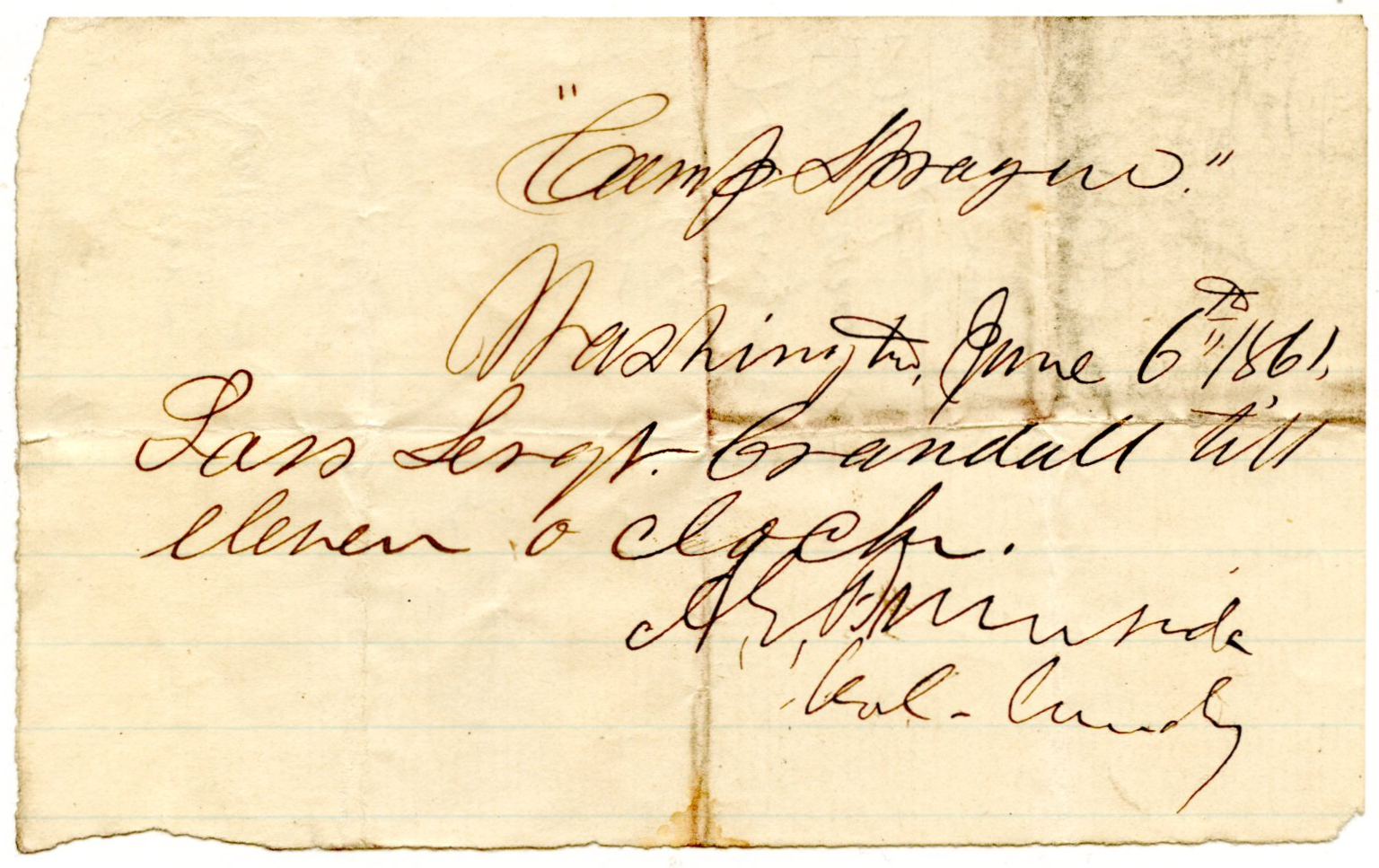
BURNSIDE, AMBROSE EVERETT (1824-81) Union Major General; Commanded the Union Army of the Potomac at the Battle of Fredericksburg; Governor of Rhode Island – 1866-69; U.S. Senator – Rhode Island – 1875-81
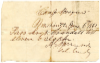
Early Civil War-Date Pass
Autograph Document Signed, 3” x 5”, a rare handwritten pass from Burnside’s early-war encampment near Washington, D.C., named for Rhode Island Governor William Sprague.
“Camp Sprague. Washington, June 6th 1861. Pass Serg[ean]t Crandall till eleven o’clock. A.E. Burnside, Col[onel] Com[man]d[in]g.”
Pencil notations in an unknown hand on the reverse list several identified enlisted men of the 1st Rhode Island Volunteer Infantry. The 1st Rhode Island Infantry under the command of Colonel Burnside was actively engaged at the Battle of First Bull Run, July 21, 1861 and returned to Providence, Rhode Island, where the unit was mustered out on August 2, 1861. Colonel Burnside re-entered Union service soon afterward and was promoted to the rank of brigadier general, effective August 6, 1861.
Lightly toned, with somewhat heavier soiling and wear at vertical and horizontal fold lines; a few small tears and minor chips at the edges.
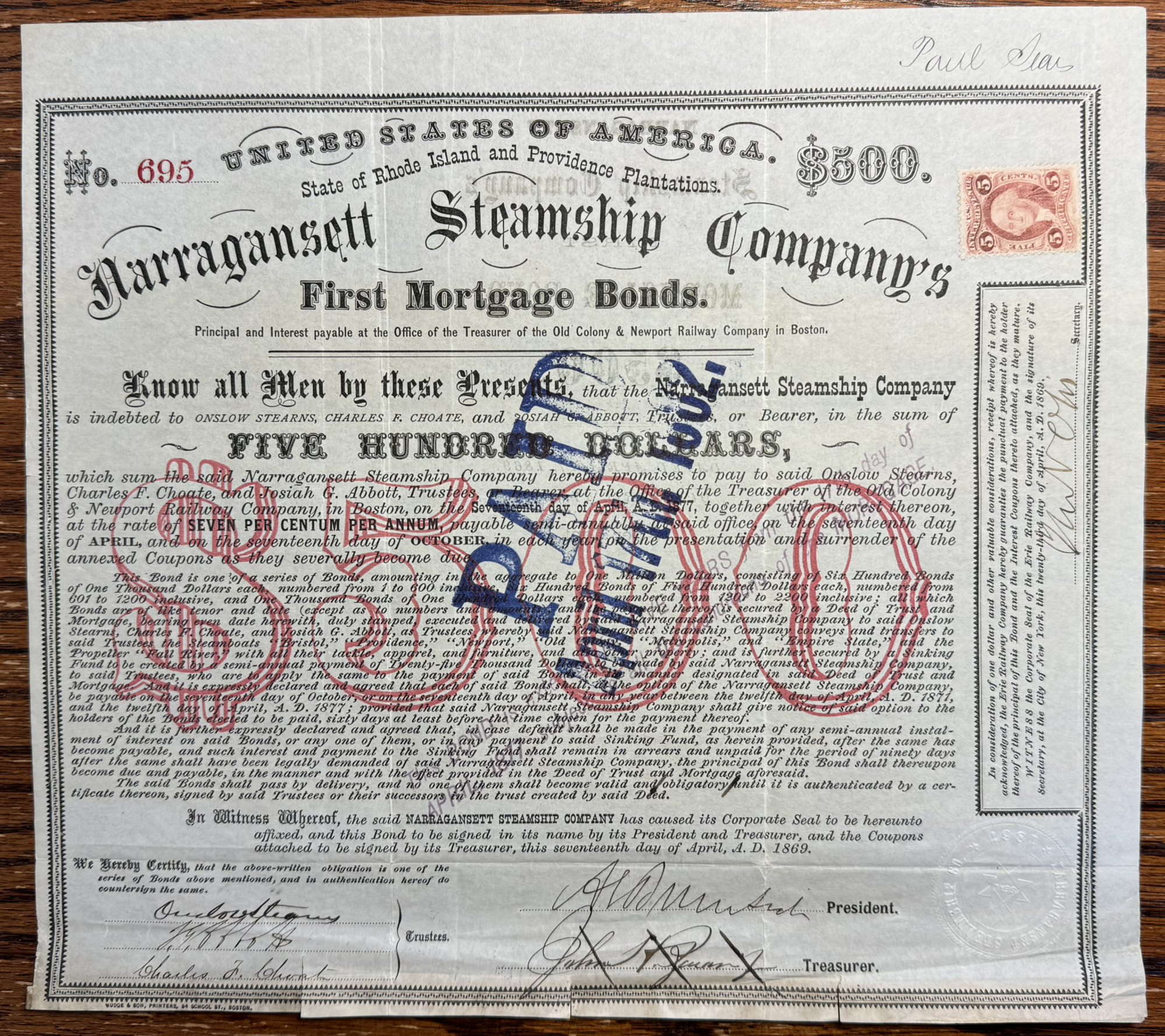
BURNSIDE, AMBROSE EVERETT (1824-81) Union Major General; Commanded the Union Army of the Potomac at the Battle of Fredericksburg; Governor of Rhode Island – 1866-69; U.S. Senator – Rhode Island – 1875-81
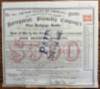
Document Signed, 9 ½” x 11”, Boston, Massachusetts, April 17, 1869, “A.E. Burnside,” as company president, a partly printed $500 “First Mortgage Bonds” certificate for the Narrangansett Steamship Company. Countersigned by four company officials. A five-cent revenue stamp is affixed at upper right, with an embossed seal at lower right.
Lightly toned, with the usual folds; a few tears and cuts at the lower edge; show-through along the lower edge from glue staining on the reverse.
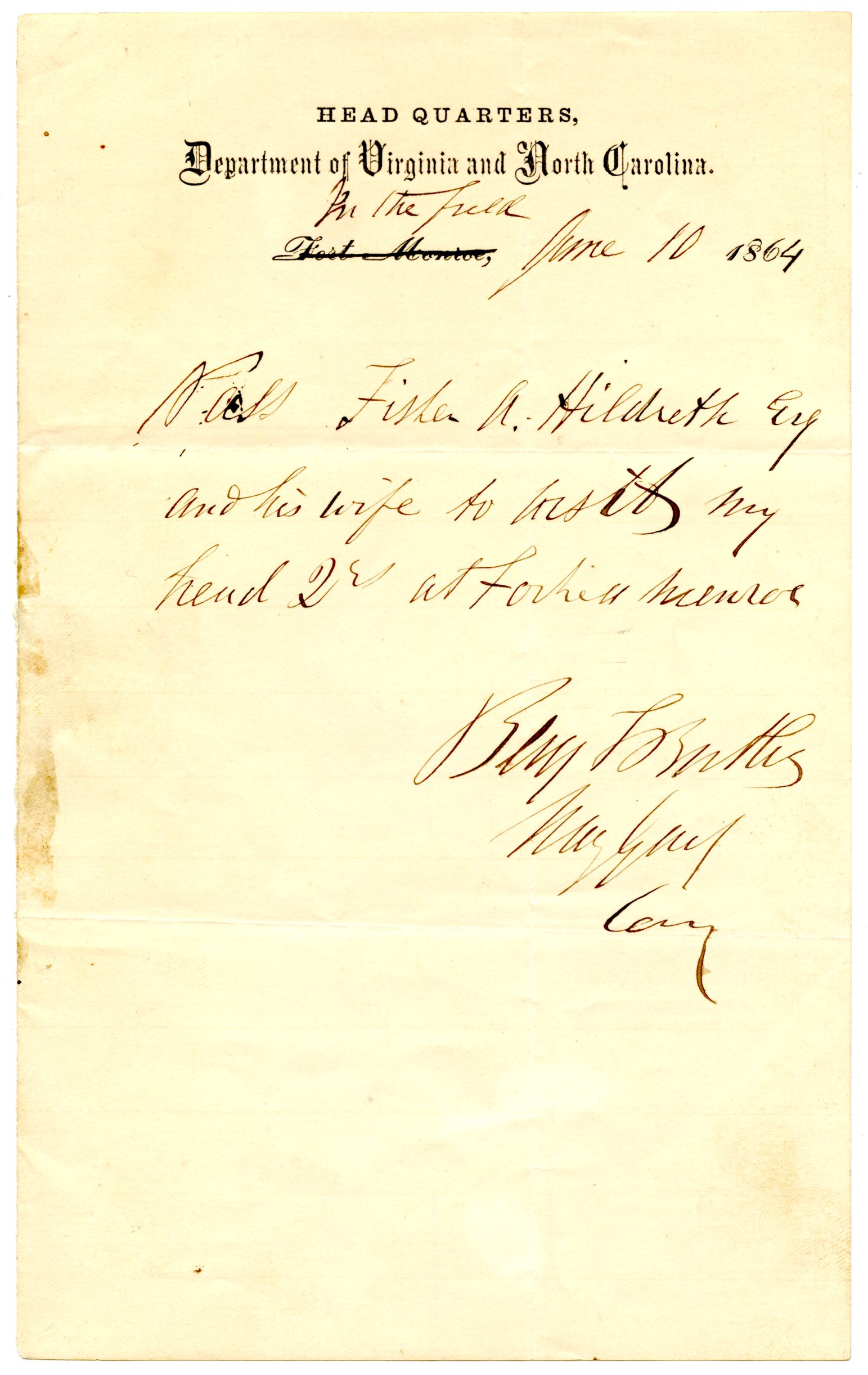
BUTLER, BENJAMIN FRANKLIN (1818-93) Union Major General; U.S. Congressman – Massachusetts – 1867-75 & 1877-79; U.S. Presidential Candidate – Greenback Party - 1884
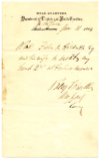
A Handwritten Civil War Pass for Butler’s Brother-in-Law
Civil War-Date Autograph Document Signed, on official 5” x 8” stationery, imprinted “HEAD QUARTERS, Department of Virginia and North Carolina.”
“In the field, June 10, 1864. Pass Fisher A[mes] Hildreth, Esq[uire] and his wife to visit my Head Q[uarte]rs at Fortress Monroe. Benj[amin] F. Butler, Maj[or] Gen[era]l Com[mandin]g.”
Lightly and evenly toned, with minor staining at the left edge and the expected folds.
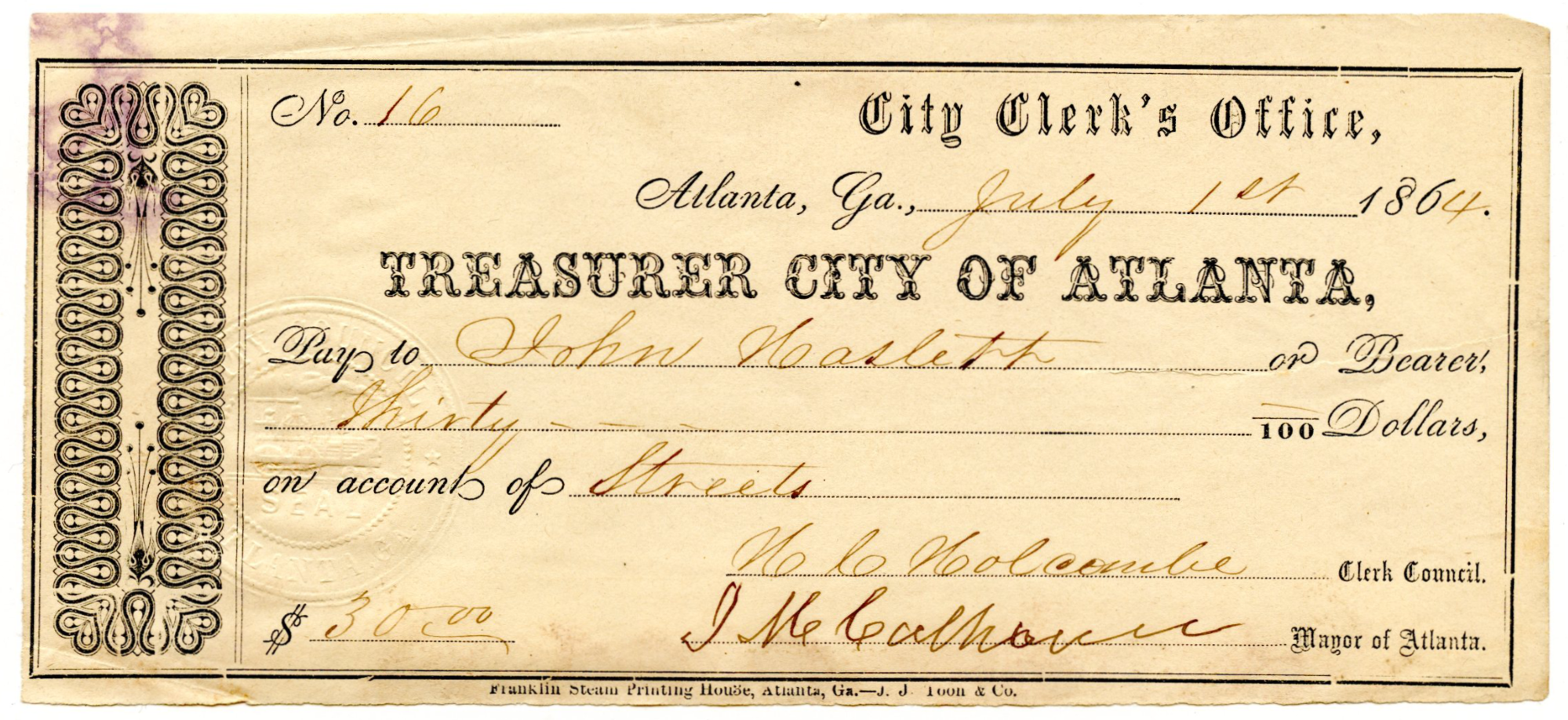
CALHOUN, JAMES MONTGOMERY (1811-75) Mayor of Atlanta, Georgia – 1862-65; Recipient of the famous “War is Cruelty” letter from Union General William Tecumseh Sherman upon the surrender of the city, September 1864
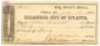
Check signed by the Confederate Mayor of Atlanta, Georgia, just two months before the fall of the city…
Civil War-Date Document Signed, 3 ¼” x 7 ½”, “City Clerk’s Office, Atlanta, Georgia, July 1, 1864…J.M. Calhoun,” a partly printed check drawn on the city account, payable to one “John Haslett” in the amount of thirty dollars, compensation for expenses described only as “Streets”; dated just two months before the city was surrendered to Union General William Tecumseh Sherman on September 2, 1864 and countersigned by another city official.
Lightly and evenly toned, with a few light creases and minor staining, wear, and soiling; text and signatures are unaffected by a two-inch horizontal tear, with no loss of paper, at the mid-right edge.
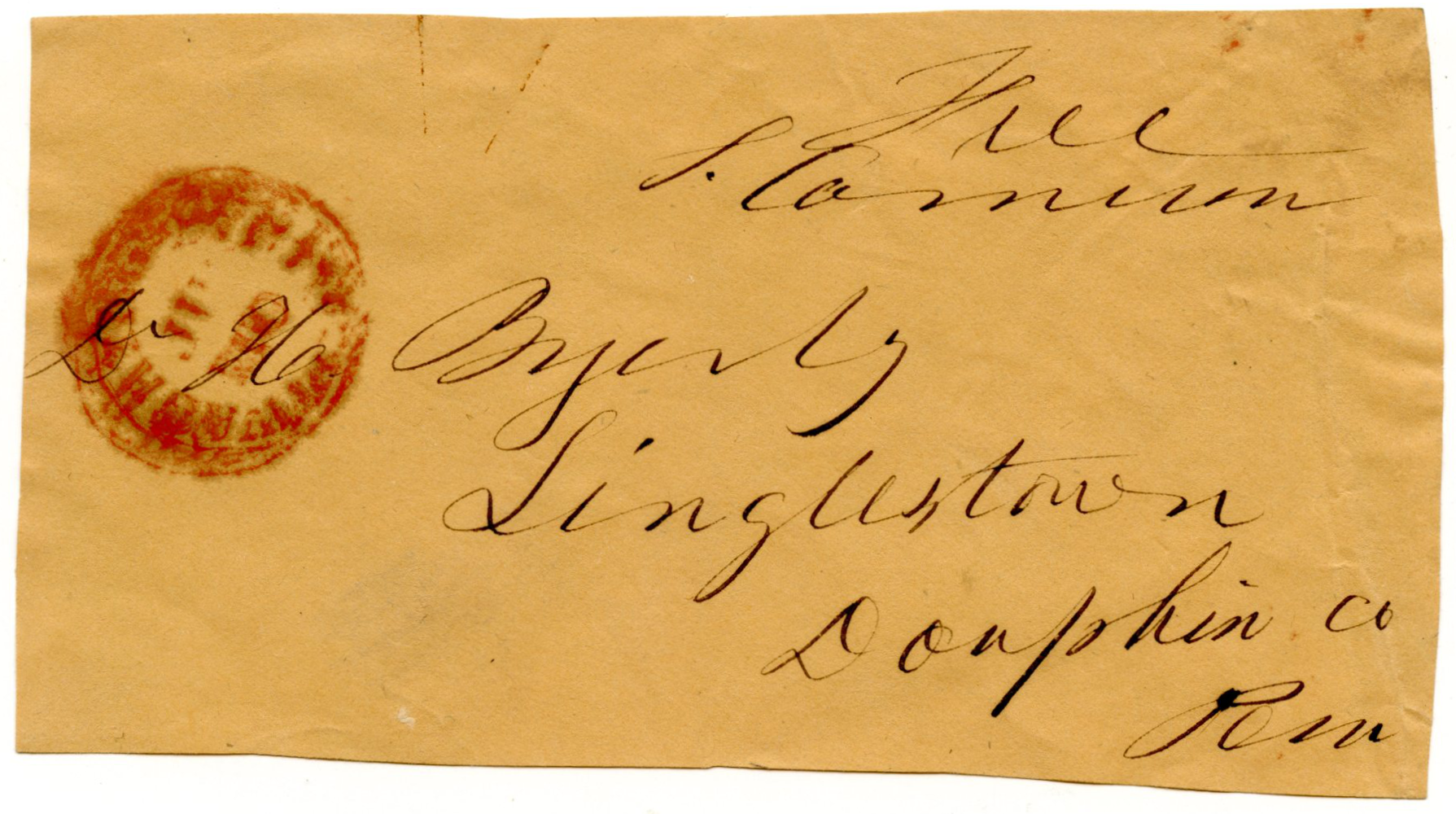
CAMERON, SIMON (1799-1889) U.S. Secretary of War – 1861-62, during the American Civil War; U.S. Senator – Pennsylvania – 1845-49, 1857-61, and 1867-77
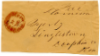
Franking Signature, “Free, S. Cameron,” on a 3 ¼” x 5 ¾” portion of a postal cover; also addressed by Cameron, to “Dr. H. Byerly, Linglestown, Dauphin Co[unty], Penn[sylvania].”
On brown paper, with an obscure early postmark at left; old mounting remnants on the reverse.
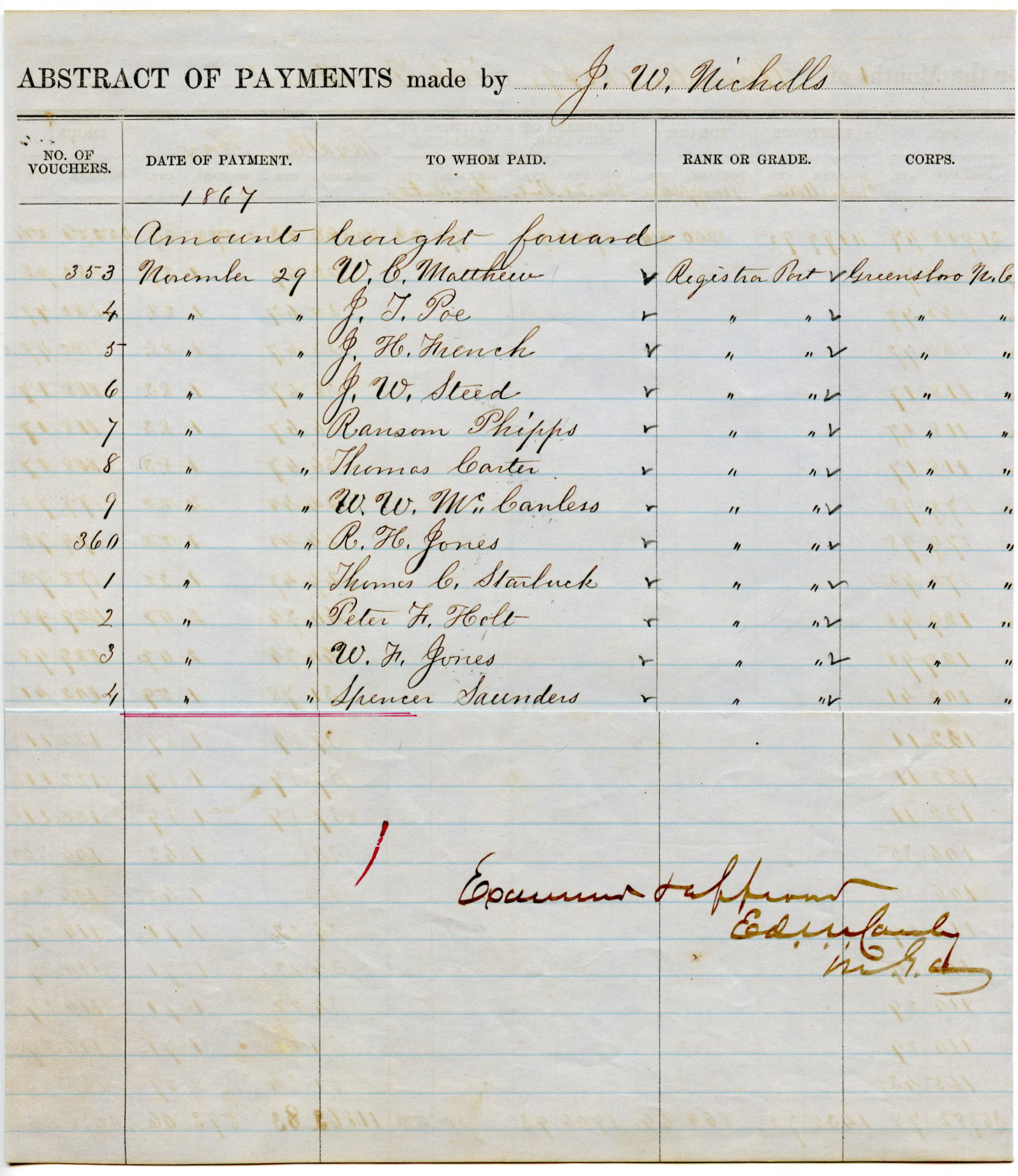
CANBY, EDWARD R.S. (1817-73) Union Major General; Veteran of the Mexican & Second Seminole Wars; Killed by Modoc Indians in California - 1873
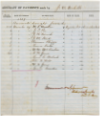
Document Signed, an endorsement on the reverse of an imprinted 9 ¾” x 16 ¼” U.S. Army form, “Examined & approved, Ed. R.S. Canby, M[ajor] G[eneral] Com[mandin]g,” approving expenditures for the month of November 1867.
Illustrated in its folded state. Very good overall condition, with the expected folds.
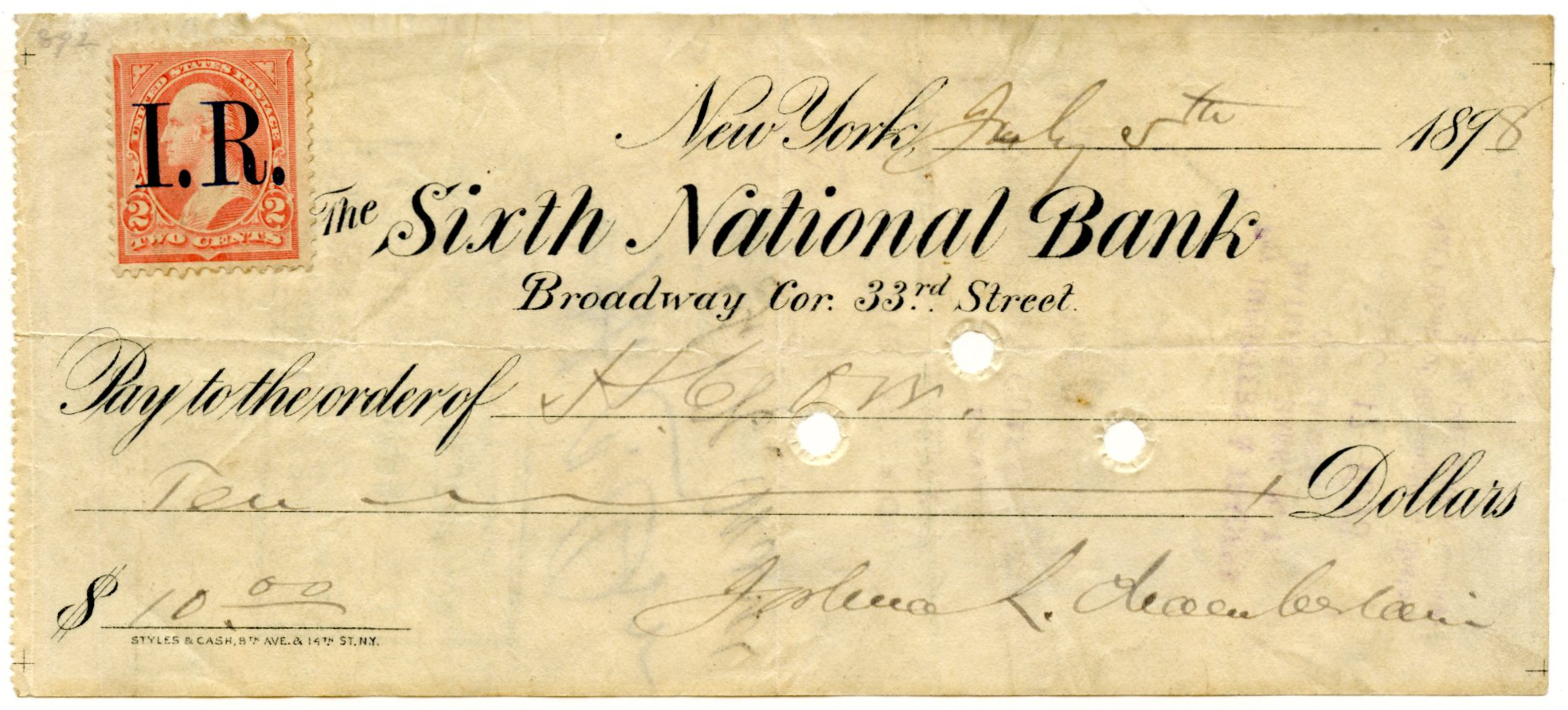
CHAMBERLAIN, JOSHUA LAWRENCE (1828-1914) Union Brigadier General; Colonel of the 20th Maine Infantry; Awarded the Congressional Medal of Honor for heroism at the Battle of Gettysburg; Governor of Maine – 1867-71; President of Bowdoin College – 1871-83
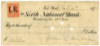
Document Signed, New York, July 5, 1898, “Joshua L. Chamberlain,” a partly printed 2 ¾” x 6 ½” check, also accomplished by Chamberlain, payable to one H.C. Orr in the amount of ten dollars. A two-cent revenue stamp is affixed at upper left.
Lightly toned, with a few stains, soiling, wear, numerous folds, and a few tiny edge chips; three hole-punch cancellations, well away from the signature.
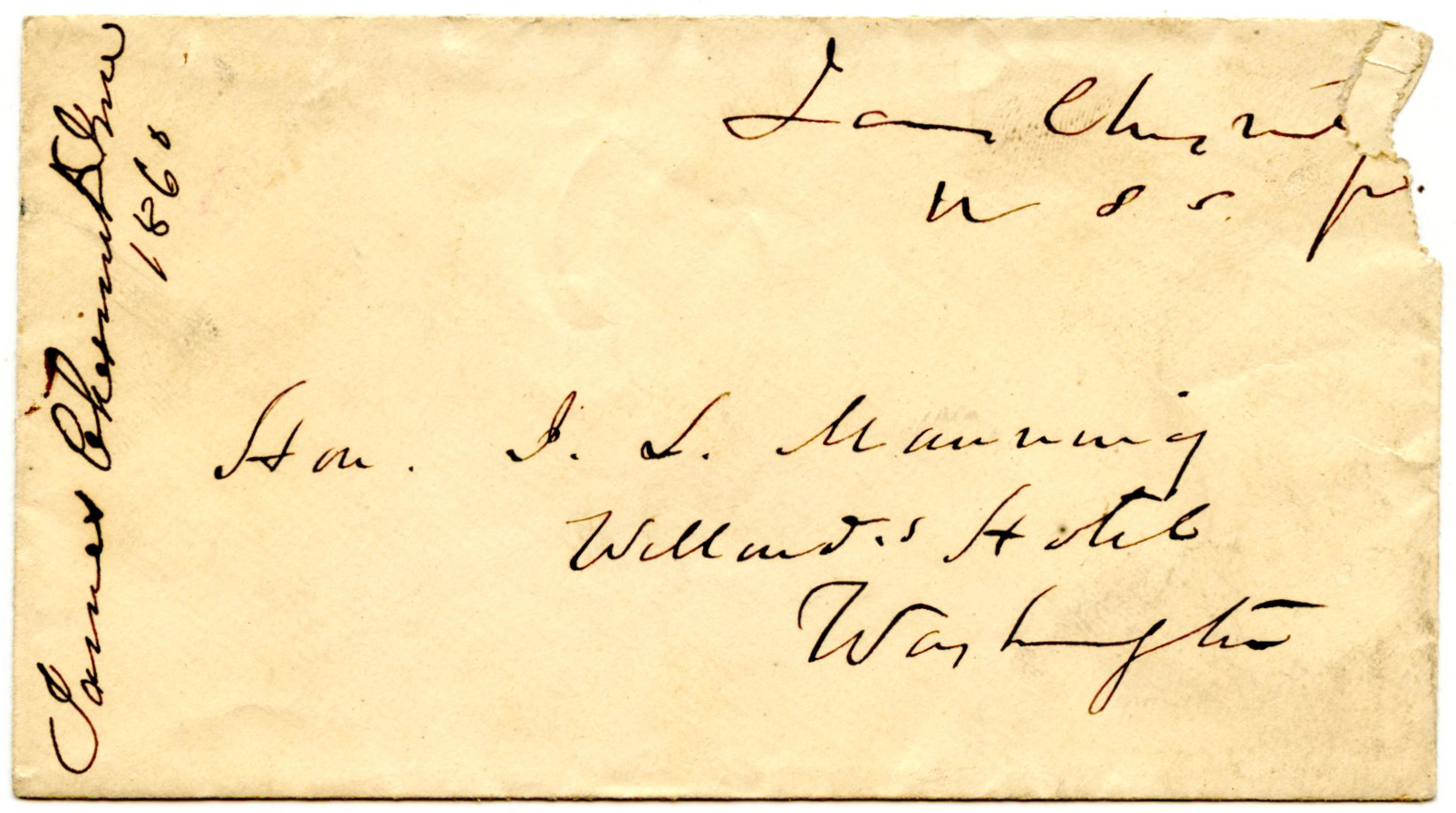
CHESNUT, JAMES, JR. (1815-85) Confederate Brigadier General; Served as aide to Confederate General P.G.T. Beauregard & President Jefferson Davis; U.S. Senator – South Carolina – 1858-60; Husband of Confederate diarist Mary Boykin Chesnut
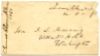
Franked Envelope, 2 ¾” x 5 ¼”, “James Chesnut, U.S.S. fr…,” as U.S. Senator from South Carolina, also addressed by Chesnut to “Hon[orable] J.L. Manning, Willard’s Hotel, Washington.” Dated 1860 vertically at the left edge, quite possibly by the recipient, John Laurence Manning, former South Carolina governor, 1852-54, who later served as a colonel in the Confederate Army.
Torn irregularly in opening at the upper right corner, affecting the last few characters of Chesnut’s frank.
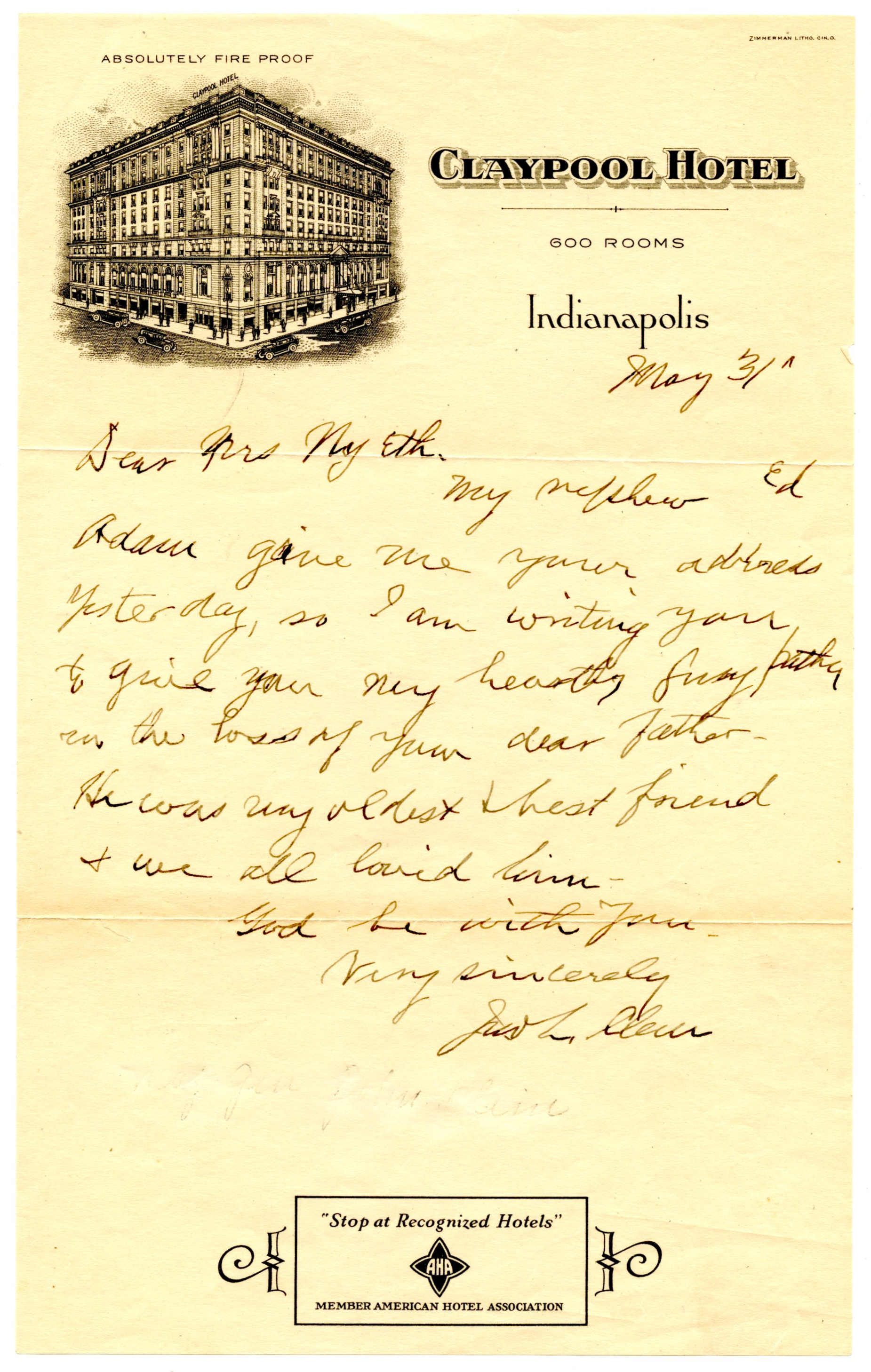
CLEM, JOHN LINCOLN “JOHNNY” (1851-1937) Union Drummer Boy - 22nd Ohio Infantry, in the American Civil War; Known as the “Drummer Boy of Chickamauga”; Retired with the rank of Brigadier General in 1915
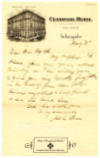
Autograph Letter Signed, on 6” x 9” Indianapolis, Indiana hotel stationery; no year, but from later life, sending condolences to an old friend.
“May 31.
Dear Mrs. Nyeth,
My nephew Ed Adam gave me your address yesterday, so I am writing you to give you my heartly [sic] Sympathy in the loss of your dear father. He was my oldest & best friend & we all loved him.
God be with you,
Jno. L. Clem.
__________________________________
Lightly and evenly toned, with two horizontal folds and a few tiny tears at the edges.
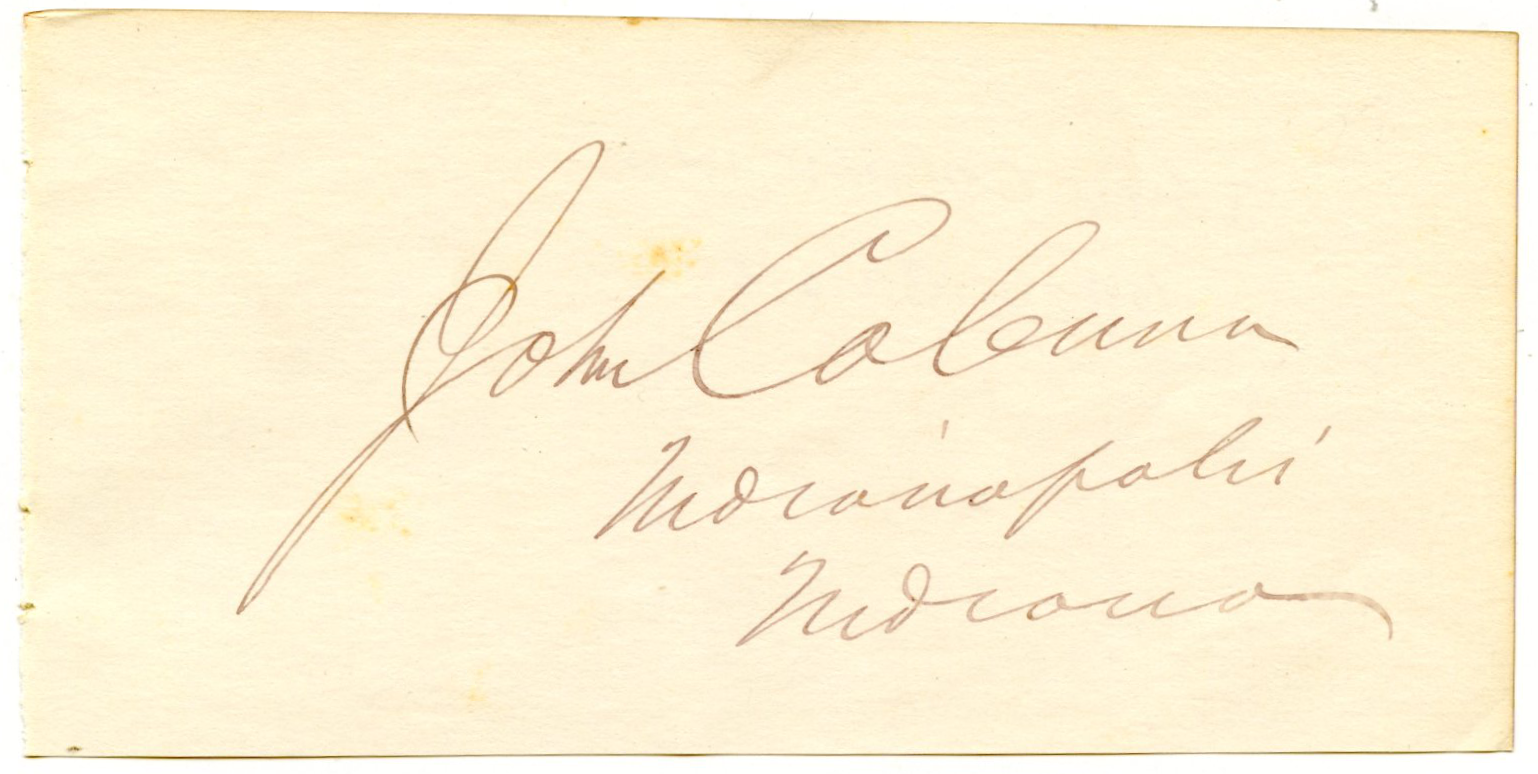
COBURN, JOHN (1825-1908) Union Brevet Brigadier General; Colonel of the 33rd Indiana Infantry; U.S. Representative – Indiana – 1869-75; Associate Justice of the Montana Territorial Supreme Court – 1884-85
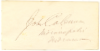
Signature, “John Coburn, Indianapolis, Indiana,” as U.S. Congressman on a 2 ½” x 5” portion of an album page.
Lightly and evenly toned, with a few minor stains; original binding traces at the left edge.
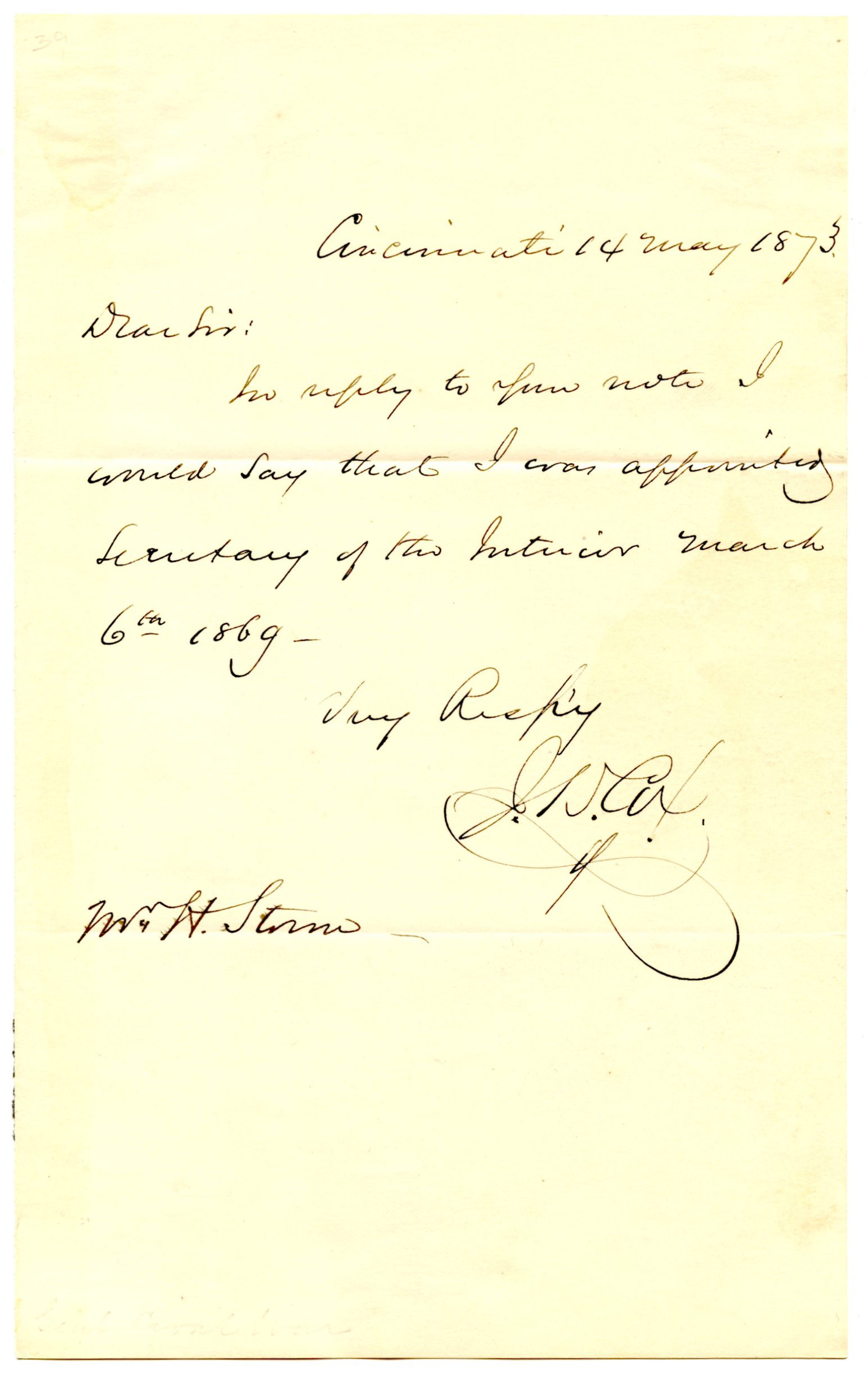
COX, JACOB DOLSON (1828-1900) Union Major General; U.S. Interior Secretary – 1869-70; Governor of Ohio – 1866-68; U.S. Representative – Ohio – 1877-79
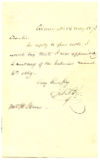
Autograph Letter Signed, 5” x 8”, confirming the date of his appointment as Interior Secretary in the administration of President Ulysses S. Grant.
“Cincinnati [Ohio], 14 May 1873. Dear Sir: In reply to your note I would say that I was appointed Secretary of the Interior March 6th 1869. Very Resp[ectfull]y, J.D. Cox.”
Lightly and evenly toned, with two horizontal folds; old hinge and mounting remnants on reverse of the integral leaf.
CUDWORTH, WARREN HANDEL (1825-83) Union Chaplain - 1st Massachusetts Infantry; Unitarian Pastor; Authored “History of the First Regiment (Massachusetts Infantry),” published in 1866
-100.png)
-100.png)
Signed Envelope, 3” x 5 ¼”, “Soldier’s Letter, W.H. Cudworth, Chaplain, Mass[achusetts] 1st,” transmittal for a Civil War letter (no longer present) from an unidentified soldier; addressed in another hand, to “Mr. Joseph L. Rand, North Waterford, Maine,” and bearing a “Due 3” postal stamp. Pencil arithmetic notations are on the reverse.
Moderate toning throughout, with the expected wear, soiling, and edge chips and tears.
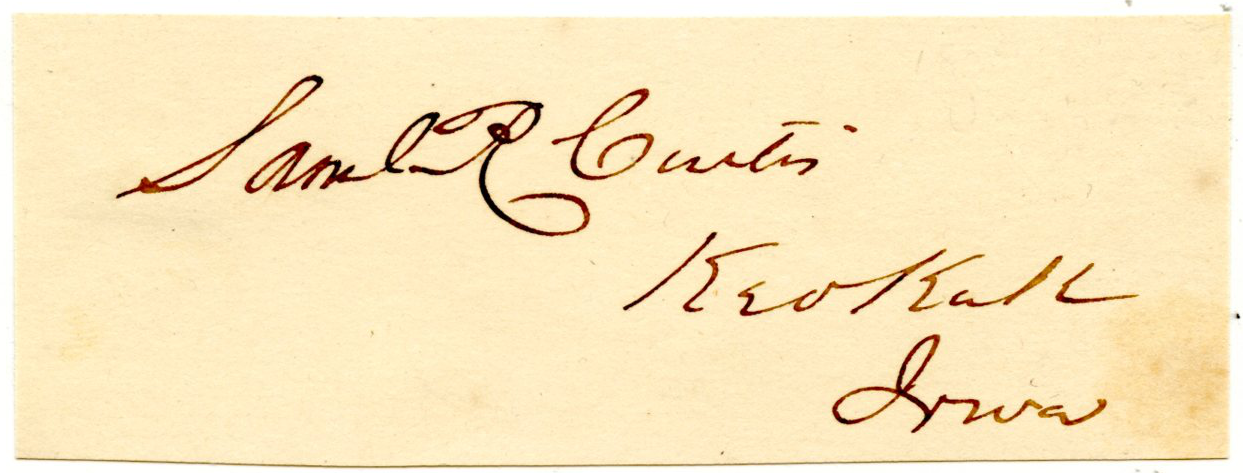
CURTIS, SAMUEL RYAN (1805-66) Union Major General; U.S. Representative – Iowa – 1857-61; Veteran of the Mexican War
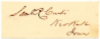
Signature, as U.S. Representative, “Saml. R. Curtis, Keokuk, Iowa,” on a 1 ½” x 4” portion of an album page.
Lightly and evenly toned, with minor staining.
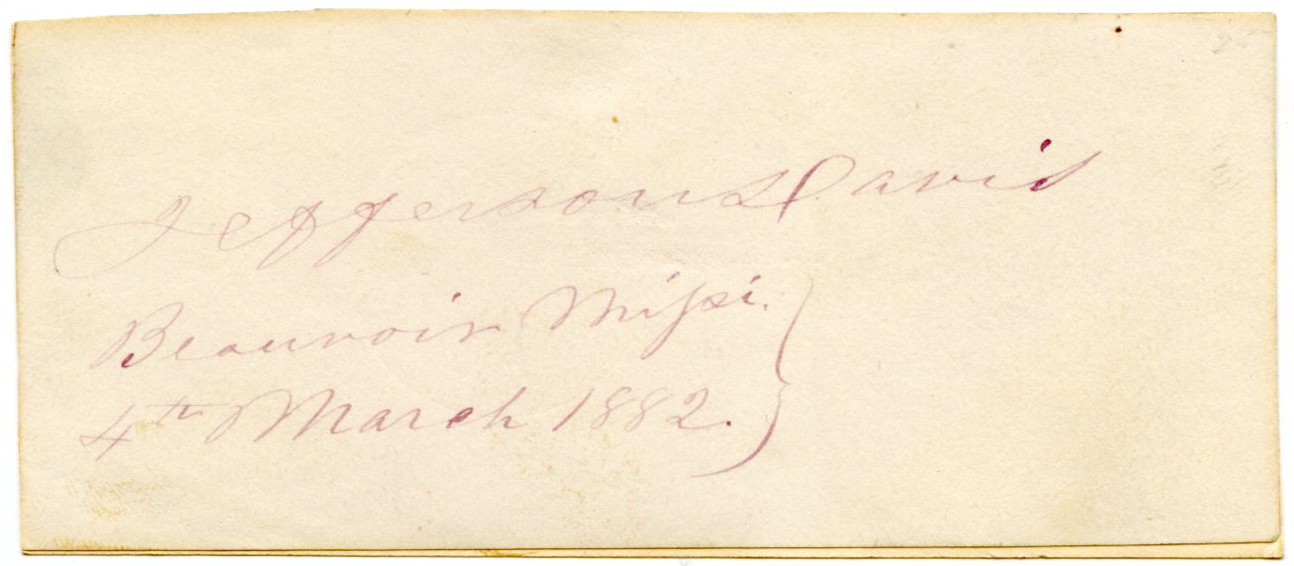
DAVIS, JEFFERSON F. (1808-89) Confederate President - 1861-65; U.S. Secretary of War – 1853-57; U.S. Senator – Mississippi – 1847-51 & 1857-61; U.S. Congressman - Mississippi – 1845-46; Veteran of the Mexican War
Signature, dated from the former Confederate president’s post-war home on the Mississippi Gulf Coast, “Jefferson Davis, Beauvoir, Miss[issipp]i, 4th March 1882,” on a 1 ¾” x 4 ¾” slip of paper. Affixed to heavier backing.
Lightly toned; the signature is noticeably light and lacking in contrast.
DYER, ALEXANDER BRYDIE (1815-74) Union Brigadier General; Chief of Ordnance of the U.S. Army – 1864-74; Veteran of the Mexican and Seminole Wars

Civil War-Date Letter Signed
Letter Signed, on imprinted 8” x 9 ¾” official stationery, directing Captain James S. Abeel of the need to renew his bond for service in the Ordnance Department.
“Ordnance Office
War Department, Washington. Nov[ember] 16, 1864
Capt[ain] J.S. AbeelMil[itary] Stporekeeper, U.S. Arsenal
Rome, N[ew] Y[ork]
Sir:
Your attention is called to Paragraph 989 General Regulations of the Army which requires that Official Bonds shall be renewed every four years.
Your present Bond bears date 26 March 1860 and should be replaced as soon as practicable.
Respectfully
Your Ob[edien]t Serv[an]t
A.B. Dyer
Brig[adier] Gen[eral] Ch[ie]f [of] Ord[nance]”
Lightly and evenly toned, with the expected folds and minor staining; several pencil notations; old mounting remnants in the corners of the reverse.
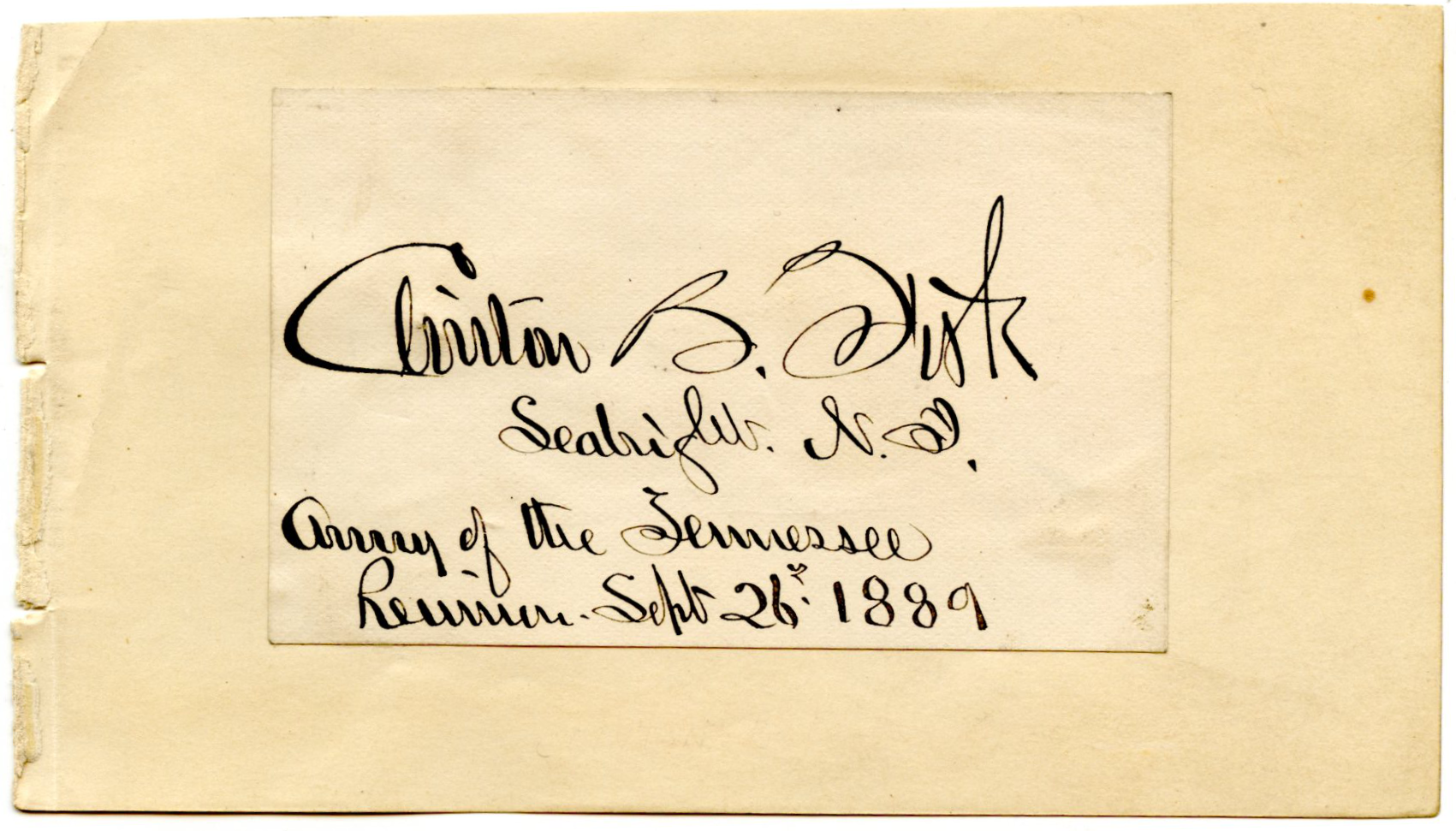
FISK, CLINTON BOWEN (1828-90) Union Brigadier General; Colonel of the 33rd Missouri Infantry; Official in the Freedmen’s Bureau; U.S. Presidential Candidate – Prohibition Party – 1888; Namesake of Fisk University
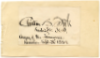
Signature, from a reunion event, “Clinton B. Fisk, Seabright, N[ew] J[ersey], Army of the Tennessee Reunion, Sept[ember] 26, 1889,” on a 2 ¼” x 3 ½” slip of paper; affixed to a larger sheet
Lightly and evenly toned, with a few minor stains; old binding holes at the left edge of the attached album page.
-1995.png)
-1995.png)
-1601.png)
-1606.png)