|
|||||||||||||||||||||
![]() |
no.5523
ABBOTT,
JOSEPH C. (1825-81)
Brevetted Union Brigadier General for the Capture of Fort Fisher; Union Colonel – 7th New Hampshire Infantry.
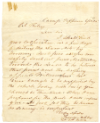
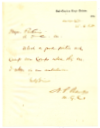
War-date Autograph Letter Signed, 3 ½ pages, with initialed postscript, on an imprinted 7 ¾” x 9 ¾” letter-sheet as New Hampshire Adjutant General in Concord, to 1st New Hampshire Infantry Colonel Mason W. Tappan, at the time encamped near Poolesville, Maryland, conveying interesting early-war details of speculation from home on the unit’s activities and progress, the organization of new regiments, and the death and funeral of a young lieutenant killed by a fall from a train car in New Jersey.
“Concord, June 26, 1861.
My Dear Colonel –
I received your letter yesterday and gave it to Hadley last night, and he published it making quite a sensation. I was glad to hear from you. We at home watch the telegraph for items about the ‘1st N.H.’ and all the letters we get are anxiously read. It seems dreamlike now that we hear from you on the Potomac in trenches. Old Camp Union is a sorry place now – thinking a force of two there, where was a little while ago heard the tramp of your thousand men. I go over there occasionally and look around among the deserted quarters much to refresh my memory and gather some little inspiration.
I have just returned from the funeral of Walker, a Lieut. In Mouton’s Reg[iment] who as you have probably heard fell from the cars in New Jersey and was killed. It has been a melancholy day. The Home Guards, the Horse Guards, the Knights Templars of Concord and the Legislature all turned out. The body was laid in State in the rotunda of the State House, and there was a great display. It was indeed splendid, and I was so much fascinated with the mode of burial, with funereal plumes, dirges, measured treads and reversed arms that I was led to question whether this was not a good time to take the leap usually so terrible. Since you left Gov. Berry has come in, and the legislature is sweltering in the Halls. They have got a militia bill on hand – a most miserable and abominable one. I am trying to kill it and hope to, but don’t know how I shall succeed. Mouton’s Regiment is a grand one. It went off notably at last – baggage train and all! But it was a devil of a while in parturition if the gestation was not nine months. You have no idea of the pride and interest with which we all look after your Regiment. Last night there was a rumor flying about town that your Reg. had attacked the battery opposite you. A man came in and told me of it. I dropped my pen and started. The first man I met was all excitement – said that twenty five of your men were killed, but, said he, ‘they took the battery,’ as if he cared nothing at all about the killed. The Governor was a little long-faced about the killed, but said he thought all along that the boys would show pluck. And so the report ran from mouth to mouth, from the Pliny to the Eagle and from Eagle to the Pliny, that you had taken a battery, and all was [con]gratulative. But when the papers came nothing was said about it! I sit here still at the table quibling – on the threshold of a third Regiment, talking to incipient captains. I am uneasy and want to take the field, and if the Gov. will give me the command of a Reg. I will take it. It is the height and glory of June, and the loveliest of June weather. Accept my kindest regards yourself – give them to Col. Whipple and Major Stevens – and your staff, or any one who remembers me. Write as often as you can, and tell me what I can do for you. I shall write by this mail to Whipple and Batchelder – perhaps others – send you a copy of my report & c. & c. In the mean time believe me true to the flag – and ‘spilin’ for a fight’ and also - Truly Yours, Joseph C. Abbott.
I find I am too busy to write to Col. Whipple to night but will write in the morning. J.C.A.”
Lightly and evenly toned, with the usual folds...................................$475
SOLD
no.5768
AMES,
ADELBERT (1835-1933)
Union Brigadier General – Maine; Mississippi Governor & Senator –
1868-76.
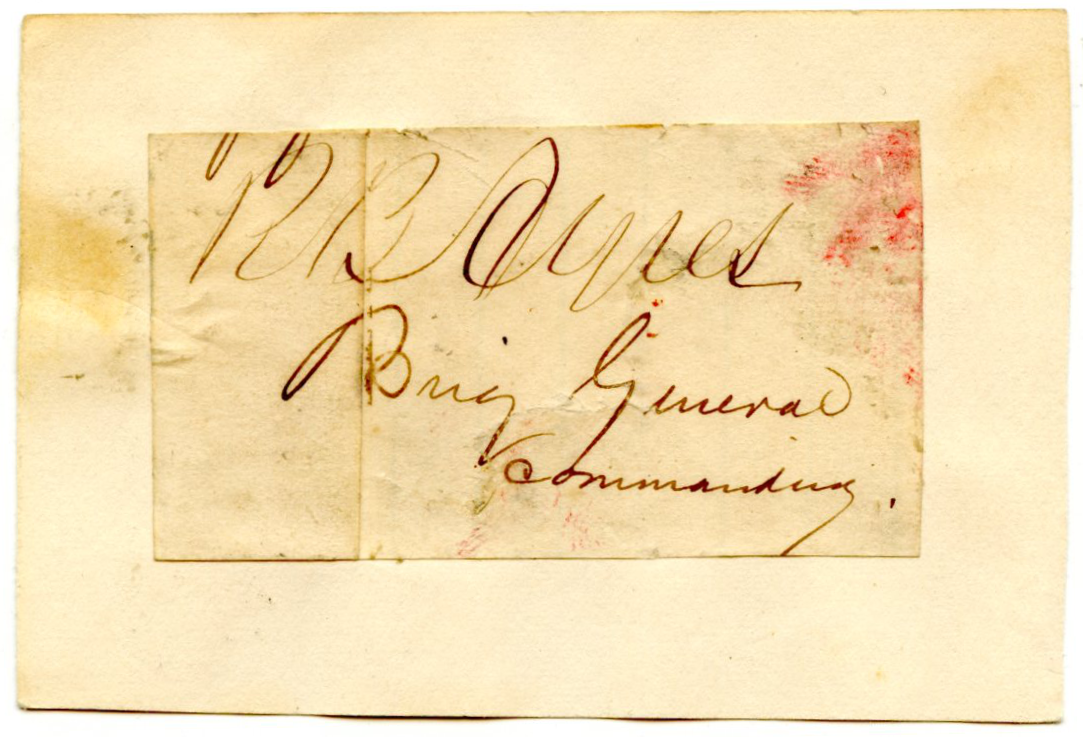
A Maine native and West Point graduate, Ames was awarded the Congressional Medal of Honor for gallant service at First Bull Run, where he was severely wounded. He saw action in the Peninsula campaign, led the 20th Maine at Antietam, Fredericksburg, and Chancellorsville, and, after promotion to brigadier, led a brigade in Howard’s 11th Corps at Gettysburg. After the war, Ames served as Carpetbag governor and senator of Mississippi and was the last surviving general, either Union or Confederate. Signature, as Reconstruction-era U.S. Congressman from Mississippi,
“Adelbert Ames, Mississippi,” on a 2 ½” x 5” portion of an album page...............................$100
SOLD
no.4726
AMMEN,
DANIEL (1820-98)
U.S. Rear Admiral; Union Naval Officer. Undated Autograph Letter Signed, 3” x 5.25”, complying with an autograph request,
“Washington, D.C., July 2. Dear Sir, Yours is before me. Enclosed please find your request complied with. Very truly Yours, Dan’l. Ammen.” Mounting traces on reverse......................$55
no.5986
ANDERSON,
ROBERT (1805-71)
Union Brigadier General - Kentucky. The “Hero of Ft. Sumter” refused Confederate demands for surrender, precipitating the artillery assault which began the Civil War.
Signature and sentiment, with the rank Anderson held from May 15, 1861 through October 27, 1863,
“Respectfully Y[ou]r Ob[edien]t Serv[an]t, Robert Anderson, Brig. Gen. U.S.A.,” on a 1 ½” x 3” slip of paper.
Tiny tear at right edge............................................$395
no.5473
ANDERSON,
ROBERT (1805-71)
Union Brigadier General - Kentucky. The “Hero of Ft. Sumter” refused Confederate demands for surrender, precipitating the artillery assault which began the Civil War. Sentiment and signature, with the rank Anderson held from May 15, 1861 through October 27, 1863,
“Respectfully, Y[ou]r Ob[edien]t Serv[an]t, Robert Anderson, Brig. Gen. U.S.A.,” on a 1 ½” x 3 ¾” slip of paper. One small tear at lower edge; old mounting remnants on reverse....................$395
no.4843
ANDERSON,
ROBERT (1805-71)
Union Brigadier General - Kentucky. The “Hero of Ft. Sumter” refused Confederate demands for surrender, precipitating the artillery assault which began the Civil War. Printed Document Signed, 7.75” X 9.75”, Trenton, New Jersey, September 17, 1857,
“Robert Anderson,” as Inspector of Iron, directing the Galena, Illinois Marine Hospital Superintendent in the returning of signed receipts, to James Buchanan administration Treasury Secretary Howell Cobb. Two horizontal folds, one passing through signature, detract very little.......................................$525
SOLD
no.5889
ANDREW,
JOHN A. (1818-67)
Governor of Massachusetts – 1861-66. Andrew urged the recruitment of blacks and was instrumental in raising the 54th Massachusetts Infantry.
Early War-Date Document Signed, 5 ¼” x 8 ¾”, Boston, “John A. Andrew,” also dated by Andrew as Civil War Governor of Massachusetts,
“May 27th 1861,” a partly-printed certificate, thanking Mrs. M.L. Hale for her donation of
“…8 Doz. Handkerchiefs…for the benefit of MASSACHUSETTS TROOPS, engaged in defending the flag of our Union.”
Excellent condition overall, with two light vertical folds..............................$195
SOLD
no.5981
BABBITT,
EDWIN B. (1804-81)
Union Brevet Brigadier General - Connecticut. War-Date Letter
Signed, 8” x 10”, forwarding provisions vouchers from Washington Territory,
“To Maj. Genl. Geo. Gibson, Comm[issa]ry Genl. of Subsistence, Washington, D.C.,” shortly after the outbreak of the Civil War.
“Vancouver Depot, W.T., April 19th 1861. General, enclosed herewith I have the honor to send you vouchers Nos. 8 & 9 to my Return of Provisions for March 1861, which please substitute for the corresponding certified Invoices accompanying Return.
E.C. Babbitt, Major & A[ssistant] Q[uarter] M[aster] & Act[ing] C[ommissary] [of] S[ubsistence].”
Excellent overall, with minor paper separation at edges of two horizontal folds..........................$100
SOLD
no.6092
BANKS,
NATHANIEL P. (1816-94) ![]()
Union Major General – Massachusetts; Speaker of the U.S. House of Representatives – 1855-57;
Republican Governor of Massachusetts – 1858-61. Banks was routed by Stonewall Jackson in the Shenandoah Valley campaign of 1862, and commanded during the campaign and subsequent surrender of Port Hudson, Louisiana. A longtime politician from Massachusetts, he was elected to multiple terms in Congress, both before and after the war.
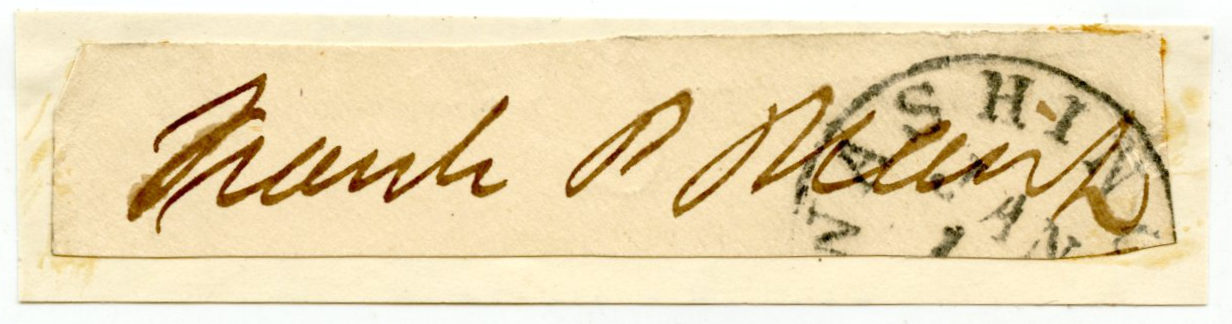
Franking Signature, as U.S. Congressman from Massachusetts, “Free, N.P. Banks, MC,” on a 1 ¼” x 3 ½” portion of an envelope...................................$55
no.5422
BANKS,
NATHANIEL P. (1816-94)
Union Major General – Massachusetts; Speaker of the U.S. House of Representatives – 1855-57;
Republican Governor of Massachusetts – 1858-61. Banks was routed by Stonewall Jackson in the Shenandoah Valley campaign of 1862, and commanded during the campaign and subsequent surrender of Port Hudson, Louisiana. A longtime politician from Massachusetts, he was elected to multiple terms in Congress, both before and after the war. Inscribed signature,
“For W.C. Lewis. No inconvenience but a pleasure. Nath. P. Banks, Waltham, Mass., 5th M[ar]ch 1888,” on a 2 ¼” x 3 ¾” card. A few small stains; mounting traces on reverse...........................$70
SOLD
no.5307
BANKS,
NATHANIEL P. (1816-94)
Union Major General – Massachusetts; Speaker of the U.S. House of Representatives – 1855-57;
Republican Governor of Massachusetts – 1858-61. Banks was routed by Stonewall Jackson in the Shenandoah Valley campaign of 1862, and commanded during the campaign and subsequent surrender of Port Hudson, Louisiana. A longtime politician from Massachusetts, he was elected to multiple terms in Congress, both before and after the war. War-date signature,
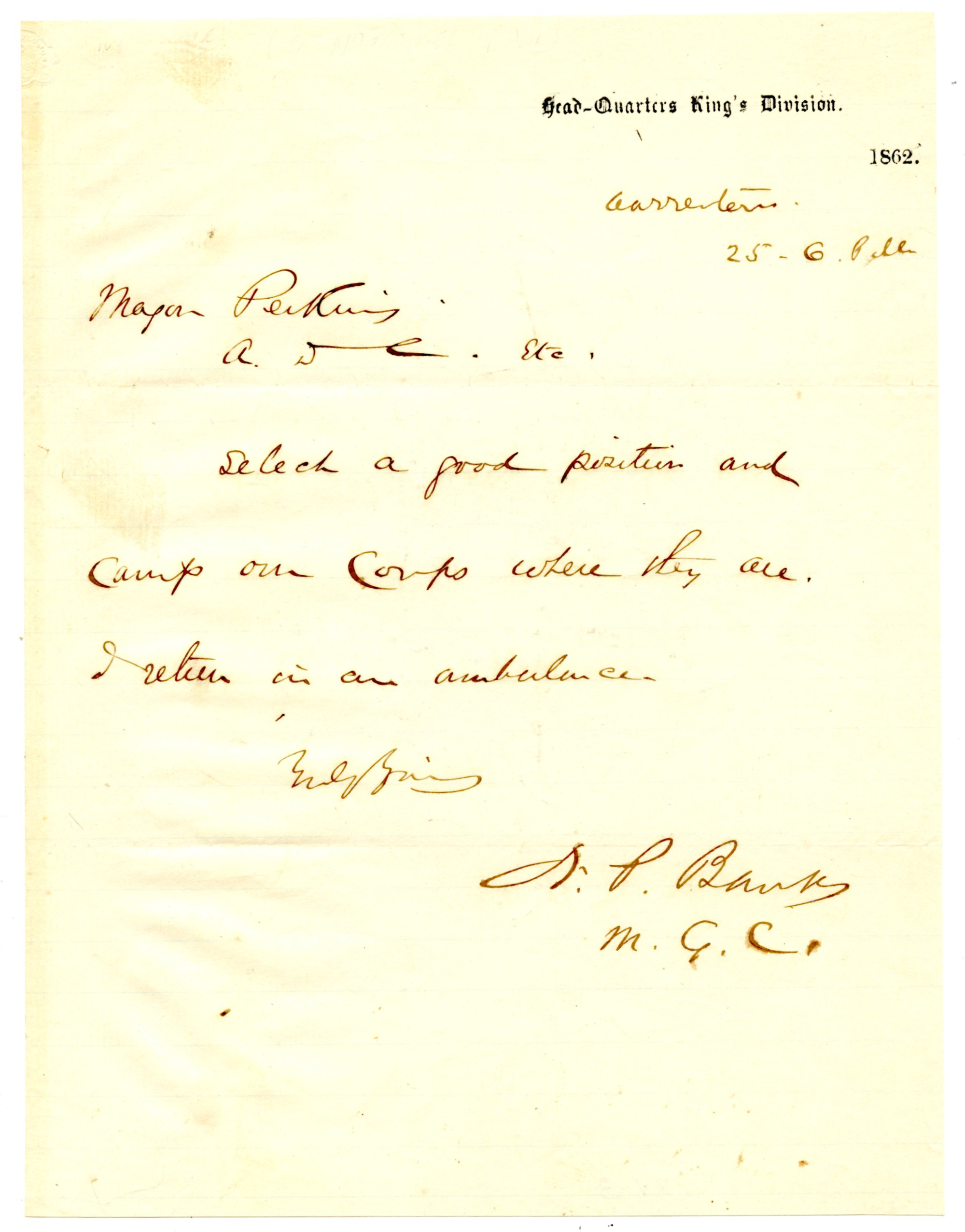
“N.P. Banks, M.G.C.,” on a 1 ¼” x 3 ¼” portion of a document, signed as major general commanding in the Military Division of West Mississippi, Department of the Gulf, with the War Department’s red-ink docketing,
“1864,” beneath. A few glue stains, particularly to the left of the signature, mounting the two portions to a heavier backing...................................$120
no.4861
BANKS,
NATHANIEL P. (1816-94)
Union Major General – Massachusetts; Speaker of the U.S. House of Representatives – 1855-57;
Republican Governor of Massachusetts – 1858-61. Banks was routed by Stonewall Jackson in the Shenandoah Valley campaign of 1862, and commanded during the campaign and subsequent surrender of Port Hudson, Louisiana. A longtime politician from Massachusetts, he was elected to multiple terms in Congress, both before and after the war.
Two page Autograph Note Signed, on the first and second pages of a 4.5” x 7” folded four-page lettersheet, as Massachusetts governor, introducing noted abolitionist Myrtilla Minor, the founder of a normal school for colored girls in Washington, D.C., and recommending her cause for financial aid. In full:
“Boston, March 16 [1858]. Miss M. Miner, the bearer of this note, has been employed for several years in superintending a school in Washington for the education of colored children. Her school bears an excellent reputation among all classes of people and is of advantage to the community, as it is to the immediate recipients of her instruction. Those who are able to render her aid in continuing the school and in enlarging its sphere of usefulness will confer upon the public a material benefit. Nathl. P. Banks.”
With further recommendation by James W. Thompson, minister of the Barton Square Church in Salem, Massachusetts, on the third lettersheet page,
“I most cordially concur with Governor Banks in the foregoing commendation of Miss Miner & her school & ask for her objects the aid of all philanthropists in this city. James W. Thompson, Salem [Massachusetts] Oct. 13, 1858.”
After employment tutoring planters’ daughters in Wilkinson County, Mississippi, Myrtilla Minor opened the Colored Girls School in Washington, D.C. in 1851. The school struggled initially, but success was assured when Harriet Beecher Stowe donated $1,000 from the proceeds of the sale of
Uncle Tom’s Cabin. For health reasons, Miner traveled to California when the school temporarily closed upon the outbreak of the Civil War, returning to Washington in 1864 to die after a serious accident. After several name changes and mergers, the Washington, D.C. school she founded has now become part of the University of the District of Columbia.
Evenly toned, with the usual folds...............................$450
no.5714
BARRY, WILLIAM F. (1818-79)
Union Brigadier General - New York. As Chief of Artillery, Barry served under McDowell at First Manassas, with McClellan on the Peninsula, in the defenses of Washington, D.C., and with Sherman from the Atlanta campaign through war's end.
Early war-date Autograph Letter Signed, 5” x 8”, informing Union General William F. Smith of the status of “Ayres’ Battery,” undoubtedly that of future Union Brigadier General Romeyn B. Ayres.
"Washington [D.C.], Sept. 26, [no year, probably 1861]. Brig. Genl. Smith, Waggamans’s Chain Bridge. Ayres’ Battery is not yet fully equipped – and his men are all recruits. It will not be fit for service for two weeks. William F. Barry.”
One small hole at date, along center vertical fold...........................$295
no.5966
BARTLETT, WILLIAM F. (1830-76)
Union Brigadier General – Massachusetts. As a captain in the 20th Massachusetts Infantry, Bartlett lost a leg at Yorktown in early 1862, graduating with his Harvard class shortly thereafter. He became colonel of the 49th Massachusetts and served under Banks at Port Hudson, where he was again wounded twice. Two further wounds came while leading the 57th Massachusetts at the Wilderness and at the Battle of The Crater, where he was taken prisoner and confined in Libby Prison.
Signed Card, 2” x 3 ¼”, with sentiment and rank, “Yours truly, W.F. Bartlett, Bvt. Maj. Genl. U.S. V[olunteers].”
Lightly and evenly toned, with old mounting traces on reverse.............................$65
SOLD
no.6094
BELKNAP, WILLIAM W. (1829-90) ![]()
Union Brigadier General – Iowa; U.S. Secretary of War – 1869-76.
A pre-war Iowa legislator, Belknap entered Union service with the 15th Iowa Infantry, seeing action in the West from Shiloh through Sherman’s “March to the Sea” and Bentonville. He became U.S. Secretary of War under Ulysses S. Grant in 1869, but was impeached and forced to resign for taking bribes in 1876.
Signed Gold-Edged Card, 1 ¾” x 3 ¾”, “Wm. W. Belknap, Wash[ingto]n D.C., May 1, 1883.”
Minor brushing of ink........................$55
no.5967
BELKNAP, WILLIAM W. (1829-90)
Union Brigadier General – Iowa; U.S. Secretary of War – 1869-76.
A pre-war Iowa legislator, Belknap entered Union service with the 15th Iowa Infantry, seeing action in the West from Shiloh through Sherman’s “March to the Sea” and Bentonville. He became U.S. Secretary of War under Ulysses S. Grant in 1869, but was impeached and forced to resign for taking bribes in 1876.
Signed Card, 1 ¾” x 3 ¾”, “Wm. W. Belknap, Ap[ri]l 11, 1888.”
Very slight bleeding and brushing of ink..................$50
SOLD
no.6095
BLAIR, FRANCIS P. (1821-75) ![]()
Union Major General – Missouri; U.S. Senator & Congressman -
Missouri.
A prominent Missouri politician and brother of Lincoln’s first postmaster general, Montgomery Blair, Francis P. Blair was the organizer of seven regiments of troops for the Union and was instrumental in keeping Missouri in the Union. He was the Democratic vice-presidential candidate on the Horatio Seymour ticket which lost to Grant in the election of 1868.
Signature, “Frank P. Blair, Jr., Missouri,” on a 2 ¼” x 4 ½” portion of an album page...............................$55
no.5769
BLAIR, FRANCIS P. (1821-75)
Union Major General – Missouri; U.S. Senator & Congressman -
Missouri.
A prominent Missouri politician and brother of Lincoln’s first postmaster general, Montgomery Blair, Francis P. Blair was the organizer of seven regiments of troops for the Union and was instrumental in keeping Missouri in the Union. He was the Democratic vice-presidential candidate on the Horatio Seymour ticket which lost to Grant in the election of 1868.
Signature, as post-war U.S. Senator, “Frank P. Blair, Missouri,” on a 2” x 4 ¼” portion of an album page...................................$55
SOLD
no.5716
BRAYMAN, MASON (1813-95)
Union Brigadier General – Illinois; Governor of Idaho – 1877-80.
An editor, printer, and attorney, Brayman was Government Commissioner in the removal of the Mormons from Nauvoo, Illinois in 1843. He led the 29th Illinois at the Civil War battles of Belmont, Fort Donelson, and Shiloh.
Partly-printed War-date Document Signed, 10” x 16”, March 28, 1862,
“Mason Brayman, Maj[or] 29th Regt. Ill[inoi]s Vol[unteeers],” a personal pay and subsistence document for the months of January and February, 1862, also partially accomplished by Brayman at Pittsburg, Tennessee shortly before the nearby Battle of Shiloh, listing two servants, one
“light” and one “dark.”
Lightly and evenly toned, with clean separation and very minor paper loss at the edges and center intersections of the usual folds.............$275
no.5696
BROWNLOW, WILLIAM G. (1805-77)
Pro-Union Newspaper Editor; Governor of Tennessee – 1865-69; U.S. Senator – 1869-75 –
Tennessee.
An antebellum Methodist minister, Brownlow became known as “The Fighting Parson” for his vehement pro-Union stance as editor of the
Knoxville Whig. He was arrested and imprisoned by Confederate authorities early in the war, was released and banished to the North in early 1862, and returned to Knoxville when the town was taken by Burnside in late 1863. After the war, he served as Reconstruction-era Governor and U.S. Senator from Tennessee.
War-date Autograph Letter Signed, 5” x 8”, sending documentation (not present) to establish official recognition for his limited service as chaplain of the 69th Ohio Infantry, for the purpose of obtaining pay, in light of the financial plight in which Brownlow found himself during the war.
“Cincinnati [Ohio], Sept. 18, 1863. H.C. Whitney, Paymaster, & c: Inclosed is the document we spoke of in our conversation of the forenoon. If you can secure the pay, I will be greatly obliged, and the more so as I find I need it more than I anticipated I should. If not successful, I will take the will for the deed, and equally thank you. When mustered out of the service, it was at my request, made to Secretary Stanton, by letter, telling him that I could not render the services, and would be in the way of someone who could. I had previously reported to the Regiment twice at Nashville, and once at Murfreesboro, and was furloughed. I am, Very truly & c., W.G. Brownlow.”
On two-thirds of the reverse, Paymaster Whitney pens a lengthy, sympathetic endorsement, forwarding Brownlow’s request:
“Resp[ectful]ly referred to Maj. Danl. McClure. Parson Brownlow applied to me for pay as Chaplain 69th O.V.I. I told him to send his documents – it would seem from them that he was mustered out to date from day of his muster in; he considers himself as the legal Chaplain until his resignation herewith accompanying and in fact said Regt. as I understand has no other; this appointment will give to Mr. Brownlow in order that he might get some support for his family & I should be glad that the matter of his right to receive pay would obtain full consideration from the Dept. H.C. Whitney, Add[itiona]l Pay[mas]ter, Sept. 18, [18]63.”
The official roster of the 69th Ohio states that Brownlow enlisted as chaplain of the unit on April 15, 1862, and that he was discharged the following day, so one might assume that the appointment was made official and that Brownlow was rewarded for his brief stint in the Union Army. Presumably, the three attempts to join the regiment of which Brownlow speaks were also at about this time, when the unit was encamped at Nashville, Tennessee. Later in the year, on December 31, 1862, the 69th Ohio would see some of its heaviest losses of the war in its charge across nearby Stone’s River against the Confederate corps of John C. Breckinridge at the Battle of Murfreesboro.
Minor wear and soiling at edges; small area of paper loss in upper right margin has been filled unobtrusively by the letter’s inlay onto a larger sheet........................$450
no.5715
BUELL, DON CARLOS (1818-98)
Union Major General - Ohio. Buell was instrumental in the Federal victories at Ft. Donelson and Shiloh, where his arrival late in the first day saved Grant from the Confederate attack. He was replaced by Rosecrans due to his hesitance in the pursuit of Bragg after the October 1862 battle of Perryville.
Partly-printed War-Date Document Signed, Cincinnati, Ohio, March 2, 1863,
“D.C. Buell, Major General,” a pay and subsistence document for himself and four servants, two of whom are described as “black,” for the month of February, 1863.
Lightly and evenly toned, with the usual folds.....................$395
no.5767
BUTLER, BENJAMIN F. (1818-93)
Union Major General - Massachusetts. Known as “Beast Butler” for his harsh treatment of civilians in New Orleans, Butler had, ironically, nominated Jefferson Davis for the presidency on the 1860 Democratic ticket.
Partly-printed War-date Document Signed, New Orleans, May 21, 1862,
“B.F. Butler,” a 2 ¾” x 7 ¾” signed check, drawn on the Bank of Commerce less than a month after the fall of New Orleans to Federal forces, payable to
“Self or bearer” for “two hundred Dollars, in coins smaller than five dollars.”
Several light creases and numerous small edge chips and tears; cross-cut cancellation passes through center of signature, with no loss of paper...................$295
no.5268
BUTLER, BENJAMIN F. (1818-93)
Union Major General - Massachusetts. Known as “Beast Butler” for his harsh treatment of civilians in New Orleans, Butler had, ironically, nominated Jefferson Davis for the presidency on the 1860 Democratic ticket. Signature, as U.S. Congressman,
“Benj. F. Butler, Mass.,” on a 2 ¼” x 3 ½” card, with the collector’s pencil notations,
“Mar. 4, 1873,” on front, and “Got direct, March 4, 1873, Wash. Rep[resentative] fr[om] Mass[achusetts],” reverse. Lightly and evenly toned, with old adhesive traces on reverse........................$65
no.5825
CALHOUN, JAMES (1845-76)
1st Lieutenant - 7th Cavalry – Killed-in-Action with George A. Custer at Little Big Horn; Civil War Union Sergeant.
Endorsement Signed, “A true copy,
James Calhoun, 1st Lieut. 7 Cavalry, Post Adjutant,” at the conclusion of a letter secretarially written and signed on behalf of Calhoun’s brother-in-law, 7th Cavalry Lieutenant Colonel George A. Custer, inviting the Department of Dakota Commander, General Alfred H. Terry, to join him at Fort Abraham Lincoln.
“Fort A[braham] Lincoln, D[akota] T[erritory], August 31st 1875. General Terry, Bismarck. Some accident may have detained the Secretary. Our lookout on the hill can see up the river ten or more miles so that by means of our ferry you could get to Bismarck landing in advance of a steamer coming down. We have plenty of room here and can make you more comfortable than you are now. Had you not better come over and bring Col. Barr and Major Hughes with you. (Signed) G.A. Custer, Bvt. Major Gen., USA, Com[man]d[in]g Post. Paid 78 Govt. rate.”
A few superficial stains and two light horizontal folds; one small hole, from a period clip, in upper margin at center; very minor bleeding of ink in signature.........................$3,250
no.3698
CANBY, EDWARD R.S. (1817-73)
Union Major General. Early in the war, Canby served in New Mexico in opposition to Confederate General Henry H. Sibley. He was subsequently transferred east where he later took command of the Military Division of West Mississippi and was involved in the late-war actions against Mobile. In 1873, he was killed by Modoc Indians in California.
War-date Endorsement Signed, "Respectfully referred to the Adjutant General, State of New York. By order of the Secretary of War,
E.R.S. Canby, Brig. Genl. & A.A.G., War Dept., March 22nd/64," on reverse of a three page letter (8" X 10") from John Moore of Poughkeepsie, New York, requesting that Secretary of War Stanton investigate the selling of commissions by 16th New York Heavy Artillery Col. Joseph J. Morrison. Moore's letter, in full:
"Poughkeepsie, March 17, 1864. [To] Hon. E.M. Stanton, Secretary of War. On the 29 of December inst. I was authorized by the Adjutant General of the State of New York, and also by Col. J.J. Morrison to recruit a company for the 16 Heavy Artillery N.Y. Vol., and was assured by Col. Morrison that as soon as I had the company full I should have my commission. I did recruit the requisite number 150, and after I going to the expense and trouble of so doing, Morrison cheated me out of my commission and sold it to one who did not recruit one man for the company, and then meanly offered me a Second Lieutenant's commission, through his agent, if I would pay him $250, which I refused. Col. J.J. Morrison of the 16 Artillery N.Y. Vol. sold a Second Lieutenancy to Lenard B. Sackett, a lawyer in this city, for his brother George Sackett, for the sum of three hundred dollars, the said George being at the time a private in the 15th N.Y. Vol., and he also sold another commission to a man named Conklin who is a private in the 15th N.Y. Vol. Morrison also tried to sell three hundred of the men of the 16 Artillery to Col. Mead of the 98 N.Y. Vol. I have reason to believe that he sold John H. Otis, Captain of Company K, 16 N.Y. Artillery his commission. I think it is too bad to allow such a man to prey upon the industry and patriotism of others. The Adjutant Gen. of N.Y. State will give me my commission if the Secretary of War will transfer the men, that I recruited at Poughkeepsie Dutchess County N.Y. to the 13 Heavy Artillery N.Y. Vol. I can furnish ample evidence to show that Col. J.J. Morrison has been guilty of the above charges, and I hope that the Hon. Secretary of War will have the case investigated. I refer you to Hon. H.A. Nelson of this District who is a member of Congress, as regards my character. John Moore, Poughkeepsie, N.Y. P.S. Morrison is under arrest by Major Gen. [Benjamin] Butler."
No evidence that the matter was investigated exists; Col. Joseph J. Morrison served for the remainder of the war and was, ironically promoted to the rank of brevet brigadier general on March 13, 1865 for "efficient service during the war."
Minor separation at horizontal folds; soiling at folds on reverse.........................................$450
no.5620
CHAMBERLAIN,
JOSHUA L. (1828-1914)
Union Brigadier General - Maine. As colonel of the 20th Maine, Chamberlain gallantly defended Little Round Top, preventing a Confederate victory at Gettysburg. Partly-printed Document Signed, with full signature, Boston, Massachusetts, July 10, 1869,
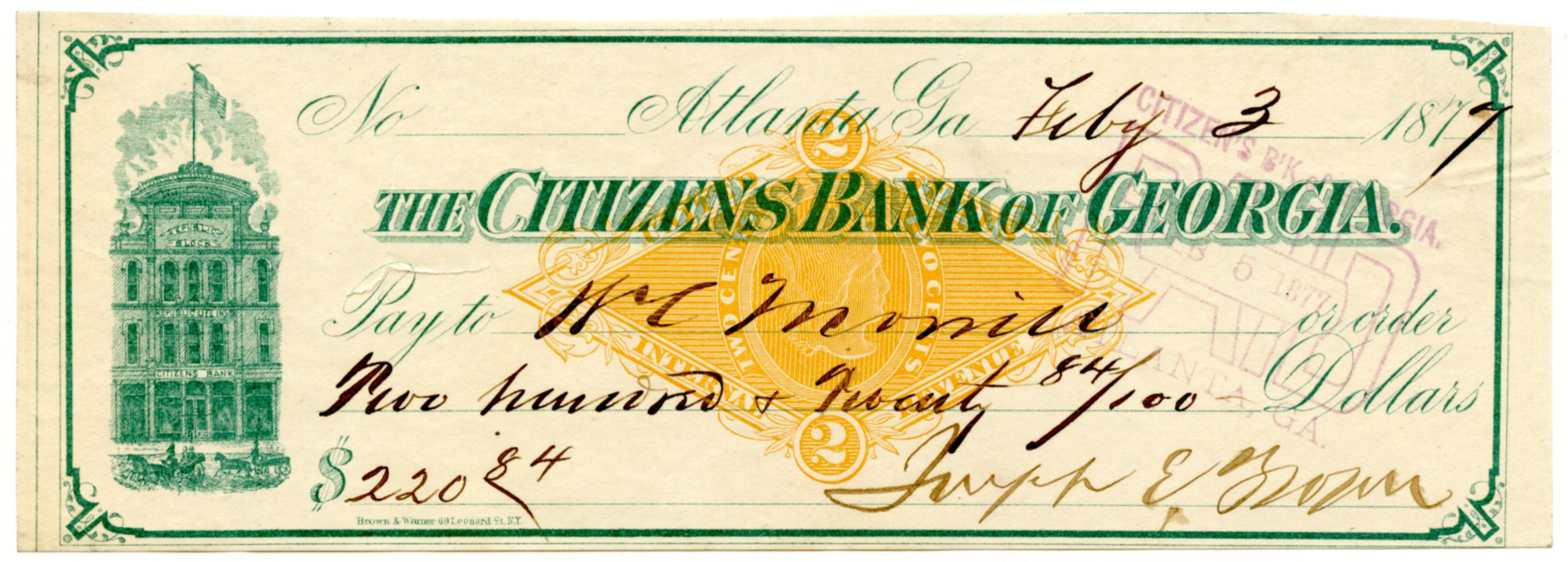
“Joshua L. Chamberlain,” a 2 ¾” x 7 ½” signed check, also accomplished by Chamberlain, drawn on the Globe National Bank for $76.19 and made payable to James M. Palmer. The two-cent revenue stamp at left is also initialed and dated by Chamberlain,
“J.L.C., 7/10/[18]69.” Light toning and soiling, with a cancellation hole and a vertical fold at center; light water-staining in upper margin..............................$875
SOLD
no.5488
CHAMBERLAIN,
JOSHUA L. (1828-1914) ![]()
Union Brigadier General - Maine. As colonel of the 20th Maine, Chamberlain gallantly defended Little Round Top, preventing a Confederate victory at Gettysburg.
Document Signed, New York, July 5, 1898, “Joshua L. Chamberlain,” a partly-printed 2 ¾” x 7 ¼” signed check, also accomplished by Chamberlain, drawn on The Sixth National Bank for ten dollars, payable to H.C. Orr.
Light toning and wear; several folds and light creases; cancellation holes at center, well away from signature..........................$650
no.4624
CHRYSLER,
MORGAN H. (1822-90) & CAMERON, ROBERT A. (1828-94) & RANSOM,
THOMAS E.G. (1834-64)
Union Brigadier General – New York; Union Brigadier General – Indiana; Union Brigadier General - Illinois.
Chrysler served with the 30th New York Infantry from the Peninsula campaign through Chancellorsville. Subsequently placed in command of the newly-organized 2nd New York Veteran Cavalry – recruited by Chrysler, largely from veterans of the “Iron Brigade” - he was sent to the Department of the Gulf, where he saw action in the Red River and Mobile campaigns.
War-date Autograph Letter Signed by Chrysler, 8” X 12.25”, to Brigadier General Robert A. Cameron, requesting that a War Department summons for the court-martial of Lt. Thomas B. Smith, on the charge of falsifying upstate New York recruiting records, be delayed until the conclusion of the ongoing, and ultimately unsuccessful, Red River campaign.
Chrysler’s letter, in full:
“Head Qrs. 2nd Vet[eran] Cav[alr]y N[ew] Y[ork] V[olunteers], Near Natchitoches, La., April 3rd 1864. Brig. Genl. Cameron. Genl., An order having been rec’d. by me asking Lt. Smith of my Regt. to report at Washington for trial by Court Martial. I most respectfully ask that compliance with the order be deferred until the close of this campaign. I think said order was sent by mistake as the matter had been explained by me to the War Dept. before leaving Washington. The charge against Lt. Smith is accrediting recruits to one town belong to another, Recruited on the border of Canada, and supposed by Lt. Smith to be non residents. If this cannot be done I desire to make the request officially to the Secy. of War. Lt. Smith is a good officer. Respectfully Your Ob[edien]t Serv[an]t, M.H. Chrysler.”
Approving Endorsements Signed by Cameron and Ransom, who would receive his fourth wound of the war a few days later at the campaign-ending battle of Sabine Cross Roads, are on reverse:
“Headquarters 3rd Div[ision]13th A[rmy] C[orps], Natchitoches, La., April 3rd, [18]64, Respectfully referred to Major Genl. [A.J.] Smith through Genl. Ransom,
R.A. Cameron, Brig. Genl. Command[in]g; Hd. Qrs…13th A[rmy] C[orps], Natchitoches, La., April 3rd 1864, Respectfully forwarded,
T.E.G. Ransom, Brig. Genl.” Lt. Smith was probably never required to answer the charge, as he was promoted to the rank of captain on April 17, 1864 and later died of disease, a fate which befell over two hundred of his 2nd New York Veterans Cavalry comrades due to prolonged service in the Department of the Gulf.
Moderate toning throughout, with scattered foxing and staining; several areas of paper weakness along three horizontal folds; the endorsements by both Cameron and Ransom are light, thus enlarged images are provided for further clarity..........................$995
no.5759
CLARK,
WILLIAM T. (1831-1905)
Union Brigadier General – Iowa; Republican U.S. Congressman – 1870-72 - Texas.
At the outbreak of war, this Davenport, Iowa attorney recruited the 13th Iowa and served most notably as McPherson’s adjutant during the Atlanta campaign. After the war, Clark became part of the Reconstruction government in Texas before being removed from Congress by the vote of both parties.
Signature, as post-war U.S. Congressman, “W.T. Clark, Texas,” in violet ink on a 2” x 4 ¼” portion of an album page.................$50
SOLD
no.5578
CLAY,
CASSIUS M. (1810-1903)
Union Major General – Kentucky. A Mexican War veteran and prominent Republican Party figure, Clay declined a general’s appointment due to Lincoln’s refusal to abolish slavery in the early Civil War years. He served as U.S. Minister to Russia from 1863 to 1869. Unusual full signature,
“Cassius Marcellus Clay, White Hall, Ky., 1888,” on a 1 ¾” x 3 ¼” bevel-edged card. A few light stains; old glue staining on reverse......................$150
SOLD
no.5771 CLAYTON,
POWELL (1833-1914)
Union Brigadier General – Arkansas; Governor of Arkansas – 1868-71; U.S. Senator – Arkansas – 1871-77.
Powell led the 1st Kansas Infantry and 5th Kansas Cavalry, serving primarily in Missouri and Arkansas throughout the war; he saw action at Wilson’s Creek and in the capture of Little Rock. As first carpetbag governor of Arkansas, he authorized Negro troops under General Robert F. Catterson to suppress the Ku Klux Klan.
Signature, as post-war U.S. Senator, “Powell Clayton, Ark[ansas],” on a 2 ½” x 4 ¾” portion of an album page....................$50
SOLD
no.5915 COCHRANE,
JOHN (1813-98)
Union Brigadier General – New York; Democratic U.S. Congressman – New York –
1857-61.
Shortly after the conclusion of his term in the U.S. Congress, Cochrane recruited the 65th New York Infantry and was mustered into Union service as its colonel. He led the regiment during the Peninsula campaign and was present at Fredericksburg. Cochrane resigned his commission in early 1863 due to poor health, and was elected attorney general of New York. A longtime states’ right Democrat, Cochrane was nominated for vice-president on the John C. Fremont ticket in 1864, but campaigned for Lincoln after its withdrawal. He was serving as president of the Society of the Cincinnati at the time of his death in 1898.
War-Date Autograph Letter Signed, on imprinted 5” x 8” stationery as New York attorney general, sending autographs (no longer present) to the recipient.
“Albany, May 18th 1864. Dear Miss Worth, I enclose a few autographs. Do not think me arrogant if I express an opinion that they are ‘worth their weight in gold’ – that is, about a half dime a piece. If you dispose of any of them, while the bargain will be a sell, there may be a question which is sold, the autograph or its purchaser. I am Truly Yours, John
Cochrane.”
Toned area in upper left corner; two light horizontal folds...................................$325
no.6032
CORBETT,
BOSTON (1832-94?)
Union Sergeant – 16th New York Cavalry; Killed Lincoln Assassin John Wilkes
Booth.
Corbett enlisted in the Union Army shortly after war broke out in 1861, rising to the rank of sergeant in the 16th New York Cavalry. He was captured by the Confederates and imprisoned at Andersonville during the summer of 1864. His unit was assigned to the pursuit of the Lincoln conspirators, and Corbett shot and mortally wounded John Wilkes Booth in a barn near Port Royal, Virginia on April 26, 1865.
Signed Card, 1 ¾” x 3”, with Corbett’s Civil War rank,
“Boston Corbett, Serg[ean]t Co. L, 16th N.Y. Cavalry.”
Lightly and evenly toned, with minor show-through of glue staining on reverse at right edge..................$950
SOLD
no.5793
COWDIN,
ROBERT (1805-74)
Union Brigadier General – Massachusetts. Mustered into service as colonel of the 1st Massachusetts Infantry when war broke out in 1861, Cowdin saw action in the East from First Manassas through the Seven Days.
War-date Autograph Endorsement Signed, at the conclusion of a 6” x 7 ¾” handwritten pass. Of the document’s two countersigners, Lieutenant Colonel Daniel S. Lamson was discharged due to disability just days later; Captain Henry T. Lawson was wounded at the battle of Chancellorsville and died of disease on October 1, 1864 at New Berne, North Carolina, after transfer to the 2nd Massachusetts Heavy Artillery.
“Camp of the 16th Reg’t. Mass. Vols., Sept. 20th 1862. Pass Private Milton T. Richardson of Co ‘I’ 16th Reg. M[assachusetts] V[olunteers] to Alexandria [Virginia] & return.
H.T. Lawson, Capt. Comdg. ‘I’ Company. Approved, D.S. Lamson, Lt. Col. Com[mandin]g. Approved, Robert Cowdin, Col. Com[man]d[ing] 1[st] Brig[ade], Grover’s Division.”
General soiling and wear, with a few tiny holes at the center intersections of the usual folds; minor ink brushing and staining at Cowdin’s signature.....................$295
SOLD
no.4831 CULLUM,
GEORGE W. (1809-92)
Union Brigadier General – New York. A West Point graduate and Mexican War veteran, Cullum served as aide to Lieutenant General Winfield Scott early in the war and later as chief of staff to Major General Henry W. Halleck. He became superintendent of West Point in 1864 and served in that capacity for two years.
Franked 8” x 10” postal cover, “Geo. W. Cullum,” as lieutenant and assistant to War Department Chief Engineer Charles Gratiot, addressed to a future Union brigadier general,
“Lt. Geo. W. Morell, Corps of Engineers, Newport, R.I.” in another hand, and bearing a June 17 [1836 ], Washington, D.C. postmark. Contained in the four-page letter-sheet are two printed War Department letters, one concluded with the printed signature of War Secretary Lewis Cass, the other signed by Gratiot,
“C. Gratiot,” both concerning an 1836 act of Congress relating to the payment of Revolutionary War pensions.
Born in St. Louis, Missouri in 1786, into the prominent Swiss family which had been instrumental in the early development of the city, Charles Gratiot was appointed cadet by President Thomas Jefferson in 1804. He graduated from the Military Academy in 1806 and was commissioned in the prestigious Corps of Engineers. In the course of a thirty-year military career, Gratiot served as chief engineer to General William Henry Harrison during the War of 1812 and was instrumental in numerous construction projects, including building of the fortifications in Charleston, South Carolina and Hampton Roads, Virginia. He was brevetted brigadier general in 1828. During the Civil War, a prison bearing his family name, the Gratiot Street Prison, became notorious for its use in holding captured Confederate soldiers, southern sympathizers, and anyone else deemed disloyal by the Union forces occupying St. Louis.
Lightly and evenly toned, with the usual folds and minor paper loss at top from the opening of a wax seal; one tear, with no paper loss, runs from near the address, along a fold, to the edge of the letter-sheet.................$325
no.5582 CUSTER,
GEORGE A. (1839-76)
Union Major General of Cavalry – Michigan. Custer served with distinction in all the cavalry battles of the Army of the Potomac during the Civil War. As active commander of the post-war 7th Cavalry, he was involved in numerous expeditions against the Sioux and Cheyenne, culminating in his death at the Battle of Little Big Horn on June 25, 1876. War-date Endorsement Signed, on a 2 ¼” x 3” slip of paper, removed from a larger document,
“Headquart[er]s 2nd Cav[alry] Div[ision], November 25th 1864. Respectfully forwarded Approved and recommended.
G.A. Custer, Bvt. Maj. Genl. Com[man]d[in]g.”.......................................$4,250
SOLD
no.5785
DAHLGREN,
JOHN (1809-70)
Union Rear Admiral - Pennsylvania. An ordnance expert, Dahlgren invented the cannon which bore his name and, when assigned to Charleston, South Carolina as Commander of the South Atlantic Blockading Squadron, he was able to observe its effects.
Signed Card, 1 ½” x 3 ¼”, with rank, “J.A. Dahlgren,
R[ear] Admiral.”
Lightly and evenly toned, with old mounting remnants on reverse..........................$125
SOLD
no.5378
DAHLGREN,
JOHN (1809-70)
Union Rear Admiral - Pennsylvania. An ordnance expert, Dahlgren invented the cannon which bore his name, and when assigned to Charleston, South Carolina as Commander of the South Atlantic Blockading Squadron, was able to observe its effects. Sentiment and signature, with rank,
“Very Resp[ectfull]y, J.A. Dahlgren, R[ear] Admiral,” on a 1 ¼” x 3” slip of paper, probably removed from a letter...........................$110
SOLD
no.5164
DAHLGREN,
JOHN (1809-70)
Union Rear Admiral - Pennsylvania. An ordnance expert, Dahlgren invented the cannon which bore his name, and when assigned to Charleston, South Carolina as Commander of the South Atlantic Blockading Squadron, was able to observe its effects. War-date signature with rank,
“J. A. Dahlgren, R[ear] Admiral, Command[ing] S[outh] At[lantic] Squadron, Charleston [South Carolina], March 28th 1865,” on a 2.75” x 4.25” slip of paper. Minor show-through of old glue staining and mounting remnants on reverse....................................$195
no.5386 DAVIES,
HENRY E. (1836-94)
Union Major General – New York. A pre-war attorney, Davies saw action at Big Bethel as captain of the 5th New York Infantry. He soon joined the 2nd New York Cavalry, known as the “Harris Light Cavalry” in honor of New York Senator Ira Harris, served in the Peninsula and Second Manassas campaigns, and saw action with the heavily-engaged unit at Brandy Station . After promotion to brigadier general, Davies took part in the late-war Shenandoah Valley cavalry actions, and was wounded at Hatcher’s Run near war’s end. After the war, he wrote a biography of Union General Philip Sheridan.
War-date Autograph Letter Signed, on imprinted 5 ½” x 8” stationery of the Congress Hall Hotel, Albany, New York, requesting a recruitment authorization from New York Governor E.D. Morgan.
“Oct. 9, 1862. To Brig. Genl. [Thomas] Hillhouse, A[ssistant] A[djutant] G[eneral]…General, I have the honor to request that an authorization to recruit in Capt. Kidd’s Company of the proposed Reg[imen]t of Cavalry to be under my command issue to W.G. Taffe of Albany. Resp[ectfull]y H.E. Davis, Jr., Col. Com[man]d[in]g.”
Separation from one of several folds repaired on reverse; old hinge and paper remnants at top of both front and reverse.................................$395
no.6115 DEVENS,
CHARLES (1820-91) ![]()
Union Brigadier General – Massachusetts; U.S. Attorney General – 1877-81.
As colonel of the 15th Massachusetts, Devens served at Balls Bluff and commanded a brigade at Seven Pines, Fredericksburg, and Chancellorsville; he was wounded in all three battles.
Signed Gold-Edged Card, 1 ¾” x 3 ¼”, “Chas.
Devens.”.............................$50
no.5792 DEVIN,
THOMAS C. (1822-78)
Union Brigadier General – New York. Devin served as colonel of the 6th New York Cavalry from the unit’s formation in late 1861 through the battles of Antietam and Fredericksburg. He led a cavalry brigade under Union General John Buford in the first day’s fighting at Gettysburg, and subsequently saw action in Kilpatrick’s raid on Richmond and with Sheridan in the Shenandoah. War-date Endorsement Signed,
“Head quarters 1st Cav[alr]y Divis[ion], May 21 [18]63. Approved and respectfully forwarded.
Thos. C. Devin, Col. Com[man]d[in]g Div[isio]n,” on a 2” x 3 ¼ slip of paper, removed from a larger document................................$425
SOLD
no.5285 DIX,
JOHN A. (1798-1879) ![]()
Union Major General - New York; Governor of New York - 1873-75; U.S. Treasury Secretary - 1861;
U.S. Senator - New York - 1845-49. Dix was too old for active Civil War field service. He is most remembered for suppressing the New York City draft riots in 1863 and for being post-war Governor of New York.
Third-person Autograph Note Signed, on his 5” x 6 ½” monogrammed stationery, declining an invitation to a reception at Delmonico’s.
“Mr. & Mrs. John A. Dix greatly regret that they are unable to accept the kind invitation of the New England Society of the City of New York to the Ladies Reception at Delmonico’s on the 9th inst[ant]. 31 West 21st St., 2. February 1876.”
Lightly and evenly toned, with two horizontal folds.............................$100